


An Afrobarometer survey on East Africa migration found that 58% of people in Kenya, Uganda and Tanzania say crossing international borders to work or trade is difficult, up from 45% in 2017.
The findings, published on 20 November, point to a gap between the East African Community’s free-movement rules and what citizens report. They also show East Africa migration intentions rising in Uganda and falling sharply in Tanzania.
What does the Afrobarometer survey say about East Africa migration?
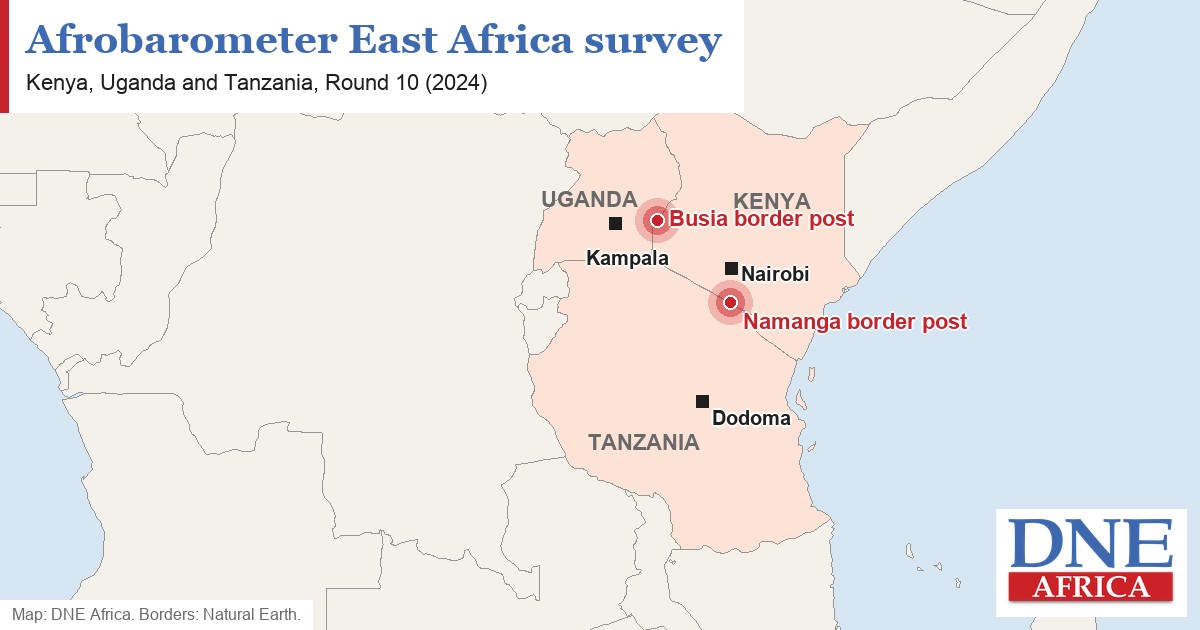
The Afrobarometer dispatch (No. 1252), written by Ssenkumba Muhammad, a statistician at Hatchile Consult, Afrobarometer’s partner in Uganda, draws on face-to-face surveys of 2,400 adults in each country. Fieldwork took place in Uganda in January 2024, in Kenya in April and May 2024 and in Tanzania in June and July 2024. The margin of error is plus or minus 2 percentage points.
The share saying borders are “difficult” or “very difficult” to cross rose by 25 points in Kenya, from 38% in 2017 to 63% in 2024, the survey network said. In Uganda it rose from 51% to 65%. In Tanzania it held steady at 47%, while the share who said crossing was easy doubled, from 12% to 26%.
The rise came “notwithstanding” the EAC labour-mobility programme introduced in 2024, the dispatch said. Degree-holders reported the sharpest change, from 40% to 61%.

Who wants to leave Kenya, Uganda and Tanzania?
About 28% of respondents across the three countries said they had considered emigrating at least “a little bit”, unchanged from 2017. The average hides wide differences. In Uganda the share rose by 7 points to 42%. In Kenya it held at 34%. In Tanzania it fell by 6 points to 9%.
Interest was higher among men (33%) than women (24%), and among urban residents (36%) than rural ones (25%). It falls with age, from 38% of 18- to 30-year-olds to 11% of those aged 61 and over. Degree-holders were five times as likely as people with no formal schooling to think about leaving (50% against 10%).
The poverty pattern has reversed since 2017: about a third of people in moderate (30%) or high (33%) “lived poverty” now consider emigrating, against roughly one in four of the better-off.
Views of the national economy matter more than personal circumstances, the dispatch said. Pessimists were 5 to 10 points more likely to consider leaving. About one in three people who rate their government badly on jobs, prices or the economy had considered it, against fewer than one in four of those who rate it well.
Among potential emigrants, 87% cited work, business or escaping hardship as the main reason, up from 79% in 2017. In Kenya the share rose from 80% to 90%.
Where do East African emigrants want to go?
North America is the first choice for potential emigrants in Kenya (38%) and Uganda (26%). Tanzanians are split between Europe and another East African country (23% each). Ugandans are far more likely to look to the Middle East (18%) than Kenyans (1%) or Tanzanians (6%).
East Africa migration abroad is already sizeable: citing the UN Population Division, the dispatch put citizens living abroad in 2024 at 578,034 for Uganda, 540,466 for Kenya and 225,017 for Tanzania.
Do East Africans welcome foreign workers?
Support for free movement within the region is strong: 79% in Uganda, 70% in Kenya and 53% in Tanzania said East Africans should be free to cross borders to trade or work. Some 44% of Tanzanians would rather the government limited cross-border movement.
Attitudes to newcomers are more mixed. On average 58% said foreigners who come to live and work are good for the economy, and 35% said they are bad. Yet 56% want fewer foreign job seekers admitted and 16% want none at all. Opposition was 75% in Kenya and Uganda and 66% in Tanzania.
The dispatch said this points to “regional tensions” in East Africa migration between seeking opportunities abroad and reluctance to let foreign job seekers in.
What is the background on East Africa migration rules?
The EAC Common Market Protocol, in force since 2010, provides for the free movement of people, labour, capital, goods and services among members. In 2024 the bloc approved a common labour-migration policy, and its states have worked on mutual recognition of skills, the dispatch noted. Migrant workers in EAC countries roughly doubled in the 2010s to almost 3mn, according to International Organization for Migration figures it cited.
Governments continue to court each other, as when Tanzania’s president visited Uganda for a truck plant opening this week. DNE Africa has also asked whether a borderless Africa is within reach.
FAQ
What did the Afrobarometer East Africa migration survey find?
East Africa migration data show 58% in Kenya, Uganda and Tanzania say borders are difficult to cross for work or trade, up from 45% in 2017, and that 28% have considered emigrating.
Which country leads East Africa migration intentions?
Uganda, where 42% have considered emigrating, followed by Kenya (34%) and Tanzania (9%), according to the 2024 surveys.
Why do East Africans want to emigrate?
Economic reasons such as work and escaping hardship were cited by 87% of potential emigrants, up from 79% in 2017.
How was the East Africa migration survey carried out?
Afrobarometer partners interviewed 2,400 adults face to face in each country in 2024, with a margin of error of plus or minus 2 percentage points.


