
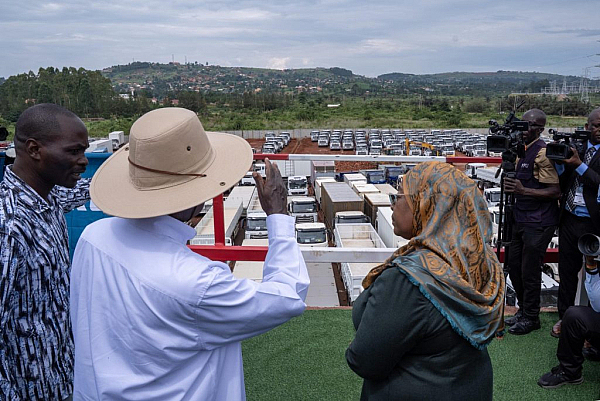

Uganda’s President Yoweri Museveni and Tanzania’s President Samia Suluhu Hassan on 19 November opened a $30mn truck assembly plant in Mpigi that can build 4,000 Sinotruk heavy-duty trucks a year, according to State House Uganda.
The plant, run by Double Q Automotive with Chinese partner Sinotruk, is one of the largest vehicle assembly investments in East Africa, and both leaders used the launch to press for regional manufacturing rather than imports.
What will the Mpigi truck assembly plant produce?
The facility sits on 45 acres in Mpigi district, west of Kampala, and assembles Sinotruk heavy-duty trucks while also representing the GMC and XCMG brands in Uganda, State House Uganda said in a statement. Its annual capacity is 4,000 trucks.
Double Q managing director Lin Yu said the company began in Uganda in 2013 hauling construction materials, became Sinotruk’s official distributor in 2017 and started local assembly in 2020. More than 5,000 trucks have been assembled since then, he said, and the company plans to move into passenger vehicles and electric trucks.
Museveni said body-building work at the truck assembly plant already accounts for about 20 per cent local value addition. He urged the company to link up with a domestic steel industry built on Uganda’s iron ore deposits so that more components are made in the country.
How many jobs does the truck assembly plant create?
Works and Transport minister Fred Byamukama said the plant directly employs more than 1,200 Ugandans, and that the lowest-paid worker earns about Shs800,000 ($220) a month. He said the government was in talks with Double Q about expanding into manufacturing, including a tyre factory at the Kayunga Industrial Park.
Lin said the truck assembly plant would train staff through partnerships he was setting up with Kyambogo University, Uganda Christian University and Nakawa Vocational Institute. Double Q also operates in Kenya, Tanzania, Rwanda, South Sudan, the Democratic Republic of Congo and Zambia.
Song Yang, general manager of Sinotruk International, said the Chinese group expected to sell more than 360,000 heavy-duty trucks worldwide in 2026, about 110,000 of them in Africa. These are company projections and could not be independently checked.
Why did Suluhu attend the launch?
The opening of the truck assembly plant closed Suluhu’s two-day state visit to Uganda. She said industrialisation was “no longer merely an economic option but a necessity” and urged East African Community members to move from importing goods to becoming “regional production and marketing hubs”.
She warned against countries in the bloc building competing industries, noting that Sinotruk operates in both Uganda and Tanzania. “East Africa must compete with the world, not within itself,” she said, and backed proposals for harmonised regional rules on vehicle assembly. She added that Tanzania was exploring partnerships to build a railway locomotive factory.
Museveni pointed to Tanzania’s natural gas and Uganda’s iron ore as resources the two neighbours could combine. China’s ambassador to Uganda, Wu Guangrong, said Beijing would keep supporting industrial and skills co-operation with Kampala.
What is the background?
Uganda has tried for years to build a vehicle industry. The state-owned Kiira Motors, which Suluhu also praised, builds buses in Jinja. The government’s “Buy Uganda, Build Uganda” policy favours locally made goods in public procurement, and Lin said Double Q would source more from local suppliers under it.
Before the Mpigi truck assembly plant, most heavy trucks sold in Uganda were imported, and most vehicles on East African roads are still imported, many of them second-hand. The region’s freight demand is rising: Suluhu said the port of Dar es Salaam handled about 33 million tonnes of cargo in 2026. Uganda’s ties with Tanzania have also deepened through the East African Crude Oil Pipeline, which will carry Ugandan oil to the Tanzanian port of Tanga.
Other recent Ugandan business stories on DNE Africa include the dispute over the Umeme buyout and the teacher shortage debated by MPs.
FAQ
Where is the new truck assembly plant in Uganda?
It is in Mpigi district, west of Kampala, on a 45-acre site owned by Double Q Automotive.
How many trucks can the Mpigi truck assembly plant build?
The company says it has capacity for 4,000 Sinotruk heavy-duty trucks a year. More than 5,000 trucks have been assembled in Uganda since 2020.
How much was invested?
Uganda’s works minister put the investment at $30mn and said it directly employs more than 1,200 Ugandans.
What comes next?
The government is discussing a tyre factory at Kayunga Industrial Park with Double Q, and the company plans to assemble passenger vehicles and electric trucks.


