
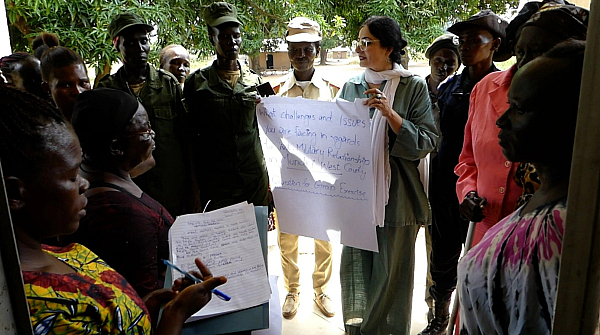

Women in Greater Mundri, in South Sudan’s Western Equatoria state, have told soldiers and officials they are “caught between armed men”, at a UN-backed dialogue that produced 16 action points to improve civilian protection.
The meeting matters because years of intercommunal violence, armed attacks and sexual violence have left communities in Greater Mundri distrustful of the security forces meant to protect them, according to the UN Mission in South Sudan (UNMISS). Insecurity on the road linking the area to Yambio has added to the fear.
What did women in Greater Mundri say?
Charity Edita, a local women’s group leader, described an attack on an elderly woman in her area. “The armed perpetrator covered his face with a mask before attacking her. She was helpless and cried out, but he went ahead and raped her,” she said, in an account published by UNMISS.
Such accounts show the protection problems facing women and other vulnerable people across Greater Mundri, where insecurity, displacement and a lack of accountability have deepened mistrust, the mission said. It also cited recent attacks on the road to Yambio, including an ambush in which a female journalist was killed. The mission did not name her or give a date.
How did soldiers respond?
The civil-military dialogue, supported by UNMISS, brought together women, community members, traditional leaders, young people, local authorities and security personnel.
John Tiko, an officer with the South Sudan People’s Defence Forces (SSPDF), acknowledged that trust had broken down. “We thought our relationship was good, but we realized today that we don’t have a good relationship. I was a civilian like you; I came to wear this uniform to protect you. You fear me now; who will I protect?” he said. He urged fellow soldiers to take responsibility for misconduct.
Ismail George, a traditional chief, said better communication between security forces and community leaders could prevent misunderstandings. “When soldiers are deployed, they should go and meet the chiefs so that they can get the right information,” he said.
What was agreed for Greater Mundri?
The dialogue produced 16 action points to address community concerns and improve relations, and set up a joint committee to monitor their implementation, according to UNMISS. The mission did not publish the action points.
“UNMISS decided to hold a civil-military dialogue to engage the military and civilians in dialogue and share their grievances, challenges and issues,” said Bibi Hadija, a civil affairs officer with the mission. Participants acknowledged that rebuilding trust would take sustained engagement, better communication and accountability, the mission said.
Why is Western Equatoria insecure?
Greater Mundri, made up of the Mundri East, Mundri West and Mvolo counties, lies on the main road between Juba and Western Equatoria. The area has seen repeated attacks on travellers, aid workers and civilians, and clashes between armed groups, cattle keepers and farming communities. Local media have reported several ambushes this year on the Mundri-Juba road and the Juba-Yambio highway.
South Sudan, independent since 2011, is in a long political transition under a 2018 peace agreement, with elections scheduled for December 2026. Women’s groups and UN agencies have repeatedly called for accountability for sexual violence by armed men, including members of the security forces. DNE Africa has also covered the region’s Ebola preparedness in Western Equatoria.
What happens next?
The joint committee is to track the 16 action points. For women in Greater Mundri, progress will be measured by whether they can go about their daily lives without fear, UNMISS said.
FAQ
Where is Greater Mundri?
Greater Mundri is in South Sudan’s Western Equatoria state, on the road between Juba and Yambio. It covers Mundri East, Mundri West and Mvolo counties.
What did the Greater Mundri dialogue agree?
Sixteen action points to address community concerns and improve relations between civilians and security forces, plus a joint committee to monitor them, according to UNMISS.
Who organised the meeting?
The UN Mission in South Sudan supported the civil-military dialogue, which included women, chiefs, young people, local authorities and soldiers.
What security problems do women in Greater Mundri report?
Sexual violence, armed attacks, intercommunal violence and ambushes on roads, and mistrust of the security forces, according to accounts published by UNMISS.


