
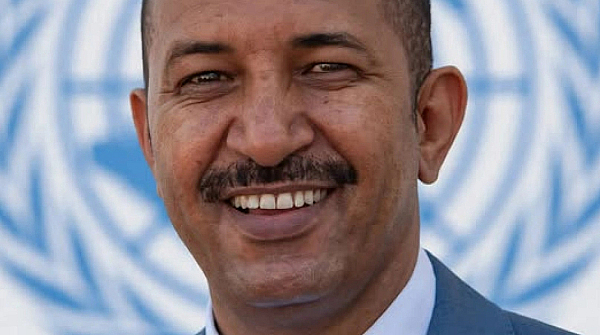

Mohamed Ag Ayoya of Mali will be the new MINUSCA head, after UN Secretary-General António Guterres named him Special Representative for the Central African Republic on 18 November, succeeding Valentine Rugwabiza of Rwanda.
The appointment gives the UN’s peacekeeping mission in the Central African Republic a leader who already knows it from the inside: Mr Ayoya has been the mission’s deputy chief since January 2023. He takes over as the Security Council trims the force and the country moves on from combined national elections.
Who is the new MINUSCA head?
Mr Ayoya has more than 25 years of experience in peace and security, humanitarian action, crisis response and development co-operation, according to the announcement published by MINUSCA. Since January 2023 he has served as Deputy Special Representative of the Secretary-General for MINUSCA and as the UN’s Resident and Humanitarian Coordinator in the Central African Republic.
Before that he spent most of his career with UNICEF. He was its representative in Afghanistan from 2022 to 2023, Somalia from 2021 to 2022, South Sudan from 2019 to 2021, Zimbabwe from 2016 to 2019 and Guinea from 2013 to 2016, where he led UNICEF’s response to the West African Ebola epidemic, the UN said. Earlier he worked on child survival programmes in Haiti, India, Sierra Leone, Mali, Niger, Chad and Mauritania.
The new MINUSCA head is a medical doctor, trained at the University of Bamako, and holds a PhD in nutrition from Cornell University. He speaks Tamasheq, Bamanan and Songhai as well as English and French, the UN said.
What did Rugwabiza achieve as MINUSCA head?
Ms Rugwabiza, a former Rwandan minister, was appointed to lead the mission in February 2022. Mr Guterres said he was grateful for her “exemplary leadership”, which he said had helped the Central African Republic reach several milestones, including combined national elections, progress in disarmament, the advance of the peace process and the consolidation of security gains.
Those are the UN’s assessments. Armed groups remain active in parts of the country, and the 2023 constitutional referendum that allowed President Faustin-Archange Touadéra to seek a third term was contested by the opposition, as DNE Africa reported in 2025.
What does the MINUSCA head take over?
MINUSCA was set up in 2014 to protect civilians and support the political transition after a conflict that began in 2013. Its mandate was renewed until 2027 last week with a lower ceiling of 12,000 troops, DNE Africa reported.
The incoming MINUSCA head will have to manage that drawdown while keeping civilian protection in areas where armed groups still operate, and while working alongside Russian security personnel who have supported the government in Bangui since 2018. Disarmament and reintegration of fighters, and the return of state authority outside the capital, remain central parts of the mission’s work.
What happens next?
The UN did not give a date for the handover. A new deputy will need to be named to replace Mr Ayoya in his current post, which combines the roles of deputy mission chief and humanitarian coordinator.
FAQ
Who is the new MINUSCA head?
Mohamed Ag Ayoya of Mali, appointed by UN Secretary-General António Guterres on 18 November 2026 as Special Representative for the Central African Republic and head of MINUSCA.
Whom does he replace?
Valentine Rugwabiza of Rwanda, who has led the mission since 2022.
What was Mr Ayoya’s previous job?
He has been MINUSCA’s deputy chief and the UN’s Resident and Humanitarian Coordinator in the Central African Republic since January 2023. Before that he was a UNICEF country representative in several countries.
How big is MINUSCA?
Its troop ceiling was cut to 12,000 when the Security Council renewed the mandate to 2027 in November 2026.


