
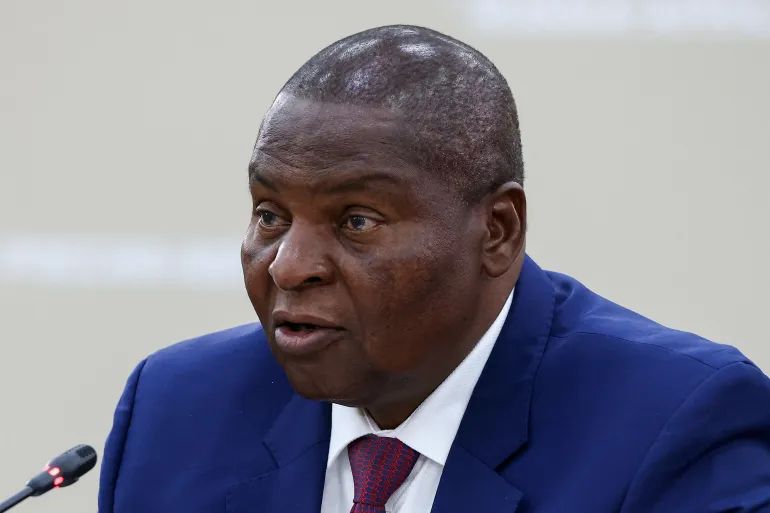

Central African Republic’s President Faustin-Archange Touadéra has officially declared his intention to seek a third term in office in the upcoming presidential elections scheduled for December 2025, reigniting fierce political debate over the legitimacy of his continued rule.
Touadéra made the announcement during a national convention of his party, the United Hearts Movement (MCU), held in the capital Bangui on Saturday. “I am saying yes, clearly, to the call of the movement to run in the presidential election,” the 67-year-old leader told delegates, adding that he was ready to take on the “new political challenge.”
The move comes nearly two years after a controversial constitutional referendum in 2023 that scrapped presidential term limits and reset the presidential count, allowing Touadéra to run again. The new constitution replaced the one adopted in 2016 and granted broader executive powers to the presidency, a shift critics describe as a step toward authoritarianism.
Touadéra was first elected president in 2016 and re-elected in 2020 amid violent unrest and logistical challenges, with much of the country under the influence of armed groups. Opposition parties contested the results, citing irregularities and insecurity that prevented voting in large swaths of the territory.
Since then, the political climate in the mineral-rich but conflict-ridden country has remained fragile. Armed groups continue to operate in the eastern and northern regions, despite relative improvements in the security situation in recent years. The United Nations peacekeeping mission, MINUSCA, still maintains a substantial presence to support stability.
The opposition has condemned the third-term bid, accusing Touadéra of attempting to entrench himself in power under the guise of constitutional reform. Civil society groups have also expressed concern that the political process is becoming increasingly closed, with little space for dissent or alternative voices.
In parallel to the presidential race, the government is also expected to organize delayed legislative and municipal elections, originally scheduled for 2024 but postponed due to funding constraints and delays in updating the electoral roll. Electoral authorities have yet to confirm a calendar for these polls.
Touadéra’s announcement sets the stage for a high-stakes election season in a country that has experienced a series of coups, rebellions, and contested transitions since gaining independence from France in 1960. While his supporters praise his leadership and vision for national development, critics argue that his administration has failed to deliver meaningful reforms or stem the pervasive insecurity.
Observers warn that without inclusive dialogue and a credible electoral process, the country risks renewed instability in the months leading up to the December vote.


