
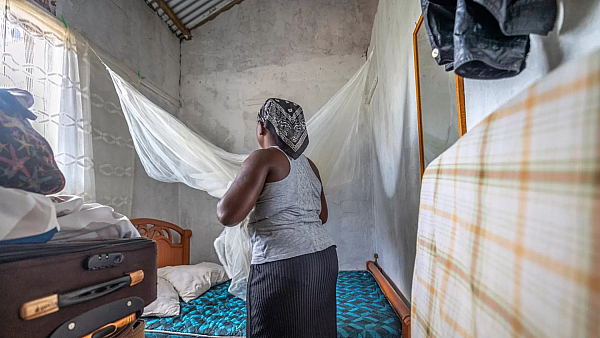

Kenya mosquito nets totalling almost 10.8 million will be handed out to families in 18 counties with high malaria rates under a national campaign launched on 19 November, the World Health Organization said.
The Kenya mosquito nets campaign comes as fewer Kenyan households own a net: a recent government survey found ownership had fallen sharply since 2022, even as confirmed malaria cases declined.
Where will the Kenya mosquito nets go?
The 2026-2027 mass campaign covers 18 malaria-endemic counties and 99 sub-counties, with the official launch at Bayula Stadium in Sirisia sub-county, Bungoma county, according to a statement from the WHO Regional Office for Africa. The Ministry of Health is running it with county governments and development partners.
Kenya mosquito nets are allocated by population, transmission patterns and insecticide resistance, the WHO said. A digital platform, Digimal KE, will be used to verify households, track deliveries and monitor progress.
“Communities are urged to participate in the exercise, collect their allocated nets, and sleep under them every night, throughout the year,” said Mary Muthoni Muriuki, principal secretary for public health and professional standards.
Why are some Kenya mosquito nets different?
In areas where mosquitoes no longer die from the usual insecticides, households will receive dual active ingredient nets, treated with two insecticides that work in different ways. The WHO recommended these nets in March 2023 because they can still kill mosquitoes resistant to the older pyrethroid-only nets.
“A mosquito net protects a family only when it hangs over the bed every night,” said Neema Rusibamayila Kimambo, the WHO representative in Kenya.
Insecticide resistance has spread across much of sub-Saharan Africa, and health agencies have been switching to the newer Kenya mosquito nets and similar products elsewhere as funding allows.
How common is malaria in Kenya?
The 2025-26 Kenya Mini Demographic and Health Survey found that 41 per cent of households had at least one insecticide-treated net, down from 54 per cent in 2022, the WHO said. Only 42 per cent of children under five and 39 per cent of pregnant women had slept under one the night before the survey.
Even so, confirmed malaria cases fell by 34 per cent, from 5.54 million in 2023 to 3.64 million in the latest reported year, under the 2023-2027 Kenya Malaria Strategy, according to the statement. Incidence among children under five dropped from 194 to 119 cases per 1,000 people, and almost 90 per cent of suspected cases are now tested by microscopy or rapid diagnostic test.
The strategy aims to cut malaria incidence by 80 per cent and deaths by 90 per cent from 2023 levels by 2027-28. The new Kenya mosquito nets are meant mainly to protect pregnant women and young children, who are most at risk.
What is the wider picture in Africa?
The WHO estimates there were 282 million malaria cases and 610,000 deaths worldwide in 2024. The WHO African Region accounted for 94 per cent of cases and 95 per cent of deaths, and about three in four deaths in the region were children under five.
Net campaigns depend heavily on donors such as the Global Fund and, until recently, the US President’s Malaria Initiative, whose funding has been cut back. Researchers have also warned that climate change could add more than 120mn malaria cases in Africa by 2050. DNE Africa has also reported on Zimbabwe’s malaria resurgence after aid cuts.
FAQ
How many Kenya mosquito nets will be distributed?
Almost 10.8 million insecticide-treated nets, across 18 counties and 99 sub-counties, under the 2026-2027 campaign.
Who will receive the new dual-insecticide nets?
Households in areas where mosquitoes have become resistant to the insecticides used in older nets.
Are malaria cases in Kenya falling?
Yes. Confirmed cases fell 34 per cent from 5.54 million in 2023 to 3.64 million in the latest reported year, the WHO said.
Why is the campaign needed now?
Household net ownership fell from 54 per cent in 2022 to 41 per cent in the 2025-26 survey, leaving more families unprotected.


