
By using this site, you agree to the Privacy Policy and Terms of Use.
Accept
DNE Africa
  • Home
  • Politics
    Carthage Theatre Days 2026 official poster: a figure with red butterfly wings and flowers on a blue background, with the dates 21-28 November
    Entertainment

    Carthage Theatre Days open in Tunis with 12 plays from 11 countries

    By DNE Africa 8 Min Read
    Jeff Goldblum at the piano, arms raised, performing with his jazz band at the Glastonbury Festival in 2019
    Entertainment

    Jeff Goldblum receives Marrakech Golden Star from Tilda Swinton

    By DNE Africa November 22, 2026
    Twyfelfontein rock art: the engraved sandstone panel known as the Lion Plate, covered with giraffes and other animals, in north-west Namibia
    Culture

    Namibia’s Twyfelfontein rock art records 2,000 years of ritual

    By DNE Africa November 22, 2026
  • Business
    Egypt gas production: LNG storage tanks and a flare at the Idku liquefaction plant on Egypt's Mediterranean coast
    Business

    Egypt gas production posts biggest monthly rise of 2026

    New wells from Shell and Eni lifted output to about 3.8bn cubic…

    By DNE Africa 6 Min Read
    FB IMG 1795265138435
    BusinessPolitics
    Egypt, Sudan Sign Training and Capacity-Building Deal
    Praia-Dakar shipping: the autonomous port of Dakar and the city skyline
    Business
    Praia-Dakar shipping service set for June 2027 launch, ECOWAS says
    Zambia smallholder farmers gather beside a maize demonstration plot
    Business
    Zambia smallholder farmers in EU project beat national maize yields
    Platform workers study: the coat of arms of the Republic of South Africa
    Business
    Platform workers in South Africa earn below minimum wage, study finds
  • Culture
  • Opinion
  • Technology
  • Sports
  • World
  • My Bookmarks
Reading: Namibia’s Twyfelfontein rock art records 2,000 years of ritual
Sign In
  • Join US
DNE AfricaDNE Africa
Font ResizerAa
  • Home
  • Politics
  • Business
  • Culture
  • Opinion
  • Technology
  • Sports
  • World
  • My Bookmarks
Search
  • Home
  • Politics
  • Business
  • Culture
  • Opinion
  • Technology
  • Sports
  • World
  • My Bookmarks
Have an existing account? Sign In
Follow US
© Foxiz News Network. Ruby Design Company. All Rights Reserved.
Twyfelfontein rock art: the engraved sandstone panel known as the Lion Plate, covered with giraffes and other animals, in north-west Namibia

Namibia’s Twyfelfontein rock art records 2,000 years of ritual

DNE Africa
Last updated: November 22, 2026 12:44 pm
By DNE Africa 8 Min Read
Share
The engraved panel known as the Lion Plate at Twyfelfontein, 2014. Photo: Olga Ernst / Wikimedia Commons, CC BY-SA 4.0
SHARE

Twyfelfontein rock art in north-west Namibia holds one of Africa’s largest concentrations of rock engravings, a record of hunter-gatherer ritual that UNESCO says spans at least 2,000 years.

Contents
What is Twyfelfontein rock art?Who made the engravings, and why?How did the site get its name?How is Twyfelfontein rock art protected today?FAQWhere is Twyfelfontein rock art?How old is Twyfelfontein rock art?When did Twyfelfontein become a UNESCO World Heritage site?Can visitors see Twyfelfontein rock art on their own?

The site in the Kunene region, also known by its local name /Ui-//aes, became Namibia’s first UNESCO World Heritage site in 2007. It has more than 2,000 engravings and paintings, according to Encyclopaedia Britannica. Namibia’s only other World Heritage site, the Namib Sand Sea, was added in 2013.

What is Twyfelfontein rock art?

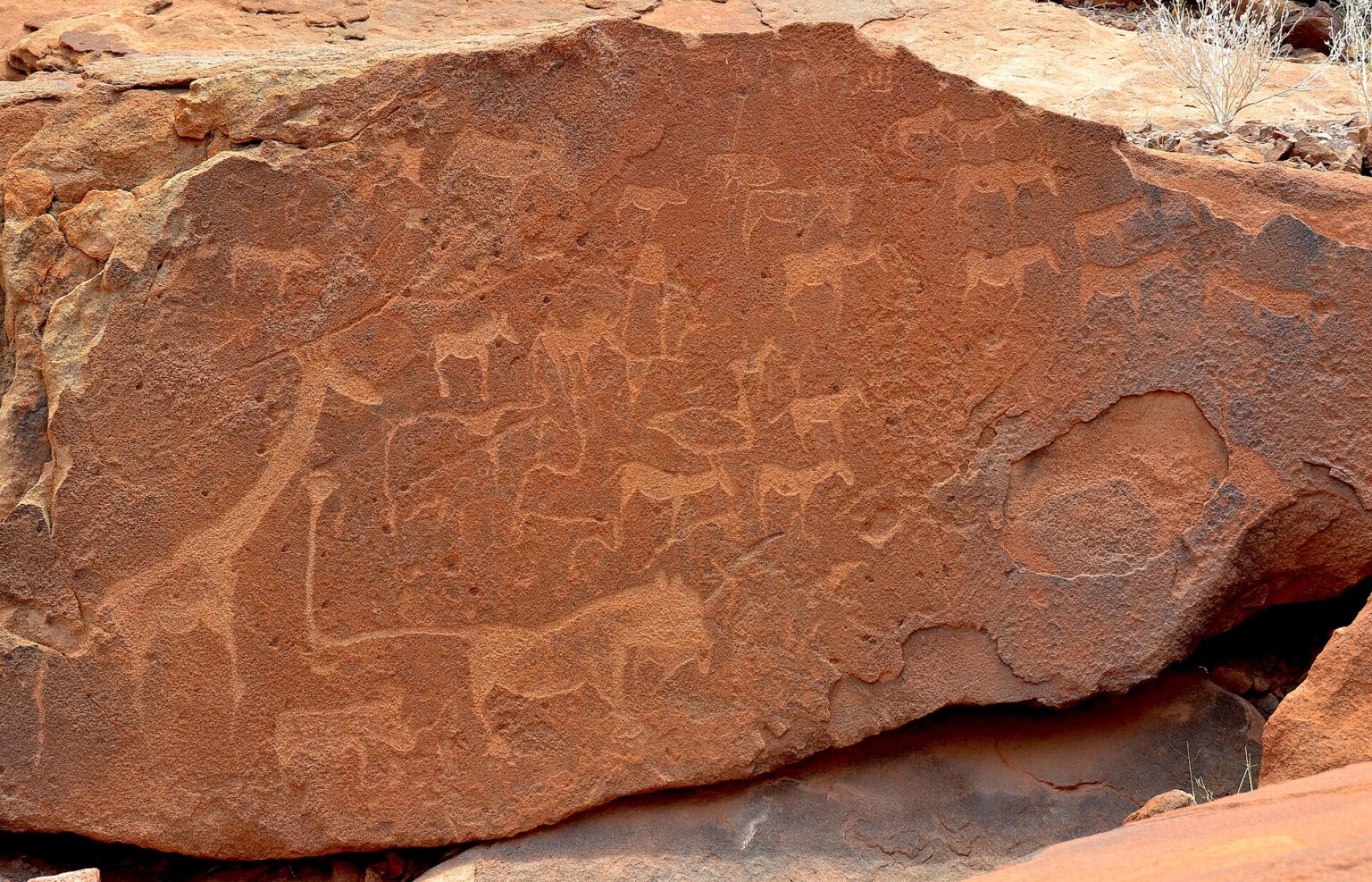
Most of the engravings show rhinoceros, elephant, ostrich and giraffe, along with drawings of human and animal footprints, according to UNESCO’s World Heritage listing. The site also has six painted rock shelters with human figures in red ochre. Objects excavated from two areas date from the Late Stone Age.

Britannica says Twyfelfontein rock art covers 235 separate rock surfaces on boulders along a west-facing slope of Namibia’s escarpment. Giraffes make up about 40% of all the engravings. Zebra, oryx, ostrich and cattle also appear often, while human figures are rare among the engravings. In the painted shelters the balance is reversed, and people dominate.

Two techniques were used, Britannica says. Most engravings were made by pecking at the rock surface with harder stones or stone hammers. Others were made by grinding and polishing the surface with small hard rocks. The variety suggests that several generations added to the panels over time.
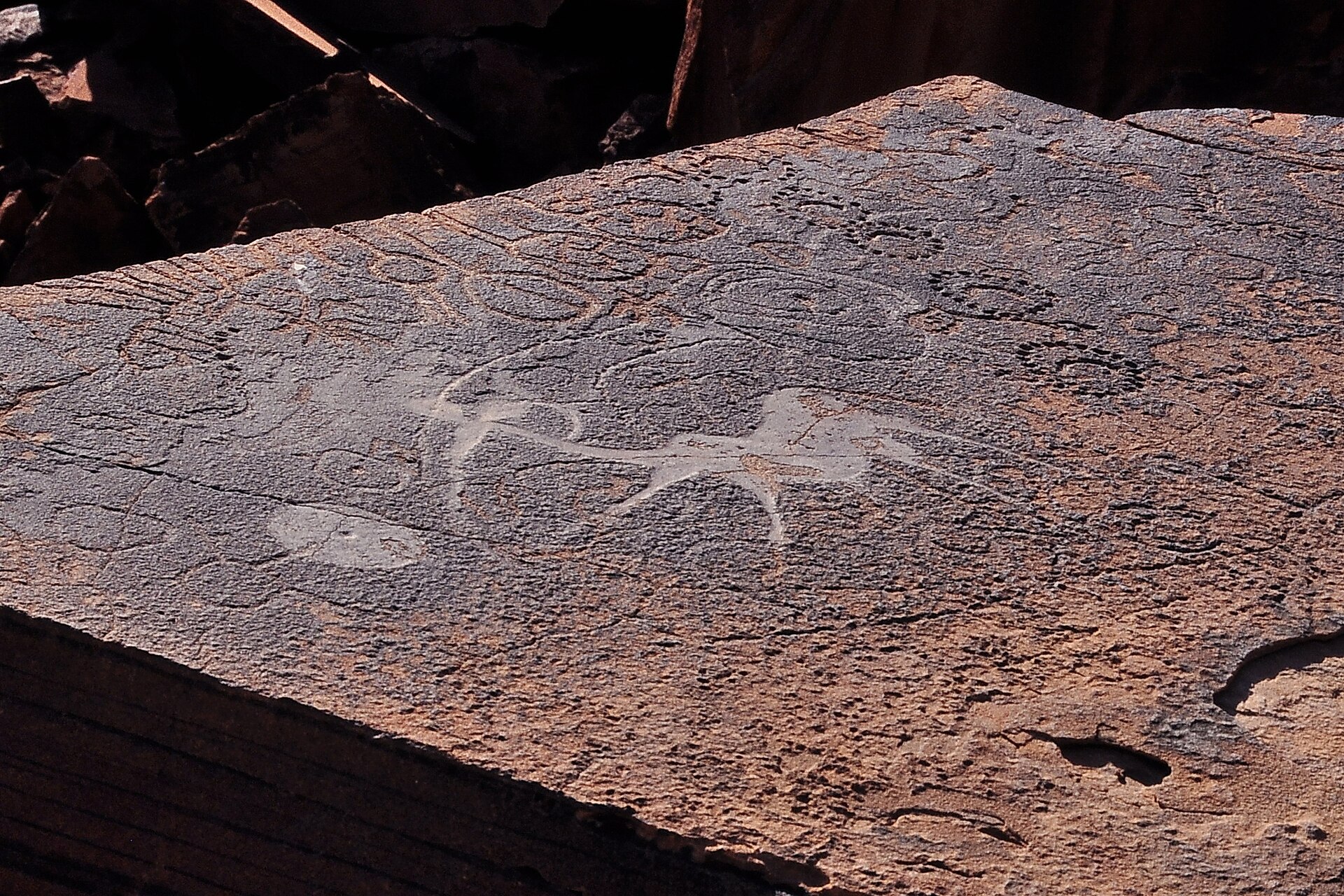
Twyfelfontein rock art: the engraving known as the Dancing Kudu, a kudu figure surrounded by circles carved into a dark sandstone slab in Namibia
The engraving known as the Dancing Kudu, 2012. Photo: Schnobby / Wikimedia Commons, CC BY-SA 3.0

Who made the engravings, and why?

UNESCO describes Twyfelfontein rock art in the core area, both engravings and paintings, as the work of San hunter-gatherers who lived in the region long before Damara herders and, later, European colonists arrived. Britannica dates the arrival of Damara pastoralists to about 1000 CE.

Britannica says the animals may relate to rituals, or may show people transforming into animals during them. One of the best-known engravings, a pregnant kudu known as the “Dancing Kudu”, was probably linked to rituals performed by women, it says.

The area gets less than 150mm of rain a year and lies between savanna and semi-desert, so its spring made it a gathering place, Britannica says. UNESCO’s listing goes further: it reads the art as evidence that hunter-gatherers held land near a reliable water source to be sacred, linking their rituals to their economic life.

Stone tools and other artefacts excavated from three of the painted shelters date from about 5,850 to about 370 years before the present, according to Britannica.

How did the site get its name?

Twyfelfontein means “doubtful spring” in Afrikaans. Britannica says the name came from David Levin, a settler granted the land in the 1940s, who doubted that the spring could supply enough water. Levin showed the engravings to Ernst Rudolf Scherz, a German-born rock art researcher, whose efforts led to the core area being declared a national monument.

Sources differ on the date: UNESCO gives 1948, Britannica 1952. The older name, /Ui-//aes, was given by the Damara people. Britannica translates it as “place among rocks”, while Namibian.org renders it as “jumping spring”.
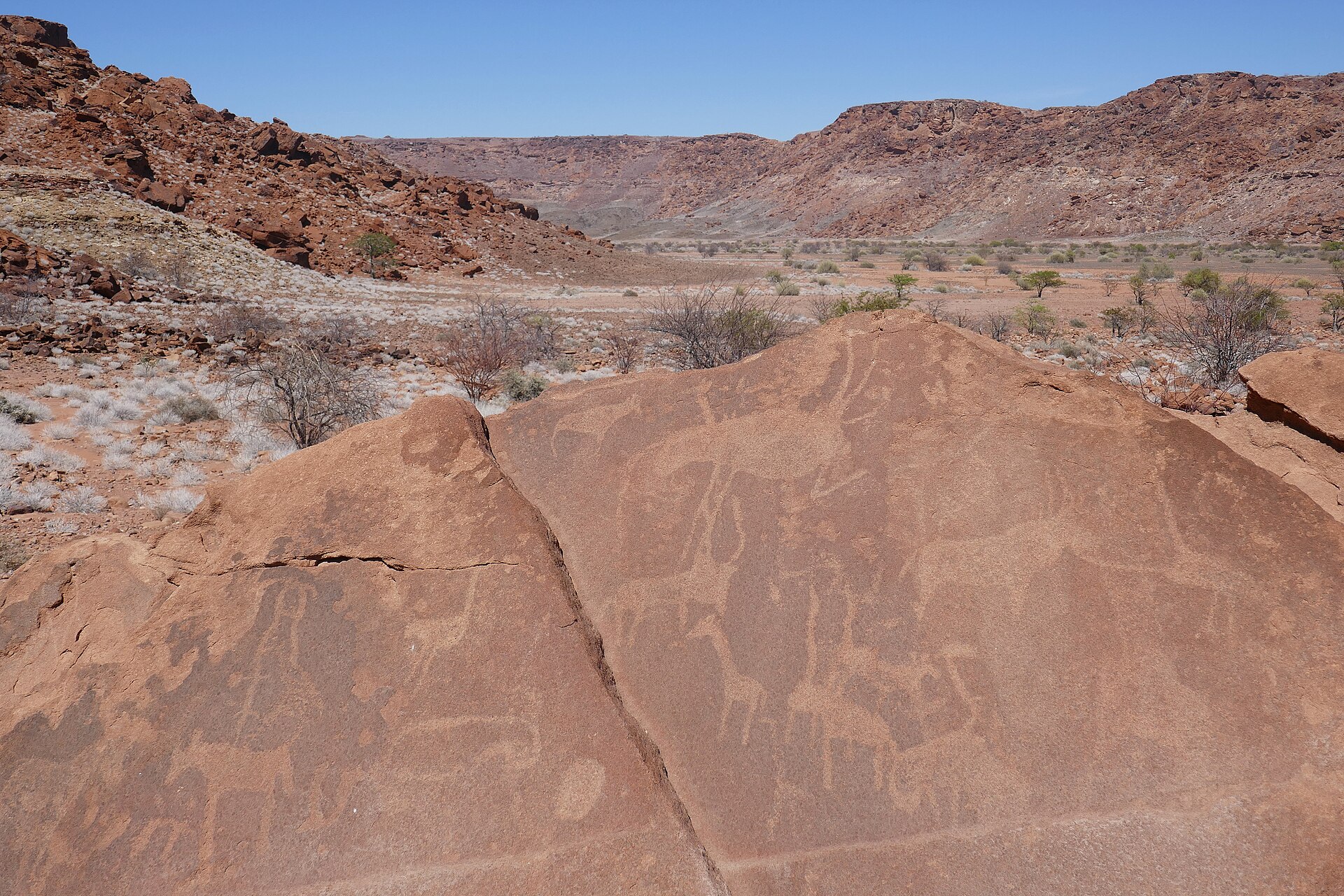
Twyfelfontein rock art: animal engravings on sandstone boulders on the slope at Twyfelfontein in Namibia's Kunene region
Engraved boulders at Twyfelfontein, 2016. Photo: Ji-Elle / Wikimedia Commons, CC BY-SA 4.0

How is Twyfelfontein rock art protected today?

The core area holding Twyfelfontein rock art covers about 57 hectares, with a buffer zone of about 9,194 hectares, according to UNESCO. The site is protected by Namibia’s National Heritage Act of 2004 and managed by the National Heritage Council. A management plan has been in force since 2005, and UNESCO says the state of conservation has improved, particularly in how visitors are managed.

A lodge built in the buffer zone in 1999-2000 at the Seremonienplatz engraving site “severely compromised” the engravings in that area, UNESCO says. Britannica notes that national monument status came without site management, and that unregulated tourism in the following decades led to vandalism, theft and damage.

The main engraving sites can be visited only on guided tours, with fees set each year by the National Heritage Council, Namibian.org reported. The site belongs to a wider group of southern African rock art sites on the World Heritage List, including Tsodilo in Botswana, Matobo Hills in Zimbabwe and uKhahlamba-Drakensberg in South Africa. In South Africa, DNE Africa has covered the return of South Africa’s Mapungubwe gold rhino, and Namibia’s coast has its own archaeology, as a 16th-century shipwreck found there showed.

FAQ

Where is Twyfelfontein rock art?

It is in the Kunene region of north-west Namibia, about 90km west of the town of Khorixas, according to Britannica.

How old is Twyfelfontein rock art?

UNESCO says the art records hunter-gatherer ritual over at least 2,000 years. Artefacts from the painted shelters date from about 5,850 to about 370 years ago, according to Britannica.

When did Twyfelfontein become a UNESCO World Heritage site?

It was inscribed in 2007, making it Namibia’s first World Heritage site.

Can visitors see Twyfelfontein rock art on their own?

No. The main engraving sites are visited on guided tours, and the National Heritage Council sets the fees each year, Namibian.org reported.


You Might Also Like

Kenyan scholars join Sufism International Association in Cairo

Brazzaville’s Poto-Poto School of painting turns 75

Kenya’s Lamu Old Town marks 25 years as a UNESCO World Heritage Site

Ghana’s highlife music nears its first year on UNESCO’s heritage list

Exclusive: Sudan’s Great Church of Jesus shows medieval Nubia’s might

TAGGED:ArtNamibia
Share This Article
Facebook Twitter Pinterest Whatsapp Whatsapp LinkedIn Reddit Telegram Email Copy Link

You Might Also Like

Ait Benhaddou ksar: earthen towers and houses climbing a hill above the Ounila riverbed and palm gardens in southern Morocco
Culture

Ait Benhaddou, Morocco’s earthen ksar that became a film set

By DNE Africa 7 Min Read
Mapungubwe kingdom heritage: the domed earth-tile roofs of the Mapungubwe Interpretation Centre in Mapungubwe National Park
Culture

South Africa’s Mapungubwe gold rhino returns to permanent display

By DNE Africa 8 Min Read
Congolese rumba star Papa Wemba smiling during an interview in 2009
Culture

Congolese rumba marks five years on UNESCO heritage list

By DNE Africa 8 Min Read

More Popular from DNE AFRICA

NCC Device Checker matters for phone buyers: phone shops and brand signs at Computer Village in Ikeja, Lagos
Technology

Nigeria’s NCC Device Checker: how to see if your phone is approved

By DNE Africa 6 Min Read
Killer robots talks: delegates in the Council Chamber of the Palais des Nations in Geneva during a UN disarmament meeting

UN killer robots talks put off binding AI weapons rules until 2028

By DNE Africa
Carthage Theatre Days 2026 official poster: a figure with red butterfly wings and flowers on a blue background, with the dates 21-28 November
Entertainment

Carthage Theatre Days open in Tunis with 12 plays from 11 countries

By DNE Africa 8 Min Read
Ad imageAd image
Sports

Kenya’s Kipkoech wins Incheon Marathon by one second

Felix Kipkoech edged Ethiopia's Haile Tigabu Desta in South Korea, and Enatnesh Alamrew Tirusew set a…

By DNE Africa
Business

Lobito Corridor may not shift Africa’s copper power, study warns

The rail route from Angola's Atlantic coast to the Copperbelt is moving more freight, but only…

By DNE Africa
Technology

Signal privacy setting blocks AI assistants from reading chats

Signal says AI assistants built into iPhone and Android can capture decrypted chats, undermining its encryption…

By DNE Africa
World

Iran’s Guards say they shot down US MQ-1 drone east of Hormuz

Iran's Revolutionary Guards say they destroyed a US MQ-1 drone east of the Strait of Hormuz,…

By DNE Africa
Politics

Sudan’s West Kordofan fighting displaces thousands around Abu Zabad

An army push towards En Nahud has made Kordofan a main front of Sudan's war, with…

By DNE Africa
DNE Africa

News by Africans, For Africans

Categories

  • Science
  • Health
  • Entertainment
  • Business
  • The Escapist

Quick Links

  • Advertise with us
  • Newsletters
  • Complaint
  • Deal

DNE Africa.All Rights Reserved.

Welcome Back!

Sign in to your account

Username or Email Address
Password

Lost your password?