
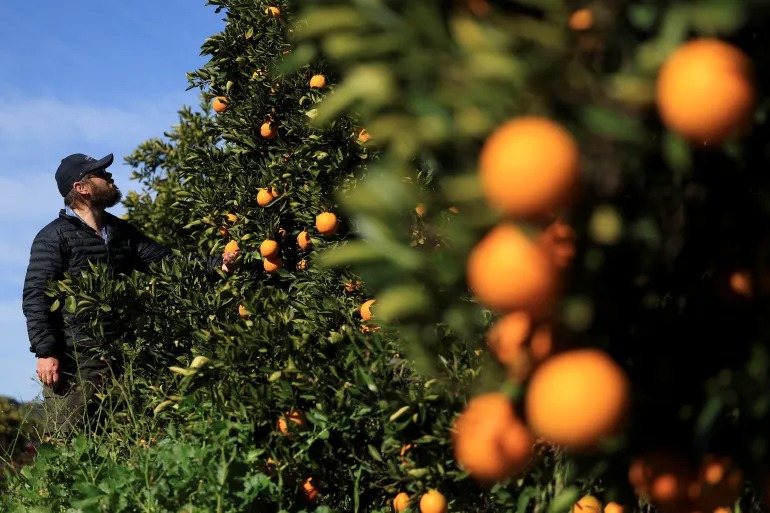

South Africa’s white farming community is expected to bear the brunt of newly imposed 30% tariffs by the United States, as observers warn of severe economic repercussions for the country’s citrus export sector.
The decision, announced by U.S. President Donald Trump, follows controversial remarks accusing the South African government of persecuting the white minority. Trump has previously cut aid to South Africa and urged Afrikaners—descendants of early European settlers—to seek asylum in the U.S.
The new tariffs, set to take effect in early August, are being seen as a paradoxical blow to the very community Trump claims to defend.
Citrus exports at risk
Roughly 75% of South Africa’s commercial farmland remains under white ownership. Citrus farmers—many of whom rely heavily on the U.S. market—now face a potentially devastating blow to their livelihoods.
Boitshoko Ntshabele, CEO of the Citrus Growers Association of South Africa, said the tariffs threaten to collapse entire agricultural communities that have supplied U.S. consumers with fresh produce for decades.
“A 30% tariff is not commercially sustainable. Entire towns built around citrus exports could be economically devastated,” Ntshabele said.
South Africa’s location in the Southern Hemisphere allows it to supply citrus to the U.S. during off-season months, helping meet year-round consumer demand. Although the U.S. accounts for only about 6% of South Africa’s total citrus exports, certain farming regions rely almost exclusively on the American market.
These regions face limited options for re-routing their produce due to strict and varying international phytosanitary and sizing standards.
Job losses anticipated
Trade associations have warned that the inability to remain competitive in the U.S. market could result in the loss of approximately 35,000 jobs across South Africa’s agricultural sector.
While the tariffs have triggered political debate, analysts argue that their economic impact will ripple beyond racial lines, affecting both farm owners and seasonal laborers across the citrus-producing provinces of the Western and Eastern Cape.
The move underscores the increasing use of trade policy as a tool of foreign influence under the Trump administration, as well as the delicate interplay between identity politics and economic strategy in U.S.–Africa relations.


