
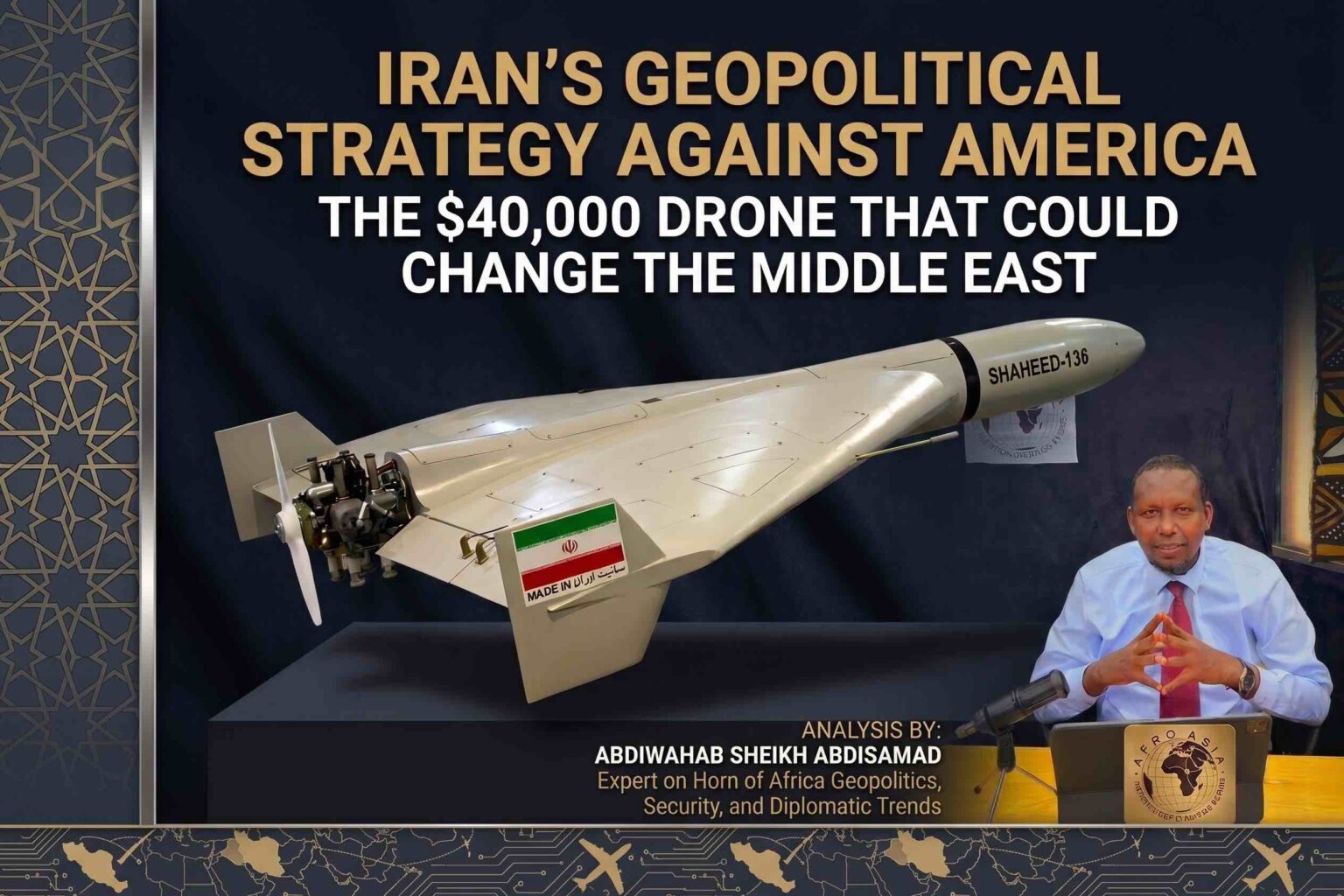

Iran’s emerging strategy against the United States does not attempt to match America’s military strength in a conventional way. Instead of building fleets of jets, carriers, and high-end missiles, Iran is pursuing a cheaper, asymmetric approach: using mass-produced drones, economic vulnerabilities, and resource chokepoints to exhaust and destabilize a far richer and more powerful opponent. The core idea is simple: Iran does not want to beat America with “muscles”; it wants to beat America with “mass.”
For decades, the global military order rested on a straightforward assumption: the nations that spent the most on defense would dominate the battlefield. Military power was measured in aircraft carriers, stealth fighter jets, nuclear submarines, and advanced missile defense systems—technological marvels that often required decades of research and hundreds of billions of dollars in investment.
No country embodied this model more than the United States. With a defense budget larger than the next several nations combined, the U.S. built a military architecture designed to project power anywhere in the world. Precision-guided munitions, satellite networks, stealth aircraft, and layered missile defenses became the backbone of modern warfare. For many years, this technological edge ensured a decisive advantage.
But a different theory of military power is emerging, one that challenges the economic foundations of that system. It is being developed not in Washington, Moscow, or Beijing, but in Tehran.
2. Iran’s Cheap Drones vs. Expensive Defenses
At the center of this strategy is the Shahed-136 drone. Each unit costs roughly $35,000 to $50,000, yet Iran can produce around 500 per day and is estimated to have a stockpile of about 80,000. Despite their low cost, these drones can destroy major infrastructure such as oil fields, water plants, or industrial sites. They are small, easy to hide, and can be launched from ordinary trucks.
Iran has increasingly invested in a doctrine built around inexpensive unmanned systems, particularly loitering munitions—drones designed to hover over an area before striking a target. The Shahed-136 follows a philosophy of simplicity, mass production, and affordability. Costing less than many luxury cars, it turns traditional defense economics upside down.
The United States counters such airborne threats with systems like THAAD (Terminal High Altitude Area Defense). Each interceptor missile costs approximately $1 million and may need to be fired in multiples to reliably take down a single drone. This creates a severe cost imbalance: Iran spends tens of thousands of dollars while the United States spends millions. Over time, this ratio becomes economically unsustainable for the defender.
Modern weapons systems are extraordinarily expensive. A single stealth fighter can cost more than $100 million, and advanced missile defense networks require billions in development and deployment. If a $1 million interceptor missile must be used to destroy a $40,000 drone, the defender may successfully stop the attack but still lose financially. This cost-exchange ratio has become one of the most pressing challenges in modern air defense.
3. The Power of Swarms and Structural Inertia
Iran’s drone strategy is rooted in a long-standing doctrine: asymmetric warfare. Rather than attempting to match the United States weapon for weapon, Iranian planners have focused on systems that exploit vulnerabilities in more advanced militaries.
Small drones are particularly well-suited to this strategy. They fly at low altitudes, making them difficult for radar systems to detect. Their small size reduces their radar signature, while their slow speed allows them to navigate terrain and approach targets from unexpected directions.
Most importantly, they are cheap enough to be deployed in large numbers. The concept of drone swarms—multiple drones attacking simultaneously—has become a growing concern. Western defense systems were designed to intercept a limited number of high-value threats, not waves of inexpensive aircraft. Even advanced systems have limits in tracking and interception capacity. A sufficiently large swarm could easily overwhelm defenses, allowing some munitions to slip through.
This mismatch is rooted in Cold War history and institutional incentives. American weapons procurement evolved around building large, technologically impressive systems to deter major rivals. Over time, a military-industrial structure grew around high-cost hardware, leaving little incentive to adopt cheap, scalable solutions. Iran’s low-cost drone strategy directly exploits this structural inertia.
4. Water as a Strategic Target in the Middle East
Beyond the battlefield, Iran’s strategy extends to critical resources—especially water. Many Middle Eastern states exist in extreme water stress and rely heavily on desalination.
Countries like Saudi Arabia, the UAE, Bahrain, and Qatar depend on desalination plants to sustain their populations and economies. Cities such as Dubai and Abu Dhabi rely entirely on these facilities for drinking water and agriculture.
Iran’s operational concept involves using cheap drones to threaten this infrastructure. A $50,000 drone destroying a key plant could deprive millions of people of water. Because these facilities are expensive and impossible to quickly relocate, they serve as highly vulnerable, high-value targets.
Iran does not need to defeat military forces directly; it only needs to break the systems that sustain daily life. In this sense, water becomes more strategically critical than traditional military installations.
This approach gives Iran a form of asymmetric leverage that is cost-effective and difficult to counter with conventional defense systems. By targeting civilian infrastructure indirectly tied to national stability, Iran can create economic disruption, public unrest, and political pressure without triggering a full-scale war. This strategy also complicates retaliation, as attribution can be intentionally ambiguous when proxies or untraceable drones are used.
Ultimately, it allows Iran to project regional power while conserving resources, avoiding direct confrontation with superior military forces, and exploiting the structural vulnerabilities of highly urbanized, resource-dependent neighboring states.
5. Iran’s Strategic Calculus and Internal Vulnerabilities
Iran’s investment in drones reflects both necessity and economic reality. Crushing sanctions have limited its access to advanced technology, forcing a focus on affordable, domestically producible systems.
Drones can be built using commercially available components, modified quickly, and produced at scale. This makes them perfectly suited to Iran’s strategic needs.
However, Iran faces severe internal vulnerabilities of its own. Water scarcity, environmental mismanagement, and population pressures have severely strained resources—the near disappearance of Lake Urmia starkly highlights these challenges.
Iran is also a diverse society with multiple ethnic groups, creating potential pressure points. The United States and Israel are often viewed as actively seeking to exploit these vulnerabilities to increase internal pressure and encourage fragmentation.
Furthermore, economic constraints have intensified public dissatisfaction, particularly among a younger population facing high unemployment and inflation. Periodic protests reflect underlying social tensions that challenge state stability. Infrastructure disparities between urban and rural areas further complicate governance and resource distribution. Cyber vulnerabilities and information warfare pose emerging risks as external actors attempt to influence public opinion.
Despite these pressures, Iran continues to invest heavily in asymmetric capabilities, viewing them as the most cost-effective tools to offset its conventional military disadvantages while maintaining regional deterrence.
6. Religious Mobilization and Pax Islamica
Iran’s strategy also operates heavily in the ideological domain. As the leading Shia-majority state, it seeks to unite Shia populations globally in opposition to American influence.
Beyond sectarian lines, Iran aims to channel broader dissatisfaction in Sunni-majority countries into political change, targeting states governed by regimes supported by the United States.
The long-term vision is a unified Islamic geopolitical order—a Pax Islamica—free from Western dominance. To achieve this, Iran invests in religious institutions, media networks, and educational initiatives that promote its ideological perspective and strengthen transnational religious identity. Simultaneously, it cultivates alliances with non-state actors and political movements that share similar grievances against Western intervention.
7. The GCC, Petrodollars, and the U.S. Economy
A central economic target of this strategy is the Gulf Cooperation Council (GCC), comprising Saudi Arabia, the UAE, Qatar, Kuwait, Bahrain, and Oman.
These countries sell oil primarily in U.S. dollars, reinforcing the dollar’s global dominance. The revenues—petrodollars—are then reinvested into global markets, overwhelmingly in the United States. GCC sovereign wealth funds hold major stakes in key technology companies such as Apple, Microsoft, Google, and Nvidia, driving a significant share of U.S. market growth.
A continued or escalating conflict between the United States and Iran could destabilize this petrodollar system. By threatening Gulf energy infrastructure, Iran weakens confidence in U.S. security guarantees—the foundational pillar of the petrodollar arrangement. Disruptions in oil flows, especially through strategic chokepoints like the Strait of Hormuz, could push nations to trade oil in alternative currencies, such as the Chinese yuan, accelerating global de-dollarization.
If sustained, this shift would reduce global demand for the dollar, increase U.S. borrowing costs, and diminish its financial hegemony, signaling a gradual transformation of the petrodollar system rather than an immediate collapse.
8. Economic Warfare Through GCC Disruption
Iran’s strategy is to destabilize the GCC through infrastructure attacks and regional instability. If oil exports become unreliable, GCC revenues decline, forcing governments to redirect capital away from investments and toward immediate defense spending.
This ultimately reduces investment flows into U.S. markets. As capital is withdrawn, stock valuations may fall, potentially triggering broader financial instability. Through this chain reaction, Iran aims to target the economic foundations of American power rather than its physical territory.
Such a strategy leverages the deeply interconnected nature of global energy markets and financial systems, where even localized disruptions carry disproportionate ripple effects worldwide. By creating uncertainty in energy supply chains, Iran can drive up global oil prices, increasing volatility and discouraging long-term investment planning.
This uncertainty weakens investor confidence not only in GCC economies but across global markets. Higher energy prices contribute directly to inflationary pressures in the U.S. and other importing nations, reducing consumer purchasing power and slowing economic growth. Over time, persistent instability in the Gulf could force a faster shift toward alternative energy sources, but such transitions require time and monumental investment, leaving economies highly vulnerable in the interim.
9. Global Repercussions and Shifting Alliances
The effects of such disruption are inherently global. Europe, which relies heavily on Gulf energy, would face serious economic consequences. Meanwhile, Russia has a vested interest in preventing Iran’s collapse, and China remains flexible, focused primarily on securing stable economic outcomes for itself.
At the same time, global alliances are shifting. Countries are forming more flexible, transactional partnerships, and asymmetric technologies like drones are actively reshaping the balance of power. These developments increase uncertainty in international markets, disrupt global supply chains, and heighten geopolitical tensions across multiple regions. Emerging powers are asserting influence while traditional alliances buckle under the weight of evolving strategic priorities.
10. The Risk of Escalation and the Future of Military Power
Cheap drone warfare increases the risk of escalation in ways both immediate and long-term. Because drones are inexpensive, widely available, and increasingly easy to operate, they are no longer restricted to powerful states with massive defense budgets. They are now accessible to smaller states, militias, and non-state actors, effectively lowering the traditional barriers to armed conflict. This democratization of firepower means more actors can project force across borders without the need for conventional military infrastructure.
A single drone attack, even if small in scale, could trigger heavy retaliation and quickly spiral into a broader regional war. The situation is made more dangerous by the difficulty of attribution. It is rarely immediately clear who launched a drone or who ordered it, especially when actors use proxies to mask their involvement. This fog of war increases the risk of miscalculation, where a response is directed at the wrong party or escalates beyond original intentions.
This dynamic reflects a profound transformation in the future of military power. Expensive, high-end systems—advanced fighter jets, missile defense networks, and large-scale military platforms—still matter and continue to shape global power structures. However, they must now coexist with low-cost, adaptable, and scalable technologies that can be deployed en masse.
The result is a dual-layered military landscape. On one hand sits the traditional era of billion-dollar systems symbolizing technological superiority and strategic dominance. On the other sits the emerging era of the $40,000 drone, where affordability, flexibility, and mass deployment can successfully challenge the most advanced militaries on earth.
11. Power, Vulnerability, and Understanding
The conflict between Iran and the United States is no longer just a contest of military strength. It is a complex struggle over economics, critical infrastructure, ideology, and strategic vulnerabilities.
Iran uses cheap drones to stress expensive defenses, targets life-sustaining infrastructure, and seeks to indirectly disrupt the U.S. financial system. The United States and its allies, in turn, aim to maintain stability, defend the global economic order, and counter these asymmetric strategies.
The outcome of this friction will fundamentally shape global energy markets, financial systems, and geopolitical dynamics. Sustained disruptions in energy supply will raise prices worldwide, affecting transportation, food production, and everyday living costs. Financial instability could easily spread from the United States into global markets, creating profound uncertainty for investors and governments alike.
In a hyper-connected world, understanding these relationships is itself a form of power. The interaction between technology, economics, and geography now dictates the rules of modern conflict. States that adapt to these changes will hold a strategic advantage, while those that rely exclusively on traditional methods of warfare will find themselves increasingly, and inevitably, vulnerable.
Expert on Horn of Africa Geopolitics, Security, and Diplomatic Trends


