
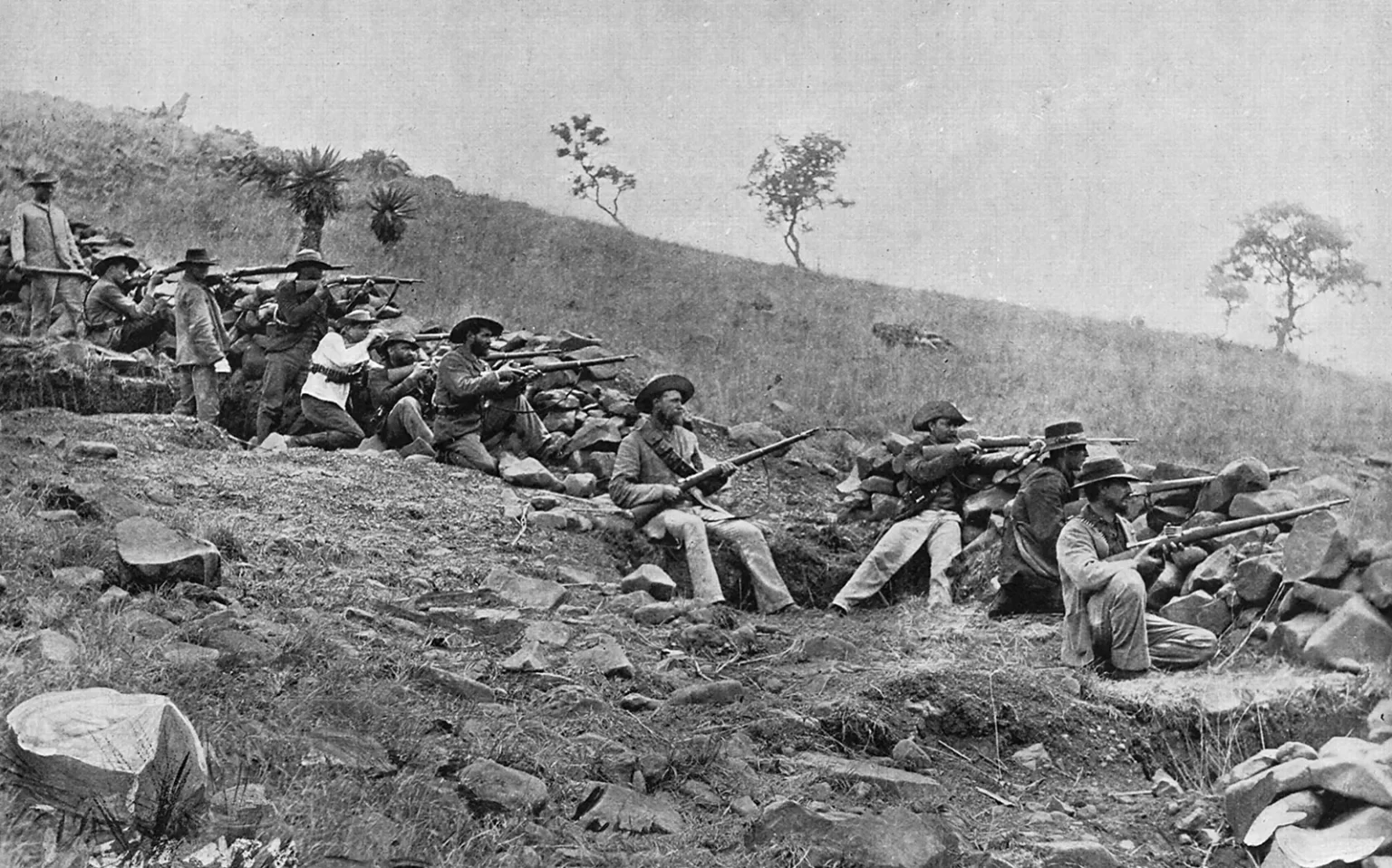

The 125th anniversary of the Anglo-Boer War of 1899-1902 is marked on 11 October 2024. Also known as the South African War or the Second Boer War, the brutal conflict between the colonising forces of the British and the Boers (originally Dutch settlers, today known as Afrikaners) affected all cultural groups in the war zone. The war had profound consequences for the way that South Africa developed in the course of the 1900s and beyond. André Wessels has researched the war and its aftermath for nearly five decades, and has published several books and academic papers on it. We asked him how – and even if – the war should be commemorated.
What led to the Anglo-Boer War?
The first Europeans to settle in what is today South Africa were the Dutch in 1652. In 1795 and again in 1806, the British took over control of the Cape Colony. The Dutch, who sought to be free from British rule, then trekked northwards and established Boer republics. But Britain did its best to regain control over these areas.
The Anglo-Boer War was a classic David-Goliath struggle, pitting two small Boer republics against the British Empire. These were the Zuid-Afrikaansche Republiek (the Transvaal, today Gauteng province) and the Orange Free State (now the Free State province). The war broke out on 11 October 1899, after the British government rejected a Boer ultimatum that all British soldiers be withdrawn from the Transvaal’s borders.
It was the culmination of a decades-long struggle between Afrikaner nationalism (and the ideal to be free and independent) and British imperialism. This was further fuelled by the discovery of rich goldfields in the Transvaal, and by the (in)famous empire-builder Cecil John Rhodes’s ideal of a British-controlled Africa from the Cape to Cairo.
About 450,000 white British soldiers (including volunteers from the colonies), and as many as 140,000 black and brown South African men on the side of the British, served in the war. They were pitted against not more than 79,000 Boers. This Boer force included about 2,500 foreign volunteers and several thousand white rebels from the Cape as well as a few hundred from the British colony of Natal (today KwaZulu-Natal province).
How did the war shape South Africa?
The Anglo-Boer War war was supposed to be a white man’s war and a “gentleman’s war”, but from the start involved all race groups of the region. It degenerated into a total war and a precursor of many of the conflicts of the 1900s and beyond, such as the wars of liberation in the region. In some instances, it also showed characteristics of a civil war, especially in the Cape Colony, where some white colonials fought against white Cape rebels.
The Anglo-Boer War war cast a shadow over South Africa and all its people. It is impossible to understand the history of the country without knowledge and insight of this far-reaching conflict.
After the Boers accepted the British terms of surrender on 31 May 1902, many Afrikaners strove to ensure that Afrikaner identity would not be jeopardised under British rule. The establishment of the Union of South Africa in 1910 brought the Boer and British colonies together under British authority. But it did not satisfy the expectations of Afrikaner nationalists. In 1914 Afrikaners founded the National Party.
Soon after the first world war broke out in 1914, an Afrikaner rebellion broke out, but was soon quelled. Staunch Afrikaner nationalists’ first aim was to ensure the future dominance of the Afrikaner. Once that was achieved, the focus shifted to ensure that white people in general would remain in power.
Thus the scene was set for the creation of apartheid. With it came a decades-long struggle between Afrikaner nationalism and black nationalism. To a large extent black nationalism was led by the African National Congress, established in 1912 in the wake of the Anglo-Boer War. Among other things this was because of promises of political rights, should black people support the British, that were not kept.
How did the war lead to trans-generational trauma?
Over and above the military casualties – more than 22,000 dead on the British side and some 6,000 on the Boer side – the war had a devastating effect on civilians in the war zone. In a desperate attempt to corner and destroy mobile Boer commandos, the British resorted to an elaborate and drawn-out counter-guerrilla strategy. This included a scorched earth policy.
The result was a humanitarian disaster. More than 40 Boer towns and villages, and some 30,000 Boer farmhouses, were destroyed, together with more than 100,000 dwellings of black farm labourers. At least 145,000 white and 140,000 black civilians were incarcerated in internment camps. There, at least 28,000 white and 23,000 (but probably many more) black civilians died – mostly children aged 16 or younger.
I argue in my research that the Afrikaners who suffered in the internment camps stored those negative experiences in their memories. The trauma was internalised and for many years some Afrikaners harboured great resentment, bitterness, frustration and fear. Later – sometimes only many years later, even in a succeeding generation – these traumatic experiences once again gained prominence and sometimes manifested themselves in some or other political view.
By the 1940s, the so-called “black threat” had in large measure replaced the “British/imperial threat”. Afrikaners wanted to ensure that they would never again be oppressed or humiliated as they had been in the war. The excessive emphasis on the protection of one’s own interests meant that the logical next step – to prevent universal oppression and suffering – was never made.
The Afrikaners had not learnt from their history and they, who had been humiliated and oppressed earlier, became the new oppressors (of black and brown people) from 1948 onwards under the colours of apartheid (and with it white supremacy).
The traumatised from the era of the Anglo-Boer War (and their descendants) became the new traumatisers. They caused a new wave of collateral damage, to the detriment of mutual relationships in South Africa, to the disadvantage of the black inhabitants of the country, and eventually also to the detriment of the Afrikaner nation.
How should the Anglo-Boer War war be commemorated – if at all?
It’s human nature to commemorate events. Everything taken into consideration, it is also proper to commemorate the outbreak of a bloody war, the events that took place in the course of the conflict, and also the conclusion of peace.
But it is, of course, important that commemorations should take place in the correct spirit. Not to refight the battles of the past, not to open up old wounds, not to ostracise or vilify “the enemy”, not to hero-worship; but rather to use the opportunity to reflect, and to take stock of a shared history and heritage. So commemorations must be inclusive.
The ideal is that the 125th anniversary will lead to greater insight into this bloody and traumatic conflict and the way it influenced developments in South Africa over the course of the 20th century. It could lead to the restoration (where necessary) of historical monuments, buildings and sites pertaining to this conflict. It could lead to people from all walks of life, and from all cultural groups, visiting museums and places of historical interest in South Africa, and in the process developing a better understanding of the country’s chequered and complicated history.
It must also be kept in mind that history enables one to forgive, without the need to forget. It is the ideal that it will be in this spirit that the 125th anniversary of the Anglo-Boer War will take place. After all, South Africa and its people are in need of healing from a brutal past.
André Wessels, Senior Professor (Emeritus) and Research Fellow, Department of History, University of the Free State
This article is republished from The Conversation under a Creative Commons license. Read the original article.


