
By using this site, you agree to the Privacy Policy and Terms of Use.
Accept
DNE Africa
  • Home
  • Politics
    IMG 28d7bbac 7f58 411b 896f ab241e966c4e
    HealthPolitics

    UNICEF-Backed Initiative Enrols 877 Out-of-School Children in Nigeria’s Yobe State

    By Ahmed Emam 5 Min Read
    Adire cloth drying beside indigo dye drums in a dyeing yard in Nigeria, with a dyer at work in the foreground
    Culture

    Adire cloth: how Nigeria’s indigo craft became fashion

    By DNE Africa November 14, 2026
    Aerial view of the Port of Cotonou; the first Benin oil cargo in almost 30 years was loaded off nearby Seme
    Business

    Benin oil exports resume with first cargo in almost 30 years

    By DNE Africa November 14, 2026
  • Business
    Morocco social aid: head of government Fatima Ezzahra El Mansouri at a summit in October 2026
    Business

    Morocco social aid to rise 20% to 600 dirhams in 2027

    The government approved a draft decree raising the minimum direct aid payment…

    By DNE Africa 6 Min Read
    Uganda tax waiver debate: an MP addresses the Speaker in the chamber of the Parliament of Uganda
    Business
    Uganda tax waiver: MPs approve Shs14.97bn for state printer
    Danpullo MTN dispute: Douala, Cameroon, with Mount Cameroon in the distance
    Business
    Danpullo MTN case: Cameroon court restores 140bn CFA freeze
    EAC Secretary General Stephen Mbundi speaking at the EAC development partners forum in Arusha
    Business
    EAC development partners back 48-project pipeline
    De Beers stake: file photo of the Jwaneng open-pit diamond mine in Botswana
    Business
    Botswana to double De Beers stake to 30% under Anglo American sale
  • Culture
  • Opinion
  • Technology
  • Sports
  • World
  • My Bookmarks
Reading: Adire cloth: how Nigeria’s indigo craft became fashion
Sign In
  • Join US
DNE AfricaDNE Africa
Font ResizerAa
  • Home
  • Politics
  • Business
  • Culture
  • Opinion
  • Technology
  • Sports
  • World
  • My Bookmarks
Search
  • Home
  • Politics
  • Business
  • Culture
  • Opinion
  • Technology
  • Sports
  • World
  • My Bookmarks
Have an existing account? Sign In
Follow US
© Foxiz News Network. Ruby Design Company. All Rights Reserved.
Adire cloth drying beside indigo dye drums in a dyeing yard in Nigeria, with a dyer at work in the foreground

Adire cloth: how Nigeria’s indigo craft became fashion

DNE Africa
Last updated: November 14, 2026 1:14 pm
By DNE Africa 8 Min Read
Share
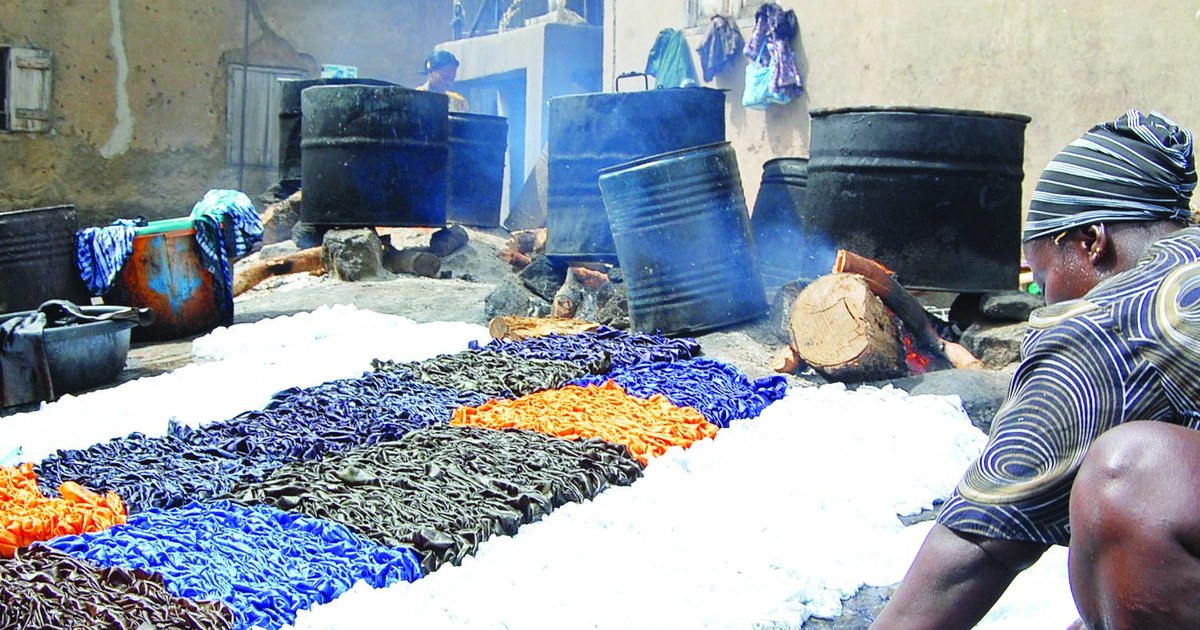
File photo (2017): tie-dyed cloth drying beside dye drums in Nigeria. Photo: Cliff / Wikimedia Commons, CC BY-SA 4.0
SHARE

Adire cloth, the indigo resist-dyed textile made by Yoruba women in south-western Nigeria since the 19th century, has moved from the wrappers of its origins into tailored suits, streetwear and international fashion collections.

Contents
What is adire cloth?Where did adire cloth come from?How has adire cloth changed since the 1960s?Who wears adire cloth now?FAQWhat does adire mean?How is adire cloth made?Where is adire cloth made?What is the difference between adire and kampala?

Examples are held by museums in London and Washington. A century ago it supported a regional trade centred on Abeokuta and Ibadan, and dyers in Ogun State still make a living from it.

What is adire cloth?

Adire means “tie and dye” in Yoruba, according to the Victoria and Albert Museum in London. A typical piece is made of two strips of factory cotton sewn into a roughly square wrapper. Women prepared the cloth and always did the dyeing, the museum says.

The blue comes from imported indigo grains or locally grown indigo leaves, fermented and mixed with water softened with caustic soda. The cloth is dipped in a large pot, lifted out to oxidise and dipped again for a darker shade.

The pattern comes from stopping the dye reaching parts of the cloth. Makers of adire oniko tie it with raffia, sometimes around stones or seeds to leave circles. Adire alabere is stitched; the machine-sewn versions were made by men. Adire eleko uses a paste of cassava starch, painted by hand or pushed through a stencil, which leaves the underside plain blue.

Where did adire cloth come from?

The technique dates to the 1800s, but the word adire came into use in the early 20th century, the V&A says. The earliest cloths were probably simple tied designs on hand-spun local cotton, much like those still made in Mali, according to the textile historian Duncan Clarke.

The arrival of imported cotton shirting changed the craft. European merchants brought it in bulk to Yoruba towns, notably Abeokuta, and women dyers there became “both artists and entrepreneurs”, Clarke writes. In the 1920s and 1930s Abeokuta and Ibadan drew buyers from across West Africa. Dyers cut stencils from the tin that lined tea chests.

Most designs had names. Olokun refers to the goddess of the sea. Ibadandun, “Ibadan is sweet”, shows the pillars of the city’s Mapo Hall alternating with spoons. A jubilee design copied souvenirs made for the silver jubilee of King George V and Queen Mary in 1935. Makers of hand-painted adire cloth often signed the hem; two at the V&A carry a scorpion mark that curators have not yet matched to a name.
Folded adire cloth and wax-resist kampala fabric stacked for sale in Abeokuta, Ogun State, Nigeria
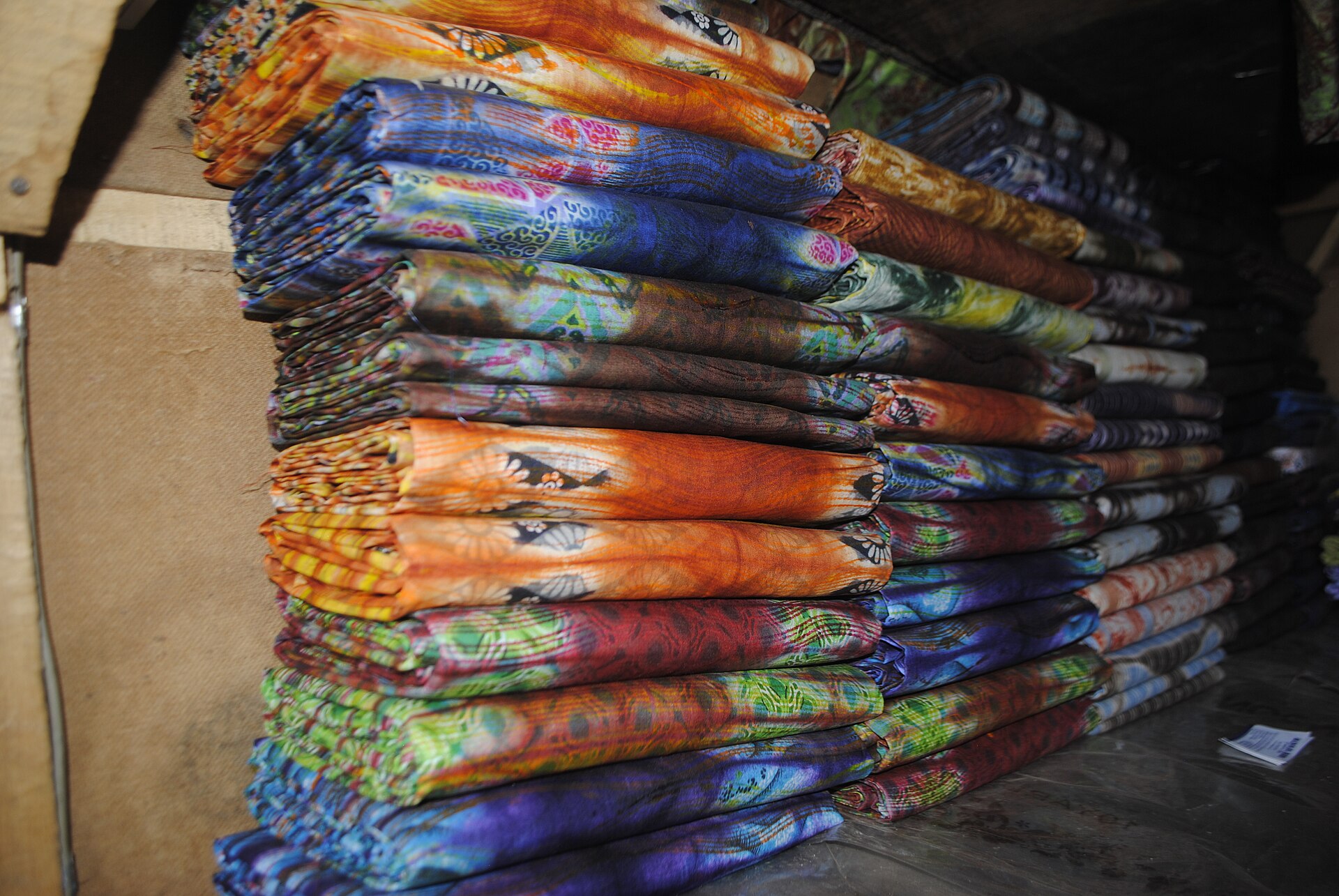
File photo (2015): adire and kampala cloth stacked for sale in Abeokuta. Photo: Olaniyan Olushola / Wikimedia Commons, CC BY-SA 4.0

How has adire cloth changed since the 1960s?

Fashions in adire cloth turned over quickly. When the V&A bought cloths in Ibadan in the 1960s, its curators were told that a folded and tied design was the “cloth of the year” for 1964, replacing a pattern of large and small circles called “moons and fruits”.

The trade itself had already shrunk. Clarke writes that by the end of the 1930s synthetic indigo, caustic soda and an influx of less skilled newcomers caused quality problems and a collapse in demand. Interest from American Peace Corps workers in the 1960s brought a revival. By then, the V&A says, the cloth was also being tailored into men’s shirts and had found buyers abroad, especially in the United States.

Methods changed too. Hot wax and paraffin have largely replaced cassava starch, and block printing has replaced many stencils, the V&A says. In Osogbo, artists at the Mbari Mbayo workshop of the mid-20th century took up wax-resist batik, Garland Magazine reported. Many buyers now prefer multicoloured wax-resist cloth known as kampala, which some people still call adire.

Who wears adire cloth now?

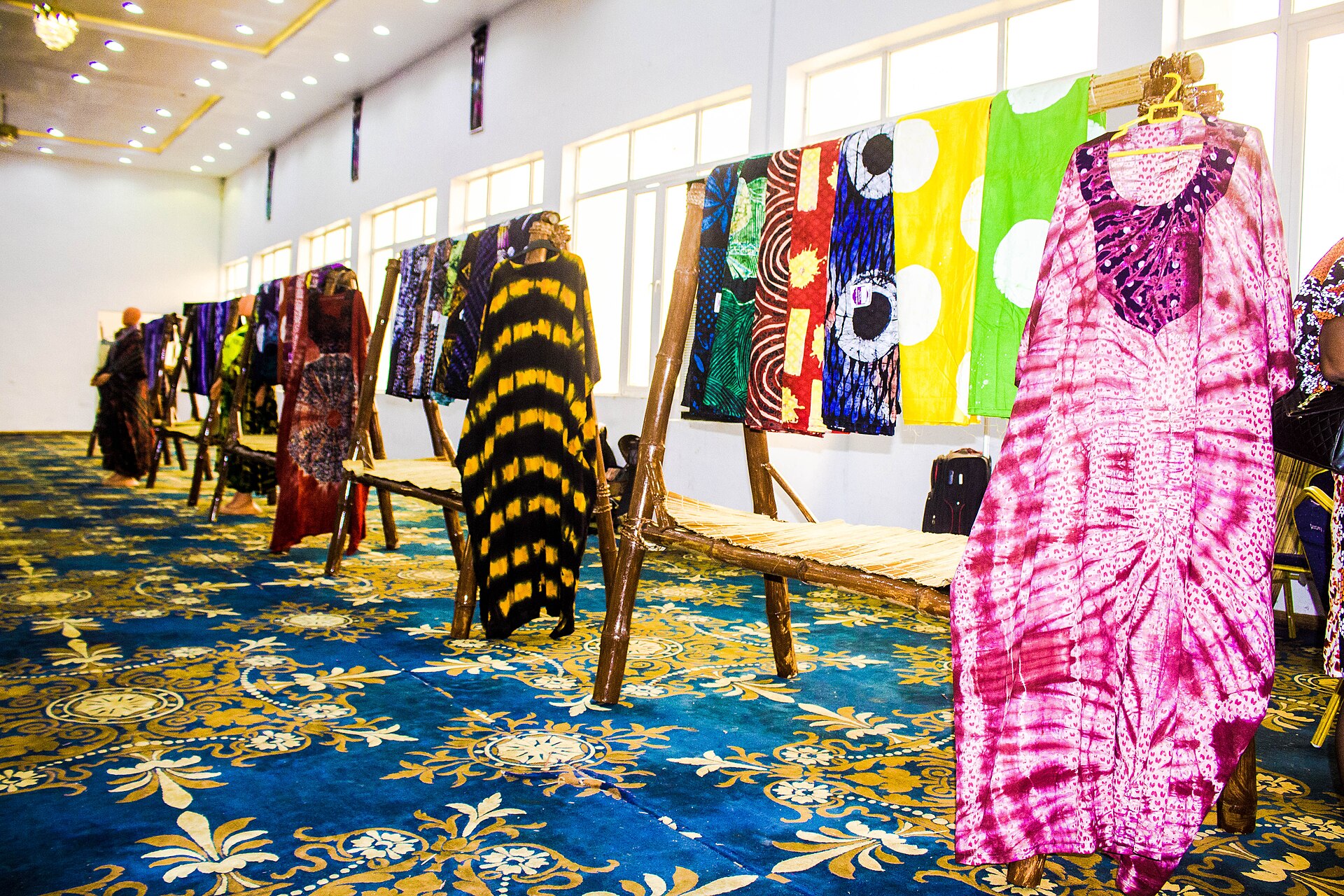
Designers now cut the fabric into suits, dresses, jackets and streetwear in place of the loose wrapper, BusinessDay reported in June. Nigeria’s film industry has helped, the paper said, with adire costumes in productions such as Kunle Afolayan’s Anikulapo.

Ecobank hosts an annual Adire Lagos Experience, and Ogun State holds an Adire Market Week that connects makers of adire cloth with boutiques and designers, according to BusinessDay. Abeokuta’s Itoku market is one of the trade’s main hubs.
Adire cloth garments in tie-dye and resist-dye patterns displayed on wooden stands at a Yoruba culture exhibition in Nigeria
File photo (2023): adire garments on display at a Yoruba culture event in Nigeria. Photo: Tunde Akangbe / Wikimedia Commons, CC BY-SA 4.0

The artist Nike Davies-Okundaye runs art centres that train young women in the craft, Garland reported, and designers such as Amaka Osakwe of the Maki Oh label have used it in their collections. Michelle Obama and the actor Lupita Nyong’o have worn adire-inspired designs, both publications noted.

The Smithsonian’s National Museum of African Art in Washington, which held an exhibition of adire cloth in 1984, describes its production by Yoruba women as “both an art form and an industry”. This is the second in DNE Africa’s series of country culture features, after Egypt’s koshary.

FAQ

What does adire mean?

Adire means “tie and dye” in Yoruba. The name describes the process, not the finished cloth.

How is adire cloth made?

Cotton is tied with raffia, stitched or painted with cassava starch, then dipped repeatedly in indigo. The protected areas stay pale and form the pattern.

Where is adire cloth made?

Mainly in south-western Nigeria. Abeokuta and Ibadan were the main centres in the 1920s and 1930s, and Osogbo and Ile-Ife also have long-standing dyers.

What is the difference between adire and kampala?

Kampala is a multicoloured cloth made with a wax resist, while classic adire cloth is indigo blue and white. Some people in Nigeria still use the name adire for both.


You Might Also Like

UNICEF-Backed Initiative Enrols 877 Out-of-School Children in Nigeria’s Yobe State

Koshary: how Egypt’s street dish became UNESCO heritage

Nigeria weighs 15-year spectrum licences tied to investment

Obi town hall attack: Lagos police probe two injured suspects

Fintech economics: how OPay and Moniepoint make money

TAGGED:FashionNigeria
Share This Article
Facebook Twitter Pinterest Whatsapp Whatsapp LinkedIn Reddit Telegram Email Copy Link

You Might Also Like

Illustration of a map of Nigeria linked by mobile towers and phones, representing Nigeria mobile subscriptions
Technology

Nigeria mobile subscriptions rise to 200mn after SIM purge

By DNE Africa 6 Min Read
Federal High Court building in Abuja, where Daniel Ojukwu was remanded
Politics

Daniel Ojukwu remanded by Nigerian court on cybercrime charges

By DNE Africa 7 Min Read
UNHCR: Violence in Northern Nigeria Forces 64,000 to Flee to Niger, Hundreds to Benin
HealthPoliticsWorld

UNHCR: Violence in Northern Nigeria Forces 64,000 to Flee to Niger, Hundreds to Benin

By Ahmed Emam 4 Min Read

More Popular from DNE AFRICA

The Roseires dam in Blue Nile state, where the army says a Sudan drone was shot down
World

Sudan drone claim: army says aircraft from Ethiopia shot down

By DNE Africa 7 Min Read
Abdul Hamid Dbeibah, accused by parliament of blocking flights to the Zintan session, in Brussels in 2024

Zintan session: Libya’s parliament accuses Dbeibah of blocking flights

By DNE Africa
Aerial view of the Port of Cotonou; the first Benin oil cargo in almost 30 years was loaded off nearby Seme
Business

Benin oil exports resume with first cargo in almost 30 years

By DNE Africa 7 Min Read
Ad imageAd image
Politics

Romanian Francophonie candidate Cioloș announces 1,709 scholarships for African students

Dacian Cioloș, Romania's candidate for secretary-general of the International Organisation of La Francophonie (OIF), has announced…

By DNE Africa
World

Sudan food aid: WFP chief urges end to war as 900,000 cut off

The World Food Programme now reaches just over 3mn people in Sudan, down from more than…

By DNE Africa
Politics

Guinea gold mining ban: 10 killed as neighbours decry expulsions

Guinea's ban on unlicensed gold digging has pushed tens of thousands of west African miners into…

By DNE Africa
Politics

South Sudan Postpones 1st General Election to February 2027

South Sudan has postponed its long-delayed general election by nearly two months, rescheduling the vote for…

By Ahmed Emam
Politics

Somalia chief justice row: UN experts demand reinstatement

Two UN special rapporteurs say the 4 November dismissal breached the constitution; the presidency says it…

By DNE Africa
DNE Africa

News by Africans, For Africans

Categories

  • Science
  • Health
  • Entertainment
  • Business
  • The Escapist

Quick Links

  • Advertise with us
  • Newsletters
  • Complaint
  • Deal

DNE Africa.All Rights Reserved.

Welcome Back!

Sign in to your account

Username or Email Address
Password

Lost your password?