
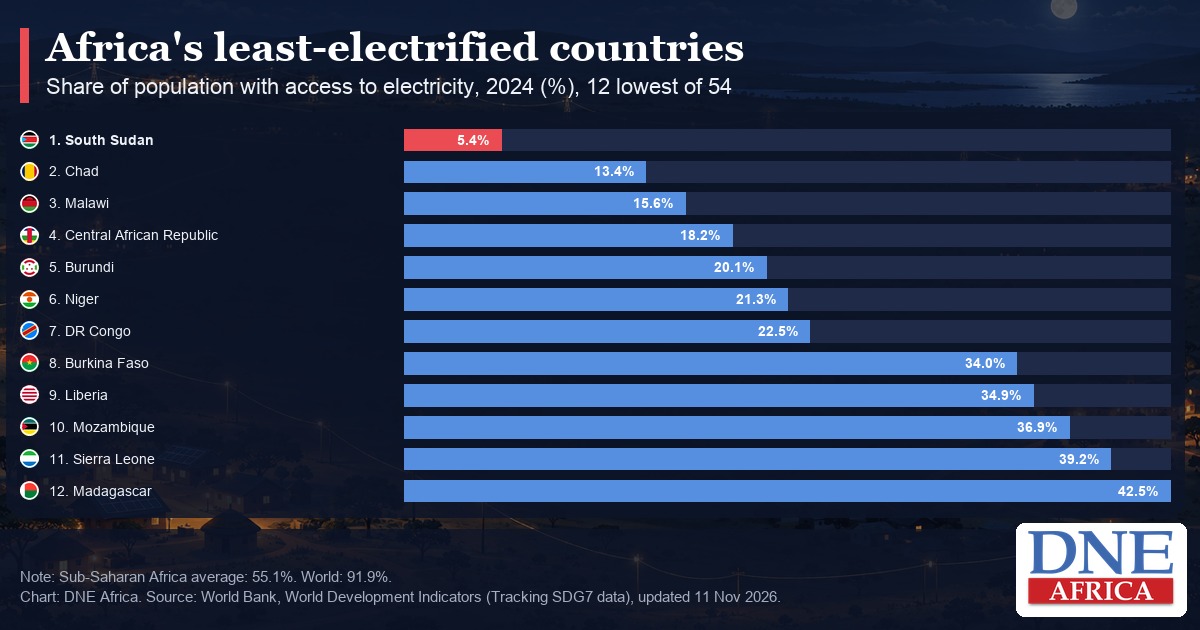

Electricity access in South Sudan reached only 5.4% of the population in 2024, the lowest of Africa’s 54 countries, according to World Bank data updated on 11 November 2026.
The figures show how far much of the continent remains from universal power: the average for sub-Saharan Africa was 55.1%, against 91.9% for the world. Chad (13.4%), Malawi (15.6%) and the Central African Republic (18.2%) follow South Sudan at the bottom of the table.
Which African countries have the lowest electricity access?
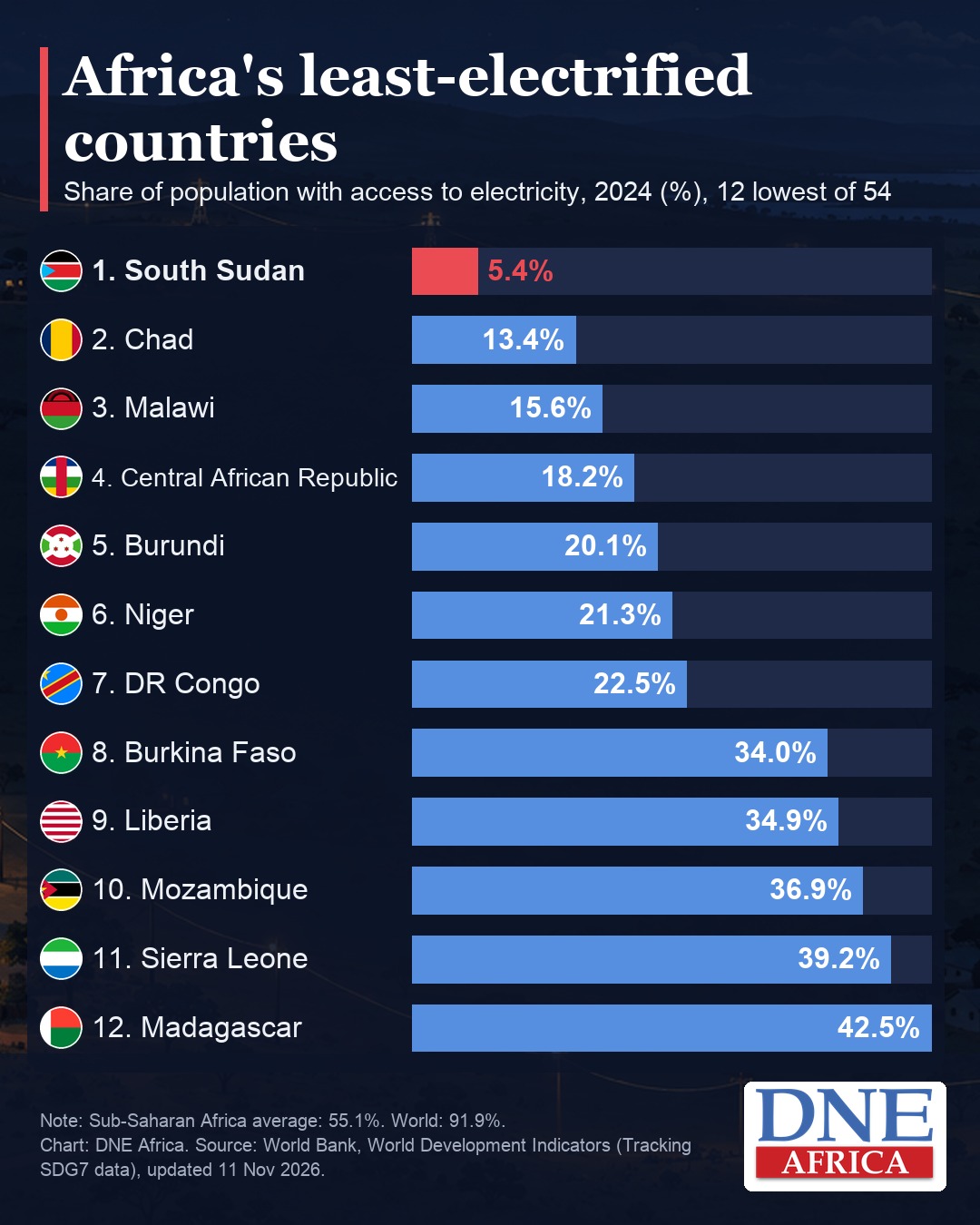
The table gives the 12 lowest figures for 2024, the latest year in the World Bank’s World Development Indicators, with 2015 for comparison.
| Rank | Country | 2024 (%) | 2015 (%) |
|---|---|---|---|
| 1 | South Sudan | 5.4 | 4.8 |
| 2 | Chad | 13.4 | 7.7 |
| 3 | Malawi | 15.6 | 10.8 |
| 4 | Central African Republic | 18.2 | 12.7 |
| 5 | Burundi | 20.1 | 7.9 |
| 6 | Niger | 21.3 | 16.6 |
| 7 | DR Congo | 22.5 | 16.6 |
| 8 | Burkina Faso | 34.0 | 16.2 |
| 9 | Liberia | 34.9 | 15.2 |
| 10 | Mozambique | 36.9 | 24.0 |
| 11 | Sierra Leone | 39.2 | 19.7 |
| 12 | Madagascar | 42.5 | 23.8 |
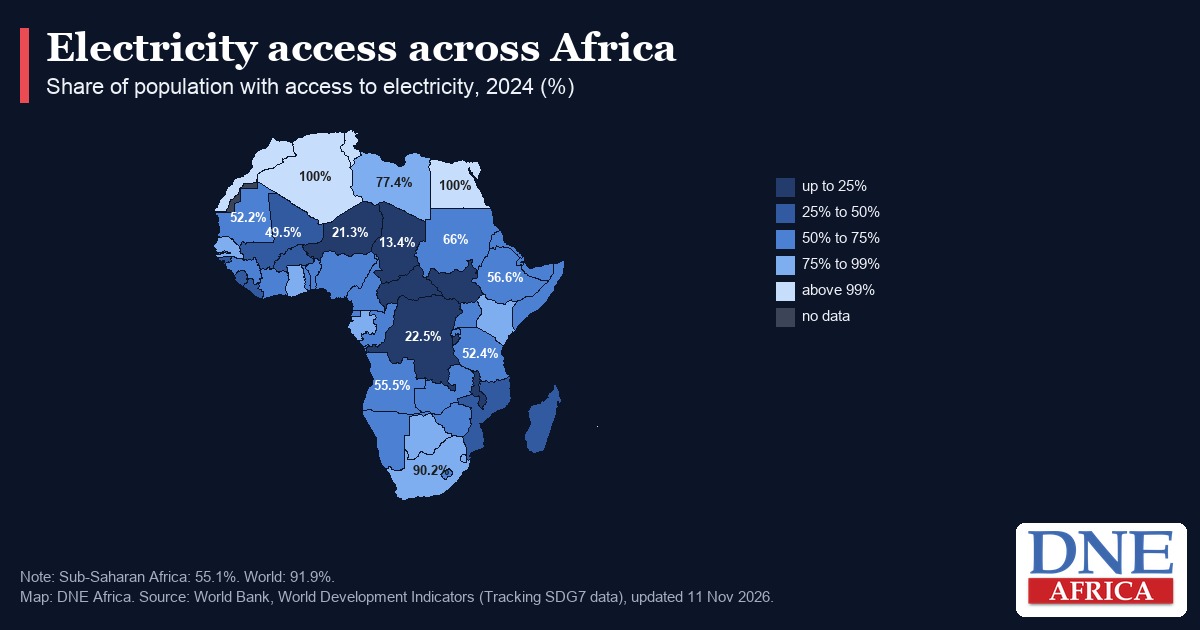
At the other end, Algeria, Egypt, Mauritius, Morocco, Seychelles and Tunisia all recorded 100% electricity access, while Cabo Verde (98.4%) and Gabon (95.1%) came close.
What does the indicator measure?
The series counts the share of people with access to electricity, from household surveys, utilities and international sources compiled for the Tracking SDG7 report on the UN goal of universal energy access by 2030. It records whether a household has a connection or an off-grid source such as solar, not how reliable or affordable that supply is, so countries with frequent outages can still score highly.
How has electricity access changed since 2015?
Progress has been uneven. Rwanda rose from 22.8% in 2015 to 72.0% in 2024 and Uganda from 18.5% to 55.3%, the World Bank figures show. South Sudan moved by less than a point, from 4.8%, and Chad remains below 15%. The sub-Saharan average climbed from 39.2% to 55.1% over the same period.
The data add to the International Energy Agency’s recent assessment of Africa’s energy access gap, and come as governments weigh the cost of supply, as in Nigeria’s debate over its electricity tariff.
FAQ
Which African country has the lowest electricity access?
South Sudan, where 5.4% of the population had access to electricity in 2024, according to the World Bank.
What is the average electricity access in sub-Saharan Africa?
It was 55.1% in 2024, up from 39.2% in 2015, compared with a world average of 91.9%.
Which African countries have universal access?
Algeria, Egypt, Mauritius, Morocco, Seychelles and Tunisia each recorded 100% in 2024.


