
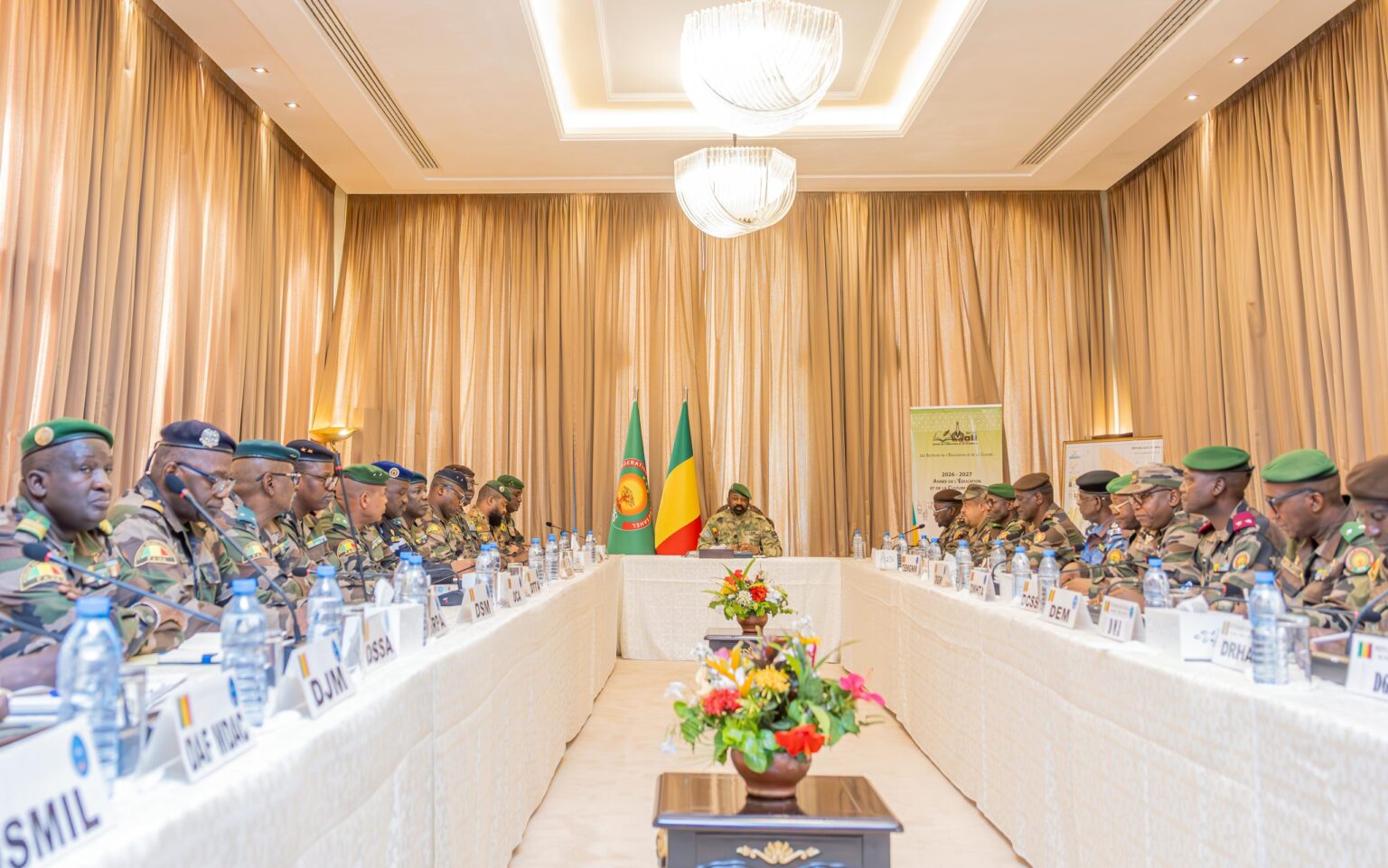

Mali army chiefs met Transitional President Assimi Goita at Koulouba Palace in Bamako on Tuesday, where he urged them to keep up operations against armed groups and strengthen the joint force of the Alliance of Sahel States (AES).
The meeting, reported by the state news agency AMAP on Wednesday, came seven weeks after the army returned to Kidal and seven months after attacks that killed the defence minister. Commanders used it to set out their own assessment of the conflict in the north and centre of the country.
What did Goita tell the Mali army chiefs?
Goita met the Mali army chiefs, the chiefs of staff of the armed forces, and the directors of the defence and security services, AMAP reported (in French). Such meetings have been held regularly since he took office and let commanders report on their units and raise concerns, the agency said.
Goita praised the progress made by the Mali army chiefs and their units and encouraged continued operations to keep up the pressure on what AMAP called “terrorist armed groups”, according to the agency.
The Minister Delegate to the Minister of Defence and Veterans Affairs, General Oumar Diarra, said the president’s guidance covered the ministry’s strategy, the military programming law, human resources, operations and co-operation with partners. Goita also stressed strengthening the unified force of the Confederation of Sahel States, which groups Mali, Burkina Faso and Niger, Diarra said.
Diarra called for preserving the gains made, “notably with the Russian Federation and within the AES”, and for keeping pressure on Mali’s enemies “until the total pacification of the national territory” (translated from French).
What did the Mali army chiefs claim about Kidal?
The Chief of General Staff of the Armed Forces, General Elisee Jean Dao, said the trend of operations was “largely positive”, citing cohesion and co-ordination in the chain of command, AMAP reported.
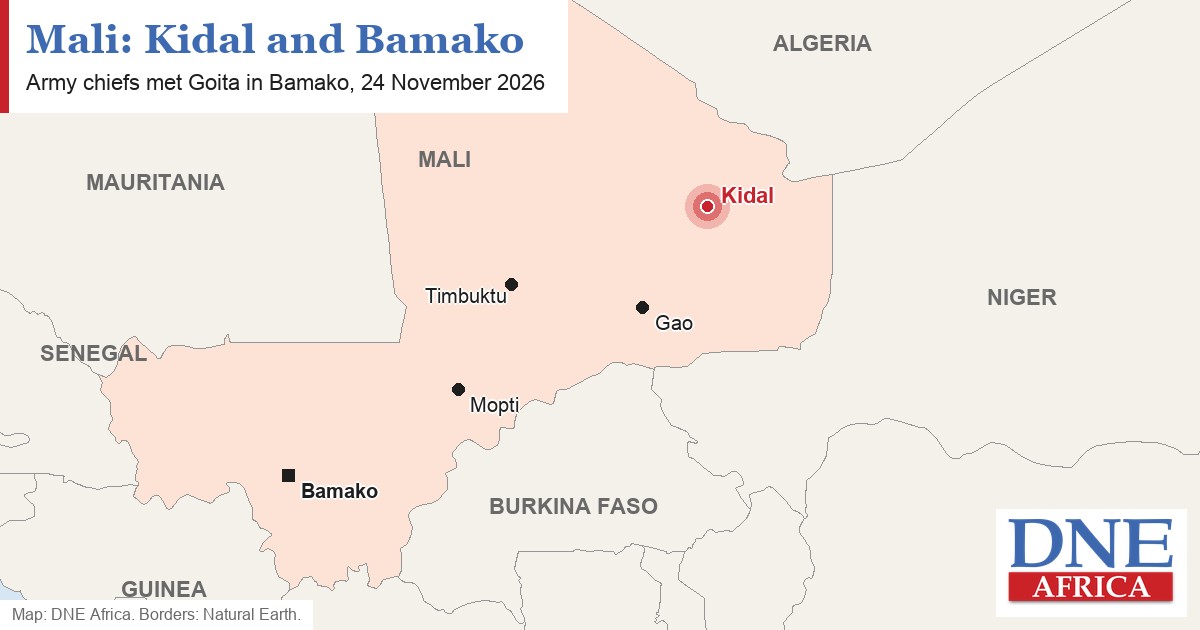
Dao recalled the attacks of 25 April 2026, in which the then Minister of Defence, General Sadio Camara, was killed. He cited fighting at Anefis in July and the advance on Kidal, which he said troops retook on 6 October in an operation named “Cram-Cram”.
The army’s return to Kidal on 6 October was reported at the time by international media. The Azawad Liberation Front (FLA), the separatist coalition that had held the town since April, said it had pulled out to spare lives and described the withdrawal as “temporary”, Al Jazeera and Arab News reported. The army’s wider claim of a “largely positive” trend could not be independently verified; access for journalists to northern and central Mali is restricted.
Why does the meeting matter?
The Mali army chiefs and the government have faced pressure on several fronts this year. The 25 April attacks hit several sites, and Kidal fell to the FLA after Malian and Russian forces withdrew from it. The Jama’at Nusrat al-Islam wal-Muslimin (JNIM), an al-Qaeda affiliate, has also disrupted fuel and goods traffic on roads into Bamako.
The International Crisis Group said this week that Sahel governments should consider talks with JNIM, an assessment set out in a report covered by DNE Africa. Mali’s government has not announced any change in its approach, and the meeting’s message, as reported by AMAP, was to keep up military pressure.
The emphasis on the AES unified force and on Russia reflects the alliances Bamako built after the army took power in 2020 and 2021, when it ended its military partnership with France and left ECOWAS with Burkina Faso and Niger. The Mali army chiefs have relied on Russia’s Africa Corps for air and ground support, including in the Kidal operation, according to the reports of October.
FAQ
Who did Goita meet on 24 November?
Mali’s transitional president met the chiefs of staff of the armed forces and the heads of the defence and security services at Koulouba Palace in Bamako, according to the state news agency AMAP.
What did the Mali army chiefs say about the war?
The Chief of General Staff, General Elisee Jean Dao, said the trend of operations was “largely positive” and cited the retaking of Kidal on 6 October. The broader claim could not be independently verified.
What is the AES unified force?
It is a joint military force of the Confederation of Sahel States, formed by Mali, Burkina Faso and Niger. Goita stressed strengthening it at the meeting, according to the defence ministry’s Minister Delegate.
Did the Mali army retake Kidal?
The army said it entered Kidal on 6 October. The Azawad Liberation Front, which had held the town since April, said it withdrew to spare lives and called the pullout temporary.


