
By using this site, you agree to the Privacy Policy and Terms of Use.
Accept
DNE Africa
  • Home
  • Politics
    Iraq oil deal: Iraqi Prime Minister Ali al-Zaidi, who visited Cairo for talks with President Sisi, file photo
    Business

    Egypt studies Iraq oil deal for 10mn barrels as Sisi hosts Zaidi

    By DNE Africa 7 Min Read
    Nigeria electricity tariff: staff in hard hats at the Egbin power station in Lagos, Nigeria's largest gas-fired plant, file photo
    Business

    Nigeria electricity tariff will not rise in 2027, power minister says

    By DNE Africa November 23, 2026
    Benghazi attacks: cranes, containers and cargo ships at the port of Benghazi, Libya, file photo
    Politics

    Libya’s east asks UN to probe Benghazi attacks and Ukrainian presence

    By DNE Africa November 23, 2026
  • Business
    Misr Life IPO: the headquarters of the Egyptian Exchange in downtown Cairo, file photo
    Business

    Egypt’s Misr Life IPO seeks up to EGP10.2bn for 15% of state insurer

    The state insurer prices its 15% offering at a discount to a…

    By DNE Africa 6 Min Read
    Nigerian industrialist Aliko Dangote
    Business
    Dangote’s $2.6bn Namibia Fuel Project Faces Hurdles
    Annaba railway: Algeria's President Abdelmadjid Tebboune at a university inauguration, in a 2025 file photo
    Business
    Algeria’s Annaba railway for phosphates due in early 2027
    Egypt Russian crude: an oil products tanker transits the Suez Canal in Egypt, in a 2011 file photo
    Business
    Egypt Russian crude imports resume with 9mn-barrel contract
    Egypt battery plant partner CATL's battery pack for commercial vehicles on display at the IAA trade fair in Hanover, 2024
    Business
    Egypt battery plant with China’s CATL to start production by mid-2027
  • Culture
  • Opinion
  • Technology
  • Sports
  • World
  • My Bookmarks
Reading: Namibia’s Twyfelfontein rock art records 2,000 years of ritual
Sign In
  • Join US
DNE AfricaDNE Africa
Font ResizerAa
  • Home
  • Politics
  • Business
  • Culture
  • Opinion
  • Technology
  • Sports
  • World
  • My Bookmarks
Search
  • Home
  • Politics
  • Business
  • Culture
  • Opinion
  • Technology
  • Sports
  • World
  • My Bookmarks
Have an existing account? Sign In
Follow US
© Foxiz News Network. Ruby Design Company. All Rights Reserved.
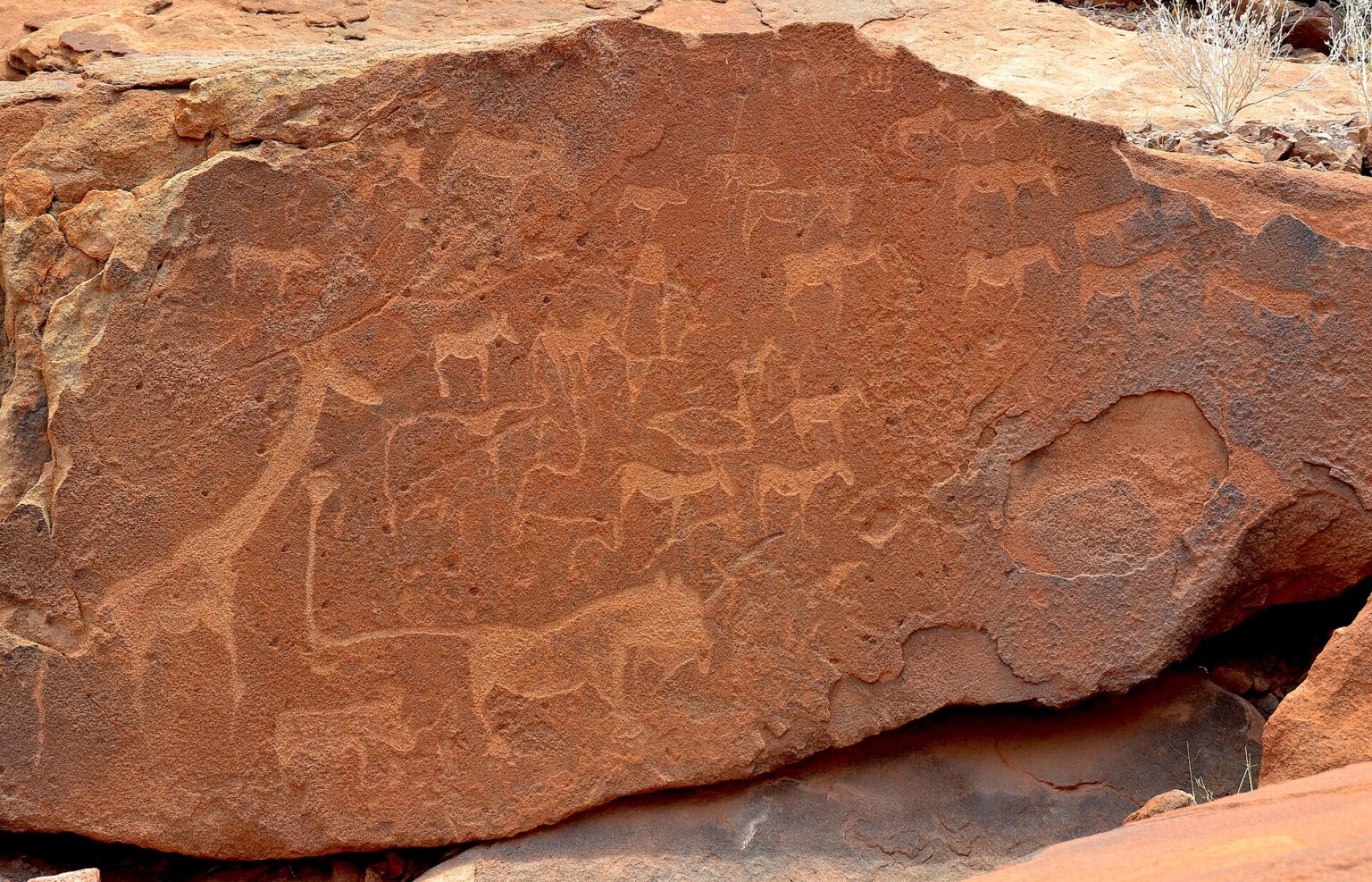
Twyfelfontein rock art: the engraved sandstone panel known as the Lion Plate, covered with giraffes and other animals, in north-west Namibia

Namibia’s Twyfelfontein rock art records 2,000 years of ritual

DNE Africa
Last updated: November 22, 2026 12:44 pm
By DNE Africa 8 Min Read
Share
The engraved panel known as the Lion Plate at Twyfelfontein, 2014. Photo: Olga Ernst / Wikimedia Commons, CC BY-SA 4.0
SHARE

Twyfelfontein rock art in north-west Namibia holds one of Africa’s largest concentrations of rock engravings, a record of hunter-gatherer ritual that UNESCO says spans at least 2,000 years.

Contents
What is Twyfelfontein rock art?Who made the engravings, and why?How did the site get its name?How is Twyfelfontein rock art protected today?FAQWhere is Twyfelfontein rock art?How old is Twyfelfontein rock art?When did Twyfelfontein become a UNESCO World Heritage site?Can visitors see Twyfelfontein rock art on their own?

The site in the Kunene region, also known by its local name /Ui-//aes, became Namibia’s first UNESCO World Heritage site in 2007. It has more than 2,000 engravings and paintings, according to Encyclopaedia Britannica. Namibia’s only other World Heritage site, the Namib Sand Sea, was added in 2013.

What is Twyfelfontein rock art?

Most of the engravings show rhinoceros, elephant, ostrich and giraffe, along with drawings of human and animal footprints, according to UNESCO’s World Heritage listing. The site also has six painted rock shelters with human figures in red ochre. Objects excavated from two areas date from the Late Stone Age.

Britannica says Twyfelfontein rock art covers 235 separate rock surfaces on boulders along a west-facing slope of Namibia’s escarpment. Giraffes make up about 40% of all the engravings. Zebra, oryx, ostrich and cattle also appear often, while human figures are rare among the engravings. In the painted shelters the balance is reversed, and people dominate.

Two techniques were used, Britannica says. Most engravings were made by pecking at the rock surface with harder stones or stone hammers. Others were made by grinding and polishing the surface with small hard rocks. The variety suggests that several generations added to the panels over time.
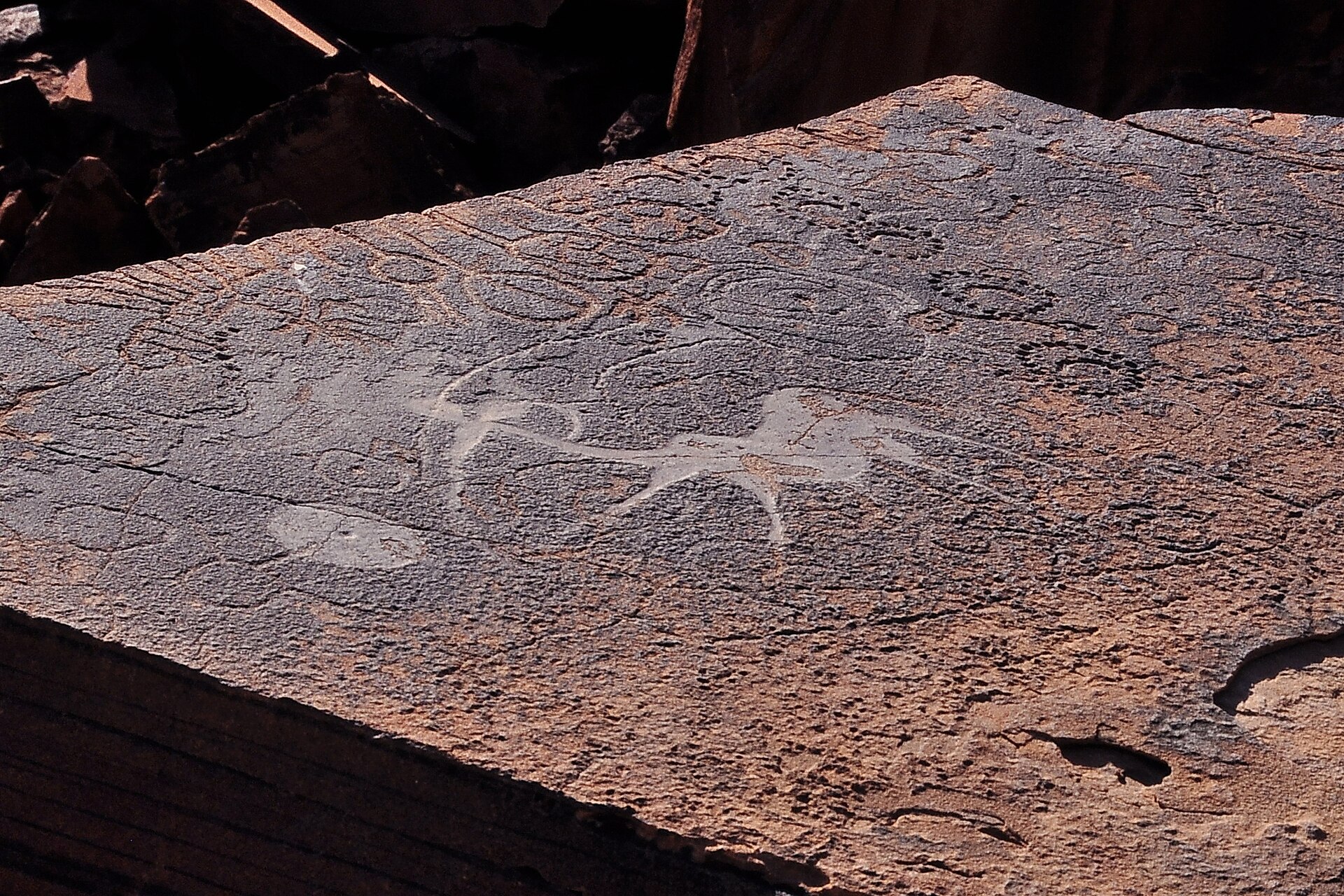
Twyfelfontein rock art: the engraving known as the Dancing Kudu, a kudu figure surrounded by circles carved into a dark sandstone slab in Namibia
The engraving known as the Dancing Kudu, 2012. Photo: Schnobby / Wikimedia Commons, CC BY-SA 3.0

Who made the engravings, and why?

UNESCO describes Twyfelfontein rock art in the core area, both engravings and paintings, as the work of San hunter-gatherers who lived in the region long before Damara herders and, later, European colonists arrived. Britannica dates the arrival of Damara pastoralists to about 1000 CE.

Britannica says the animals may relate to rituals, or may show people transforming into animals during them. One of the best-known engravings, a pregnant kudu known as the “Dancing Kudu”, was probably linked to rituals performed by women, it says.

The area gets less than 150mm of rain a year and lies between savanna and semi-desert, so its spring made it a gathering place, Britannica says. UNESCO’s listing goes further: it reads the art as evidence that hunter-gatherers held land near a reliable water source to be sacred, linking their rituals to their economic life.

Stone tools and other artefacts excavated from three of the painted shelters date from about 5,850 to about 370 years before the present, according to Britannica.

How did the site get its name?

Twyfelfontein means “doubtful spring” in Afrikaans. Britannica says the name came from David Levin, a settler granted the land in the 1940s, who doubted that the spring could supply enough water. Levin showed the engravings to Ernst Rudolf Scherz, a German-born rock art researcher, whose efforts led to the core area being declared a national monument.

Sources differ on the date: UNESCO gives 1948, Britannica 1952. The older name, /Ui-//aes, was given by the Damara people. Britannica translates it as “place among rocks”, while Namibian.org renders it as “jumping spring”.
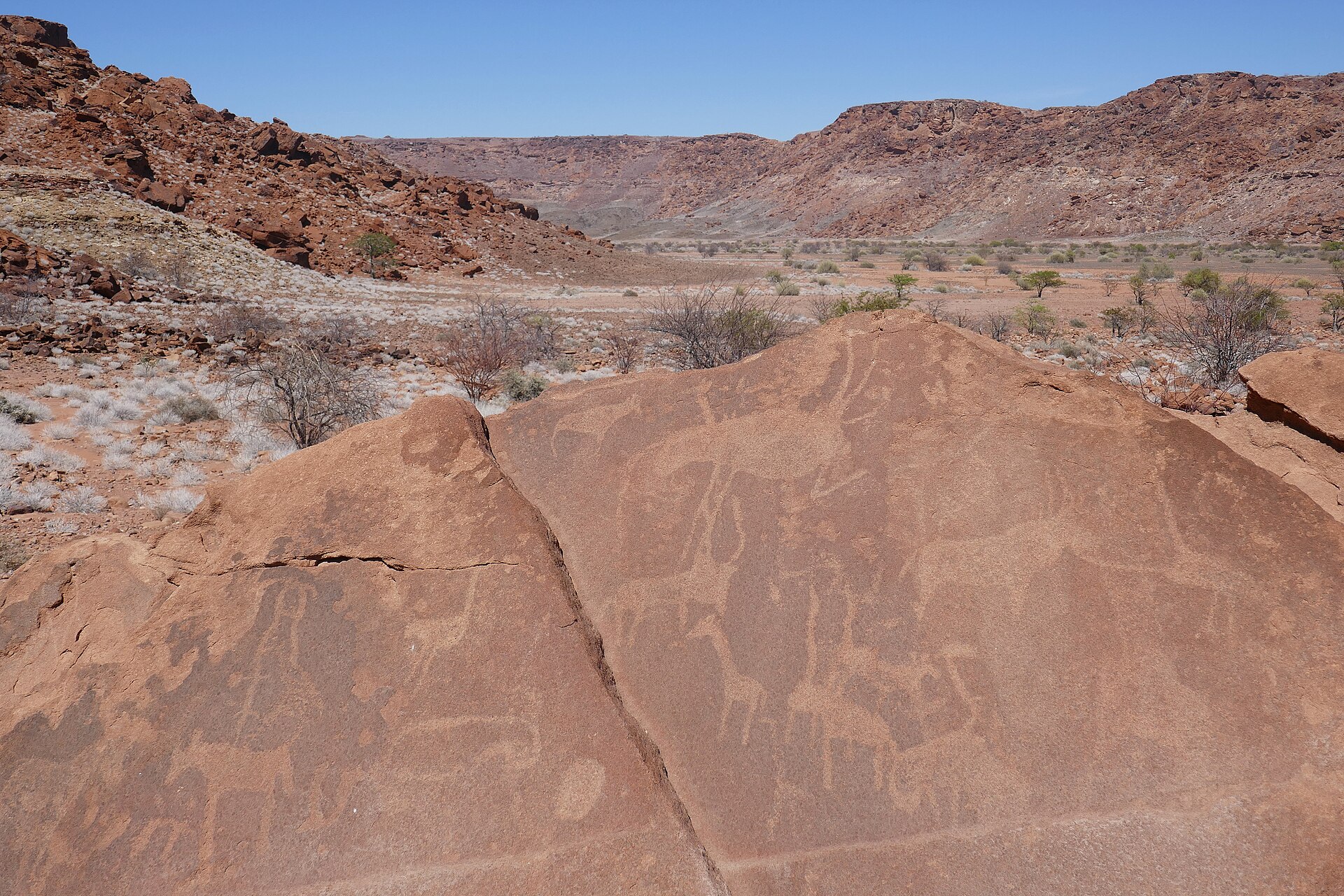
Twyfelfontein rock art: animal engravings on sandstone boulders on the slope at Twyfelfontein in Namibia's Kunene region
Engraved boulders at Twyfelfontein, 2016. Photo: Ji-Elle / Wikimedia Commons, CC BY-SA 4.0

How is Twyfelfontein rock art protected today?

The core area holding Twyfelfontein rock art covers about 57 hectares, with a buffer zone of about 9,194 hectares, according to UNESCO. The site is protected by Namibia’s National Heritage Act of 2004 and managed by the National Heritage Council. A management plan has been in force since 2005, and UNESCO says the state of conservation has improved, particularly in how visitors are managed.

A lodge built in the buffer zone in 1999-2000 at the Seremonienplatz engraving site “severely compromised” the engravings in that area, UNESCO says. Britannica notes that national monument status came without site management, and that unregulated tourism in the following decades led to vandalism, theft and damage.

The main engraving sites can be visited only on guided tours, with fees set each year by the National Heritage Council, Namibian.org reported. The site belongs to a wider group of southern African rock art sites on the World Heritage List, including Tsodilo in Botswana, Matobo Hills in Zimbabwe and uKhahlamba-Drakensberg in South Africa. In South Africa, DNE Africa has covered the return of South Africa’s Mapungubwe gold rhino, and Namibia’s coast has its own archaeology, as a 16th-century shipwreck found there showed.

FAQ

Where is Twyfelfontein rock art?

It is in the Kunene region of north-west Namibia, about 90km west of the town of Khorixas, according to Britannica.

How old is Twyfelfontein rock art?

UNESCO says the art records hunter-gatherer ritual over at least 2,000 years. Artefacts from the painted shelters date from about 5,850 to about 370 years ago, according to Britannica.

When did Twyfelfontein become a UNESCO World Heritage site?

It was inscribed in 2007, making it Namibia’s first World Heritage site.

Can visitors see Twyfelfontein rock art on their own?

No. The main engraving sites are visited on guided tours, and the National Heritage Council sets the fees each year, Namibian.org reported.


You Might Also Like

Algeria’s Timgad shows how Rome planned a city in 100 CE

The Cairo Trilogy lingers on Egypt’s 1919 and races through the 1930s

Things Fall Apart is read worldwide but off Nigeria’s exam list

Kenyan scholars join Sufism International Association in Cairo

Brazzaville’s Poto-Poto School of painting turns 75

TAGGED:ArtNamibia
Share This Article
Facebook Twitter Pinterest Whatsapp Whatsapp LinkedIn Reddit Telegram Email Copy Link

You Might Also Like

Lamu Old Town: donkeys carrying sacks along Usita wa Mui, the narrow main street of Kenya's Swahili island town
Culture

Kenya’s Lamu Old Town marks 25 years as a UNESCO World Heritage Site

By DNE Africa 8 Min Read
Highlife music: Ghanaian guitarist Ebo Taylor singing and playing electric guitar on stage with his band in 2017
Culture

Ghana’s highlife music nears its first year on UNESCO’s heritage list

By DNE Africa 8 Min Read
Apse domes of the Great Church of Jesus during excavation at Old Dongola, Sudan
CultureInsider

Exclusive: Sudan’s Great Church of Jesus shows medieval Nubia’s might

By Ahmed Emam 18 Min Read

More Popular from DNE AFRICA

Benghazi attacks: cranes, containers and cargo ships at the port of Benghazi, Libya, file photo
Politics

Libya’s east asks UN to probe Benghazi attacks and Ukrainian presence

By DNE Africa 8 Min Read
Lubumbashi march: worshippers outside Saints-Pierre-et-Paul cathedral, the Catholic Church's planned gathering point in Lubumbashi, DR Congo, file photo

DR Congo police block Lubumbashi march by Catholic Church

By DNE Africa
Iraq oil deal: Iraqi Prime Minister Ali al-Zaidi, who visited Cairo for talks with President Sisi, file photo
Business

Egypt studies Iraq oil deal for 10mn barrels as Sisi hosts Zaidi

By DNE Africa 7 Min Read
Ad imageAd image
Entertainment

Ghana rapper Kweku Smoke holds nine of Apple Music’s top 20 songs

Songs from the rapper's album No Days Off still lead Ghana's Apple Music chart almost 12…

By DNE Africa
Sports

Algeria’s Amine Gouiri reaches 100 goals as Marseille lose to Le Mans

Algeria forward Amine Gouiri reached 100 career goals against Le Mans, but Marseille let a 2-0…

By DNE Africa
Sports

Ghana beat Morocco to win first Amputee World Cup in all-African final

Ghana's Black Challenge beat Morocco 1-0 in Mexico to become the second African winners of the…

By DNE Africa
Technology

OpenAI perplexity proposal would set shared limits on AI progress

OpenAI's chief scientist wants AI labs to agree limits on model progress measured by perplexity, and…

By DNE Africa
Technology

Memory chip shortage pushes South African PC prices up, Mustek says

South African distributor Mustek sold fewer computers at higher prices as AI data centres absorbed memory…

By DNE Africa
DNE Africa

News by Africans, For Africans

Categories

  • Science
  • Health
  • Entertainment
  • Business
  • The Escapist

Quick Links

  • Advertise with us
  • Newsletters
  • Complaint
  • Deal

DNE Africa.All Rights Reserved.

Welcome Back!

Sign in to your account

Username or Email Address
Password

Lost your password?