
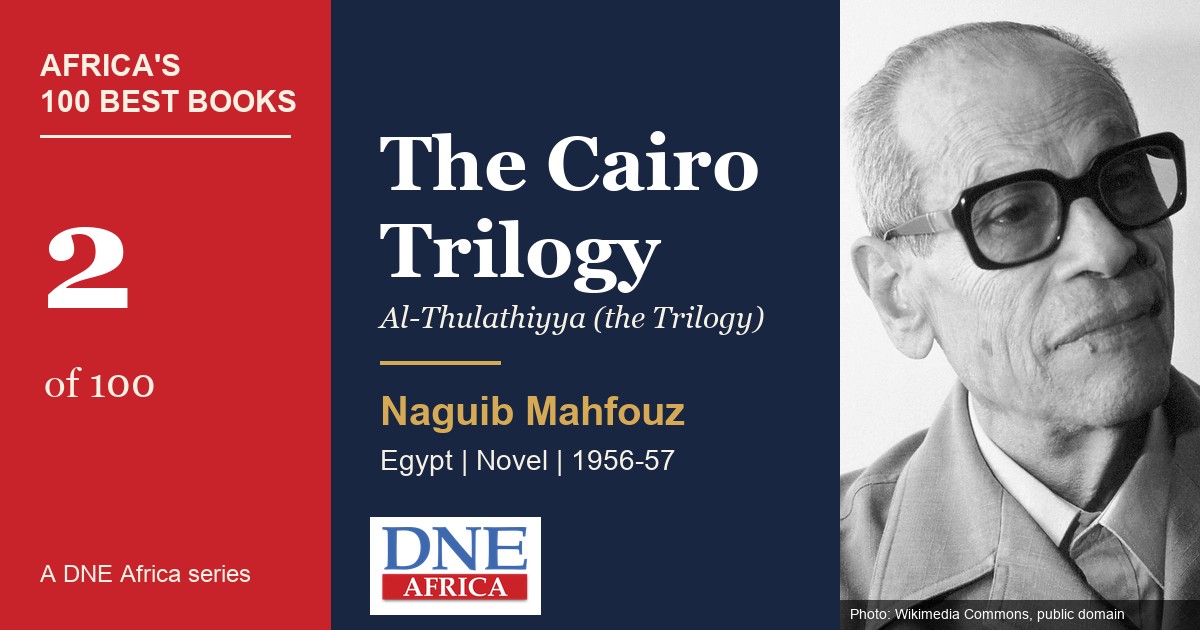

The Cairo Trilogy, the three novels Egypt’s Naguib Mahfouz published in 1956 and 1957, spends 136,000 words on 18 months before the 1919 revolution and 79,000 on nine years from 1935.
Africa’s 100 Best Books, No. 2 of 100. See the full list and every article in the series.
That imbalance is the key to The Cairo Trilogy. Mahfouz lingers inside one house while the old order holds, then lets the years run as it breaks up. The standard account is well known: The Cairo Trilogy made Mahfouz the leading Arabic novelist of his age, he became the first Arabic-language writer to win the Nobel Prize in Literature in 1988, and the jury that chose Africa’s 100 best books in 2002 placed it in its top 12, according to the African Studies Centre Leiden. The novels were first published by Maktabat Misr in Cairo and appeared in English between 1990 and 1992, according to Britannica and Penguin Random House.
This review is based on a reading of the Arabic text in the free edition of the Hindawi Foundation, issued in 2022 under an agreement with Mahfouz’s family. Word counts are Hindawi’s own; chapter references are to that edition.
Table of Contents
In this article
What is The Cairo Trilogy about?
The Cairo Trilogy follows the family of al-Sayyid Ahmad Abd al-Jawad, a prosperous merchant in the old quarter of Gamaliya, across three generations. Each volume takes its name from a Cairo street: Bayn al-Qasrayn (Palace Walk), Qasr al-Shawq (Palace of Desire) and al-Sukkariyya (Sugar Street).
At home al-Sayyid Ahmad is a stern patriarch whom his wife Amina addresses as her master; at night he is a genial drinker, singer and lover in the city’s houses of entertainment. Amina, married before she was 14, waits up for him every night. Their children are Yasin, his son by an earlier marriage; Fahmy, a law student drawn into nationalist politics; the daughters Khadija and Aisha; and Kamal, the youngest, who becomes the trilogy’s thinking centre.
Palace Walk opens in October 1917, a day after the death of Sultan Hussein Kamel, with the war in its third year and Australian soldiers in the streets (chapter two), and builds towards the revolution of 1919. Palace of Desire moves to the mid-1920s and Kamal’s student years. Sugar Street runs from 1935 into the Second World War, when Kamal remarks that one of his sister’s sons has joined the Muslim Brotherhood and the other the communists (chapter 23).
How does The Cairo Trilogy handle time?
The three volumes of The Cairo Trilogy shrink as the years they cover grow. Hindawi’s edition counts 136,260 words in Palace Walk, 115,196 in Palace of Desire and 78,792 in Sugar Street. The first covers about 18 months, ending after the celebrations of April 1919 (chapter 69); the last covers about nine.
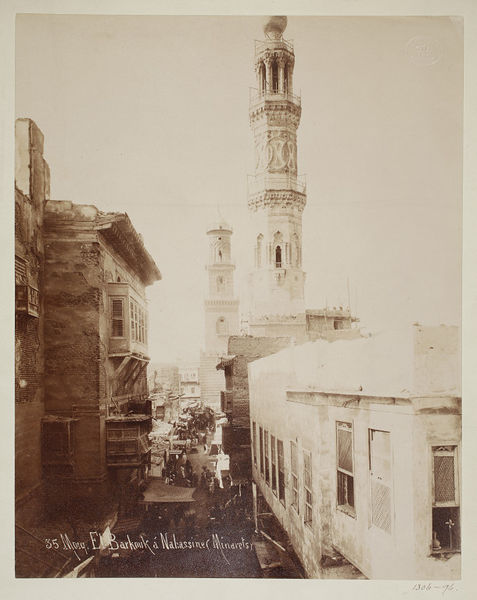
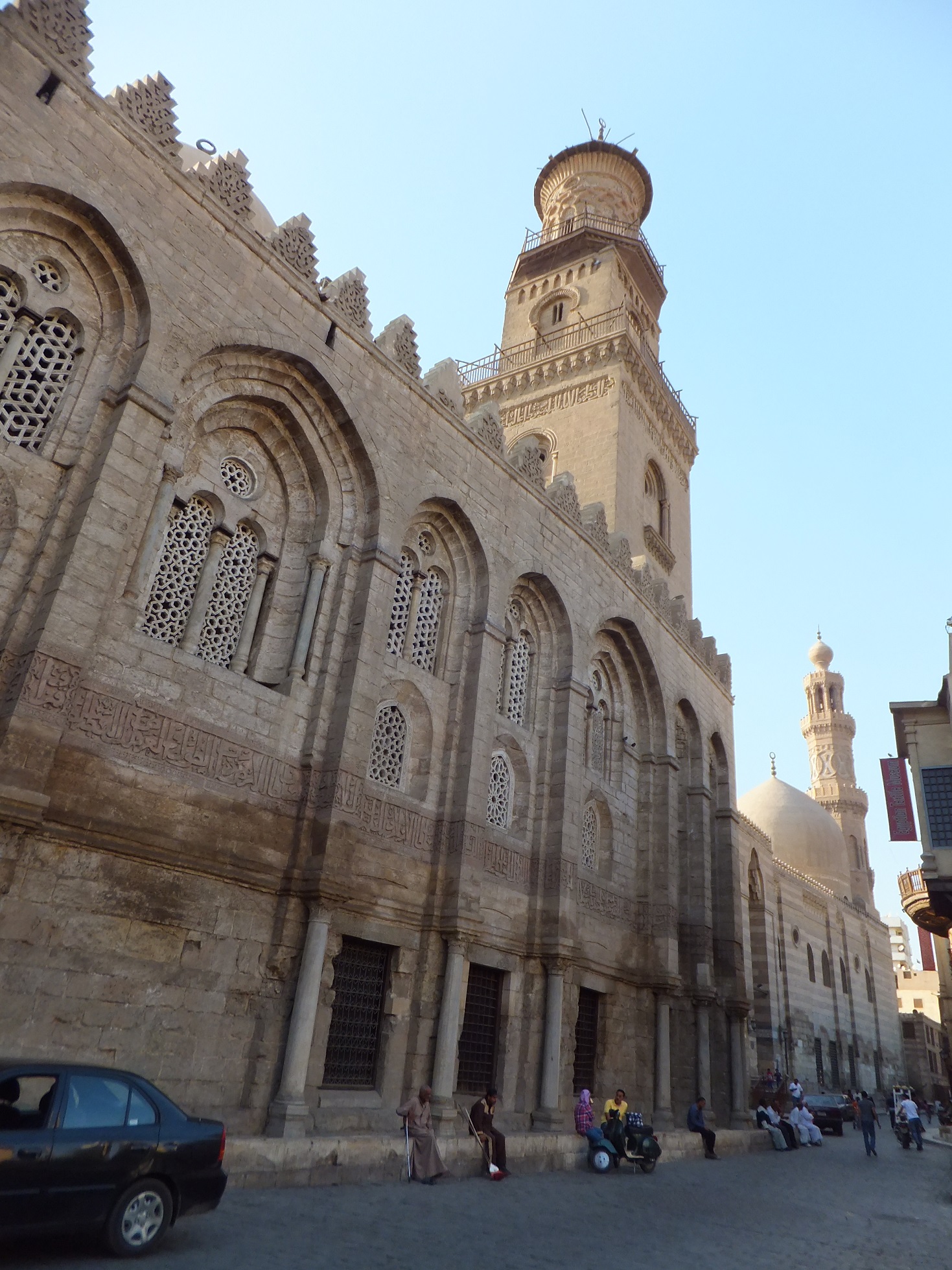
Read in Arabic, the slow first volume is not padding. It is how Mahfouz shows a closed world. The novel opens at midnight with Amina waking, unaided, to wait for her husband, then standing in the latticed mashrabiya above the street. From there she sees the sabil of Bayn al-Qasrayn, the junction with al-Nahhasin street and the minarets of Qalawun and Barquq, a view, the narrator says, she has known for a quarter of a century (chapter one). The book makes the reader live at her pace.
When her husband travels to Port Said, her stepson Yasin urges her out to the shrine of al-Husayn, a short walk away, mocking the quarter “you have lived in for 40 years without seeing anything of it” (chapter 27). The narrator says the whole family joined, without knowing it, in a revolt against the father’s will. The national revolt follows only 26 chapters later.
By Sugar Street the pace has changed. It opens in a January cold, with Amina not yet 60 but looking ten years older, an electric bulb where the gas lantern hung, and the family’s coffee hour moved downstairs because al-Sayyid Ahmad’s heart can no longer manage the stairs. Whole years now pass in a paragraph.
What do Egyptian critics say about The Cairo Trilogy?
The first great Egyptian verdict came from Taha Hussein. In a review for the newspaper al-Gumhuriya, collected in his book Min Adabina al-Mu’asir (From Our Contemporary Literature), he called Palace Walk “the most splendid Egyptian fiction I have read since Egyptians began writing fiction” (our translation from Arabic). He credited two qualities: a unity that never slips and a variety that keeps boredom away. He also praised the language: neither colloquial nor archaic, but a pure “middle” Arabic that even listeners who could not read would follow if it were read aloud to them.
Later critics turned to Kamal. The Egyptian critic and translator Maher El-Battouty, in an essay in his book Riwayat wa Riwa’iyyun min al-Sharq wa al-Gharb, reads him through Colin Wilson’s idea of “the outsider”. On this reading Kamal is first a man who belongs, to his faith, his politics and his love for Aida Shaddad, and his loss of each ideal pushes him into doubt. In Palace of Desire, after writing on evolution, Kamal says his religion has gone “as al-Husayn’s head went, as Aida went, as my confidence in myself went” (chapter 33). The head refers to the relic that, by tradition, lies in the Cairo shrine.
That shrine runs through The Cairo Trilogy, as the Egyptian writer Mahmoud Khalil noted in El Watan in 2022: Amina’s visit, her prayers there in Sugar Street, the old friends’ evening prayers at the mosque. He reads it as part of the tolerant, Sunni devotion to the Prophet’s family that Mahfouz knew from his childhood near al-Husayn.
Spoiler (the end of Palace Walk): a reading of both volumes adds a turn to Khalil’s point. In Palace Walk, Amina’s one trip to al-Husayn without permission costs her dearly. In Palace of Desire, Kamal tells her she may now visit the shrine whenever she likes, because his father has loosened her chains; she thinks that she would rather have stayed as she was and kept the son she lost (chapter 15). Her freedom is the price of Fahmy’s death in 1919.
How is The Cairo Trilogy read in Egypt today?
Since 2022 anyone with a phone can read The Cairo Trilogy in Arabic free and legally. The Hindawi Foundation signed with Mahfouz’s family in 2021 to publish his works on its website and app, Al Jazeera reported, and began uploading them in 2022, starting with al-Harafish and then Palace Walk, Masrawy reported. Mahfouz’s daughter Umm Kulthum told El Watan she was happy to see her father’s work online and free.
Many Egyptians first met the family on screen. Hassan al-Imam filmed the three novels in 1964, 1967 and 1973, with Yehia Chahine as al-Sayyid Ahmad, according to Masrawy and Al-Jarida. In 2019 the Ministry of Culture opened a Naguib Mahfouz museum in the Tekiyya of Muhammad Bey Abu al-Dahab, near his birthplace, Al Jazeera and Youm7 reported.
Who was Naguib Mahfouz?
Mahfouz was born on 11 December 1911 in Gamaliya, the quarter of the trilogy, and saw the 1919 revolution as a boy of eight, according to his Hindawi biography and Britannica. He studied philosophy at the Egyptian University, worked for decades as a civil servant and published his first novel, Abath al-Aqdar, in 1939. He survived a knife attack in 1994 that weakened his writing hand, and died in Cairo on 30 August 2006.
In English the trilogy is the work of four translators: William Maynard Hutchins with Olive E. Kenny (Palace Walk, 1990), with Lorne M. Kenny and Olive E. Kenny (Palace of Desire, 1991), and with Angele Botros Samaan (Sugar Street, 1992). The single-volume Everyman’s Library edition carries an introduction by the Egyptian critic Sabry Hafez.
Read today, The Cairo Trilogy is strongest where Taha Hussein said it was: in its people, above all al-Sayyid Ahmad, whose two lives are drawn without judgment, and Amina, whose confinement is shown, not lectured on. It is weakest in Kamal’s long passages of argument in the second and third volumes, which can read like essays, and the late chapters on the grandsons’ politics move fast after the slow, rich start. That trade is the design of The Cairo Trilogy.
Questions for discussion
- Palace Walk gives 136,000 words to 18 months; Sugar Street gives 79,000 to nine years. What does each pace let Mahfouz show?
- Al-Sayyid Ahmad is a tyrant at home and a charmer outside. Does the novel judge him, and do his children?
- Amina watches the street through a lattice for 25 years. How does her world widen across the trilogy, and at what cost?
- Taha Hussein praised the book’s “middle” Arabic. What is gained, and what is lost, when it is read in English?
- Kamal loses his faith, his love and his certainties. Is he the trilogy’s hero, its conscience or its warning?
- One grandson joins the Muslim Brotherhood, the other the communists. What does Mahfouz suggest about where Egypt was heading in the 1940s?
Read next in the series
- Things Fall Apart, No. 1: Chinua Achebe’s novel of an Igbo clan as colonial rule arrives.
- Zayni Barakat, No. 50: Gamal al-Ghitani’s novel of Mamluk Cairo, set in the same old city.
- Season of Migration to the North, No. 62: Tayeb Salih’s Sudanese novel of a village and a man shaped by Britain.
More from Africa’s 100 Best Books
- Previous, No. 1: Things Fall Apart by Chinua Achebe (Nigeria)
- Next, No. 3: So Long a Letter by Mariama Bâ (Senegal) (coming next in the series)
- All 100 books in the series
FAQ
What is The Cairo Trilogy?
Three linked novels by Naguib Mahfouz, Palace Walk (1956), Palace of Desire (1957) and Sugar Street (1957), following a Cairo merchant’s family from 1917 into the Second World War.
Can The Cairo Trilogy be read free in Arabic?
Yes. The Hindawi Foundation has published all three volumes free online since 2022 under an agreement with Mahfouz’s family.
In what order should The Cairo Trilogy be read?
Palace Walk first, then Palace of Desire, then Sugar Street. Each continues the story of the same family.
Who translated The Cairo Trilogy into English?
William Maynard Hutchins, with Olive E. Kenny, Lorne M. Kenny and Angele Botros Samaan. The English volumes appeared between 1990 and 1992.


