
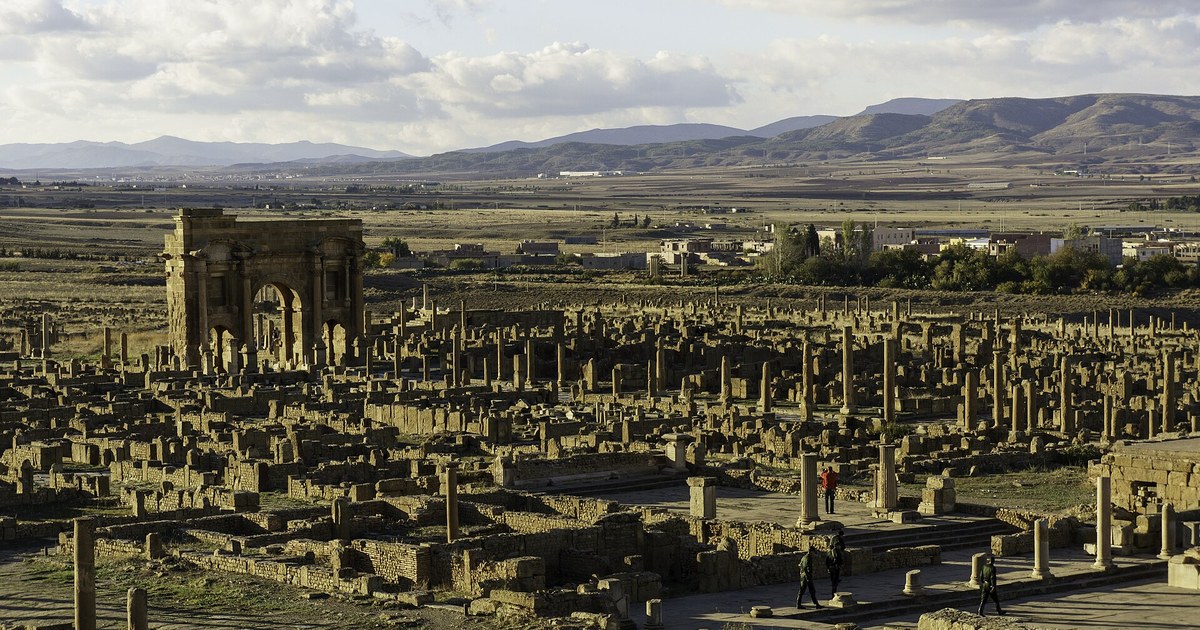

Timgad, a Roman city founded by the emperor Trajan in 100 CE on the high plateau of north-eastern Algeria, is one of the most complete surviving examples of how Rome laid out a town from nothing.
The ruins lie in Batna province, on the northern slopes of the Aurès mountains, 480km south-east of Algiers and 110km south of Constantine. UNESCO added the site to its World Heritage List in 1982. Encyclopaedia Britannica describes the remains as the most thoroughly excavated and best preserved of any Roman site in North Africa.
What is Timgad?
The city’s full Roman name was Colonia Marciana Traiana Thamugadi. Trajan founded it as a military colony, probably as an encampment for the Third Augustan Legion, which was later quartered at nearby Lambaesis, according to UNESCO’s World Heritage listing. Britannica says the town proved strategically important in the defence of Numidia, the Roman-era region that covered much of what is now northern Algeria.
The original town at Timgad was a square enclosure divided by two main streets that met at right angles, the cardo running north to south and the decumanus running east to west. UNESCO calls the layout an example of Roman urban planning “at its height”, and the outline is still plain to see from the hills above the site.
Between 10,000 and 15,000 people lived there, by Britannica’s estimate. The town owed its long prosperity to the fertile land around it.
What can still be seen at Timgad?
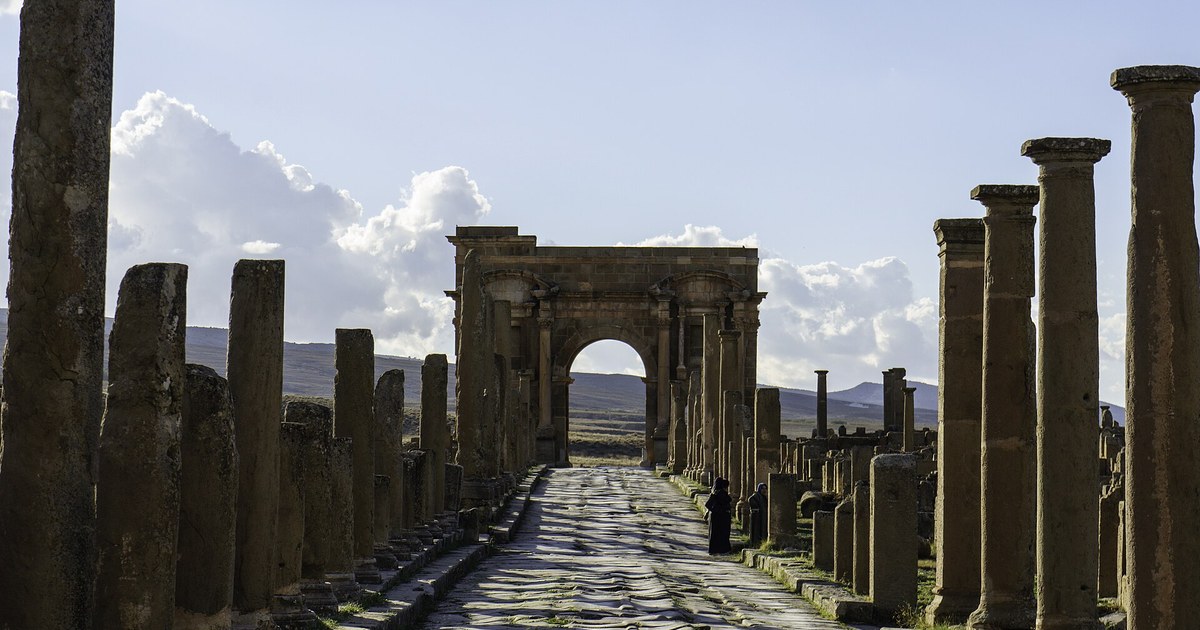
The streets are paved with large rectangular limestone slabs, and the buildings were made entirely of stone. At the western end of the decumanus stands the arch named after Trajan, which UNESCO says was restored in the middle of the second century.
By the middle of the second century the city had outgrown its walls. New districts went up outside the original square, and several of the largest public buildings were built there: the Capitol, temples, markets and baths. Most date from the Severan period in the late second and early third centuries, which UNESCO describes as the city’s golden age.
Britannica lists a forum, a public library from the fourth century and a theatre that could hold about 4,000 people. It also notes an unusually large number of public baths, and UNESCO counts 14 that are still visible. The larger houses had mosaic floors, which UNESCO says were meant to make up for the lack of fine marble in the region.
Why was the city abandoned?
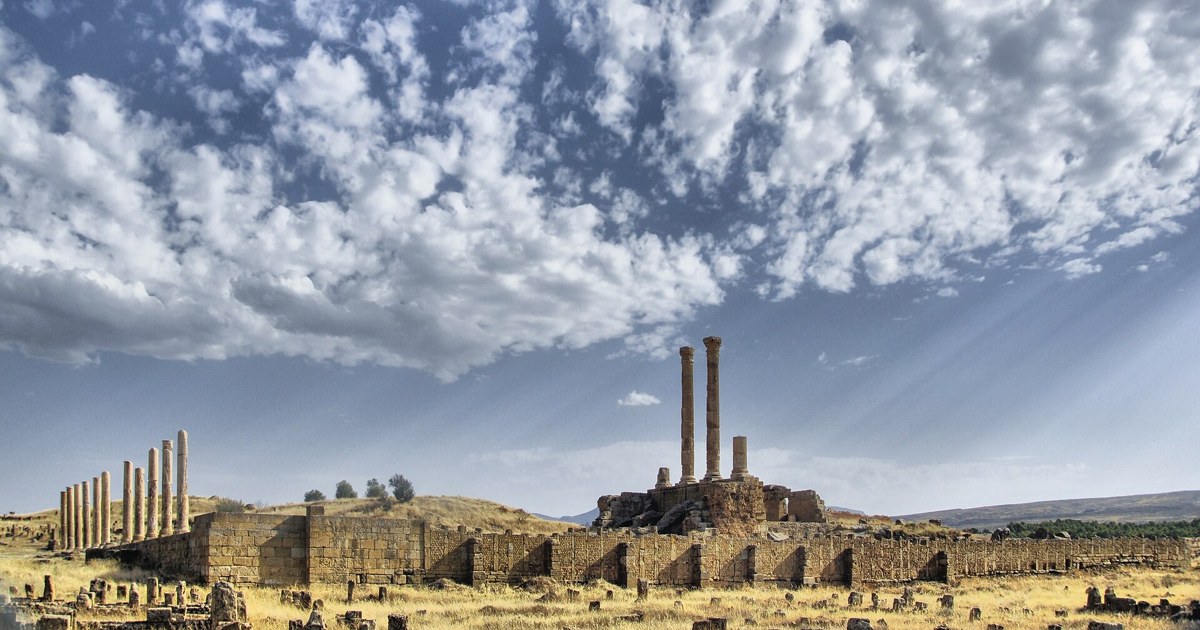
Timgad stayed prosperous for about three centuries, and in the Christian period it was the seat of a well-known bishop. Its decline began in the fifth century. UNESCO says that after the Vandals arrived in North Africa in 430 the city was destroyed, at the end of that century, by people from the Aurès mountains. Britannica dates the sack to the early sixth century.
The Byzantine empire brought some life back. In 539 its forces built a fortress south of the town, reusing blocks taken from Roman monuments. The recovery did not last, and UNESCO says the city ceased to be inhabited after the eighth century.
So much survives because nobody built over it. Archaeologists excavated the site almost without a break from 1881 to 1960, and UNESCO says the long abandonment spared the ancient city from modern construction.
How is Timgad protected today?
The World Heritage property covers 90.54 hectares in the commune of Timgad. It is managed by Algeria’s National Office for the Management and Exploitation of Protected Cultural Property (OGEBC), a public body under the Ministry of Culture and Arts, working with the provincial culture directorate. Algeria’s 1998 law on the protection of cultural heritage applies, along with a protection and presentation plan for the site.
UNESCO’s listing says the ruins have been structurally stable and that earthquakes and weather have not damaged them. Visitors have done more harm: an annual cultural festival once held among the ruins brought crowds, vehicles, graffiti and litter, the listing says, and the culture ministry moved the festival’s events outside the site.
Algeria has told UNESCO that the rules for the site need revising, the listing adds.
Timgad is one of seven World Heritage sites in Algeria listed by Britannica. The others include the Roman town of Djémila, the coastal ruins of Tipasa, the Kasbah of Algiers, the M’Zab Valley and the rock art of Tassili n’Ajjer. Elsewhere in North Africa, DNE Africa has written about Morocco’s Ksar of Ait Benhaddou, and on the East African coast about Kenya’s Lamu Old Town.
FAQ
Where is Timgad?
It is in Batna province in north-eastern Algeria, on the northern slopes of the Aurès mountains, 480km south-east of Algiers, according to UNESCO.
Who founded Timgad, and when?
The Roman emperor Trajan founded it in 100 CE as a military colony named Colonia Marciana Traiana Thamugadi.
When did the site join the UNESCO World Heritage List?
It was inscribed in 1982. The protected property covers 90.54 hectares.
Why is the city so well preserved?
It was abandoned after the eighth century and never built over. Excavations ran almost continuously from 1881 to 1960, UNESCO says.


