
By using this site, you agree to the Privacy Policy and Terms of Use.
Accept
DNE Africa
  • Home
  • Politics
    TPLF Presses Tadesse Worede to Step Down Amid Escalating Tigray Power Struggle
    Politics

    TPLF Presses Tadesse Worede to Step Down Amid Escalating Tigray Power Struggle

    By Taha Sakr 3 Min Read
    Fano Claims Gains in Attack Near Bahir Dar as Fighting Intensifies in Amhara
    Politics

    Fano Claims Gains in Attack Near Bahir Dar as Fighting Intensifies in Amhara

    By Taha Sakr May 2, 2026
    Fano Denies Mass Surrender Claims as Amhara Conflict Grinds On
    Politics

    Fano Denies Mass Surrender Claims as Amhara Conflict Grinds On

    By Taha Sakr May 2, 2026
  • Business
    Mahmoud Mohieldin: Africa’s share of global FDI does not exceed 6%
    Business

    Mahmoud Mohieldin: Africa’s share of global FDI does not exceed 6%

    Dr Mahmoud Mohieldin, Chair of the African Advisory Council to the G-FAFS,…

    By DNE Africa 2 Min Read
    climate shocks vulnerability
    BusinessScience
    Climate Change Could Deepen Food Crisis in East Africa by 2050
    WhatsApp Image 2026 02 02 at 4.01.57 PM
    BusinessHealth
    Takeda hosts regional summit in Cairo to improve care for rare hereditary angioedema
    omega 1 130922 cakuo
    BusinessScienceTechnology
    Heat and Dust Are Cutting Solar Power Output Across Sub-Saharan Africa, Study Finds
    Double-Edged Sword- Backbase Reveals How AI is Redefining Trust in African Banking
    Business
    Beyond the Chatbot: Backbase Report Charts Africa’s AI-Driven Financial Revolution
  • Culture
  • Opinion
  • Technology
  • World
  • My Bookmarks
Reading: Ancient humans were so good at surviving the last ice age they didn’t have to migrate like other species – new study
Sign In
  • Join US
DNE AfricaDNE Africa
Font ResizerAa
  • Home
  • Politics
  • Business
  • Culture
  • Opinion
  • Technology
  • World
  • My Bookmarks
Search
  • Home
  • Politics
  • Business
  • Culture
  • Opinion
  • Technology
  • World
  • My Bookmarks
Have an existing account? Sign In
Follow US
© Foxiz News Network. Ruby Design Company. All Rights Reserved.
Ancient humans were so good at surviving the last ice age they didn’t have to migrate like other species – new study

Ancient humans were so good at surviving the last ice age they didn’t have to migrate like other species – new study

The Conversation
Last updated: October 21, 2024 5:23 pm
By The Conversation 6 Min Read
Share
Gorodenkoff:Shutterstock
SHARE

Humans seem to have been adapted to the last ice age in similar ways to wolves and bears, according to our recent study, challenging longstanding theories about how and where our ancestors lived during this glacial period.

Previous studies have supported the view of most archaeologists that modern humans retreated into southern Europe during the height of the last ice age and expanded during the later increase in global temperatures. But our study is the first to use genetic data to show that at least some humans stayed in central Europe, unlike many other animals and despite our species having evolved in the much warmer climate of Africa.

Scientists have known since the 19th century that the distributions of animals and plants across the world may fluctuate with the climate. But the climate crisis has made it more important than ever to understand these fluctuations.

Populations of the same species that live in different places often have different genetics to each other. More recently scientists have studied how climate change has altered the distribution of these genetically distinct populations of species.

Most of the studies in this field focus on individual species of animal or plant. They have shown that many species, including humans, expanded their geographical ranges since the height of the last ice age, approximately 20,000 years ago.

At this time, European ice sheets reached Denmark and south Wales. Europe was cold but mostly unglaciated, probably much like Alaska or Siberia today.

Our team’s new study, led by Oxala García-Rodríguez at Bournemouth University, took a different approach and reviewed the genetic history of 23 common mammals in Europe. In addition to humans, these included rodents such as bank voles and red squirrels, insectivores like shrews and hedgehogs, ungulates like red deer and wild boar, and carnivores like brown bears and weasels.

An important metric in our study was where the greatest diversity is today across Europe. This is because areas of high genetic variation are likely to be the areas of longest occupation by species.

These areas, known as refugia, are locations where species retreated to survive during periods when environmental conditions were unfavourable elsewhere. For the mammals we studied, these refugia would have been occupied since the height of the last glaciation, at least. These refugia were probably the warmest areas or places where it was easiest for the animals to find food.

The genetic patterns we found include cases where some mammals (such as red foxes and roe deer) were restricted to glacial refugia in southern areas such as Iberia and Italy, and that they expanded from these areas as global temperatures warmed following the ice age. Other mammals (such as beavers and lynx) expanded from glacial refugia to the east of Europe only to spread west.

Species such as pygmy shrew and common vole had been restricted to sheltered areas such as deep valleys in northern Europe, small enclaves in otherwise inhospitable glacial landscapes. These patterns have previously been documented by other scientists.

But we found a fourth pattern. Our study indicated some species (such as brown bears and wolves) were already widely distributed across Europe during the height of the last glaciation with either no discernible refugia or with refugia both to the north and south.
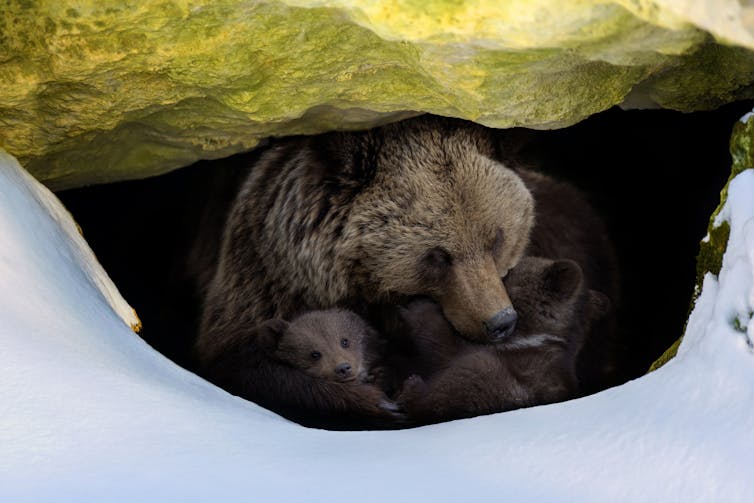
Brown bear with two cubs looking out of shelter
Humans seem to have followed the same distribution pattern as brown bears in the last ice age. Volodymyr Burdiak/Shutterstock

This pattern includes Homo sapiens too. Neanderthals had already been extinct for around 20,000 years by this point.

It’s not clear why ancient humans and other animals in this group lived in this seemingly harsh climate rather than explore more hospitable places. But they seemed able to tolerate the ice age conditions while other animals withdrew to refugia.

Perhaps most important of all is that among the species that seem to conform to this pattern, where little or no geographical contraction in population took place at the height of the last ice age, are modern humans. It is particularly surprising that humans are in this group as our ancestors originated in Africa and it may seem unlikely that they were resilient to cold climates.

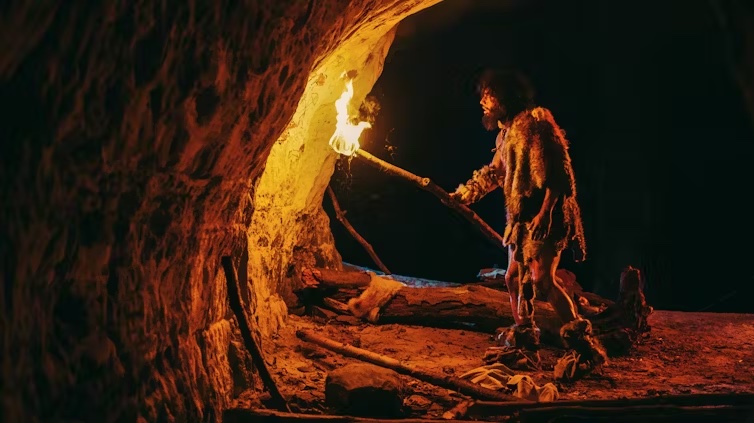
It is unclear whether these humans relied on ecological adaptation, for example the fact that they were omnivorous meant they could eat many different things, or whether they survived due to technology. For instance, it is well established that humans had clothing, built dwellings and controlled fire during the cold conditions of the last ice age.

This new pattern, and the inclusion of humans within it, could cause rethink of climate change and biogeography among scientists, especially for those studying human distribution changes. It could mean that some areas may be habitable for longer than expected as the climate changes.

John Stewart, Professor of Evolutionary Palaeoecology, Bournemouth University and Jeremy Searle, Professor of Ecology and Evolutionary Biology, Cornell University

This article is republished from The Conversation under a Creative Commons license. Read the original article.


You Might Also Like

Iran’s Geopolitical Strategy Against America: The $40,000 Drone That Could Change the Middle East

UAE, OPEC, and Somaliland: A Question of Timing, Not Direction

East Africa Rift Study Suggests Continent Slowly Splitting—and May Explain Fossil Richness

Less Intensive Farming Can Boost Coconut Yields and Protect Soil

250-Million-Year-Old Fossil Egg Solves Mystery of Early Mammal Relatives

TAGGED:Ancient humansIce Age
Share This Article
Facebook Twitter Pinterest Whatsapp Whatsapp LinkedIn Reddit Telegram Email Copy Link

You Might Also Like

elephant genomes revea 1
Science

Africa’s Elephants Are Losing Genetic Diversity as Habitats Shrink, Study Finds

By Mohammed El-Said 5 Min Read
Picture2 20
HealthScience

Blending Traditional Knowledge and Modern Science Could Help Africa Fight Crop Diseases

By Mohammed El-Said 5 Min Read
Low Res Sampling Image 1
HealthScience

Wastewater Plants in South Africa May Be Spreading Antibiotic Resistance

By Mohammed El-Said 5 Min Read

More Popular from DNE AFRICA

Fano Denies Mass Surrender Claims as Amhara Conflict Grinds On
Politics

Fano Denies Mass Surrender Claims as Amhara Conflict Grinds On

By Taha Sakr 2 Min Read
TPLF Presses Tadesse Worede to Step Down Amid Escalating Tigray Power Struggle
Politics

TPLF Presses Tadesse Worede to Step Down Amid Escalating Tigray Power Struggle

By Taha Sakr 3 Min Read
Ad imageAd image
HealthScience

Simple Blood Test Could Transform Cancer Diagnosis for Children in Africa

A new study has found that a simple blood test could help doctors diagnose a fast-growing…

By Mohammed El-Said
Politics

Amhara Fano National Movement captures 520 troops in large-scale  offensive

The Amhara Fano National Movement (AFNM) captured 520 government combatants on Wednesday during a coordinated offensive…

By Ashebir Getahun
Science

New African Mushroom Discovery May Solve Mystery of ‘Magic Mushroom’ Origins

Scientists say they may have solved a long-standing mystery about the evolutionary origin of the world’s…

By Mohammed El-Said
Politics

 Sudan, Ethiopia and Somalia brace as Gulf patrons look inward

Ethiopia, Sudan and Somalia face a deepening power vacuum as Gulf states — their principal external patrons…

By DNE Africa
DNE Africa

News by Africans, For Africans

Categories

  • The Escapist
  • Entertainment
  • Business

Quick Links

  • Advertise with us
  • Newsletters
  • Complaint
  • Deal

DNE Africa.All Rights Reserved.

Welcome Back!

Sign in to your account

Username or Email Address
Password

Lost your password?