
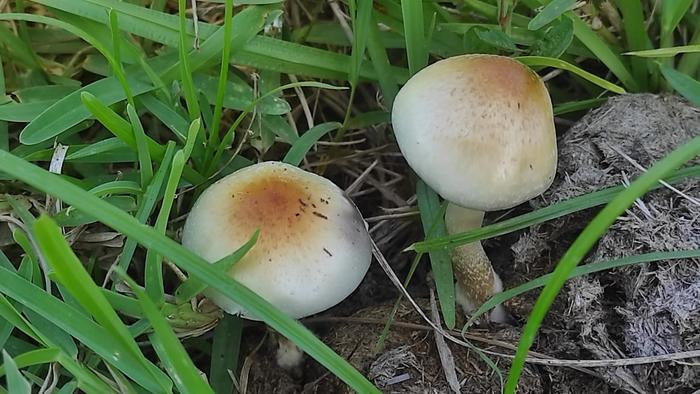

Scientists say they may have solved a long-standing mystery about the evolutionary origin of the world’s most widely cultivated “magic mushroom,” known as Psilocybe cubensis.
In a new study, researchers from southern Africa and the United States discovered a closely related but previously unknown species of psychedelic mushroom. The species, called Psilocybe ochraceocentrata, was found growing in grasslands in South Africa and Zimbabwe.
The findings were published in the journal Proceedings of the Royal Society B.
According to the researchers, the discovery helps clarify the evolutionary history of one of the most widely known psychedelic mushrooms. Genetic analysis suggests that the newly identified species and P. cubensis shared a common ancestor around 1.5 million years ago.
This challenges a widely held idea about how P. cubensis spread around the world.
For many years, scientists believed that the mushroom appeared in the Americas only after cattle were introduced from Africa and Europe during the 1500s. Because the mushroom often grows in cattle dung, the assumption was that it may have been accidentally transported with livestock.
However, the new research suggests that the relationship between the two mushrooms is much older and more complex.
Breyten van der Merwe, a mycologist and PhD student in chemical engineering at Stellenbosch University in South Africa, said the newly discovered species closely resembles P. cubensis but is genetically different.
“Even though the two species look similar, they have different genetic, ecological and chemical traits,” he explained.
Van der Merwe is one of the co-authors of the study, which involved scientists from several institutions in the United States and Africa. The team included researchers from Clark University, University of Utah Health, Duke University, and the Natural History Museum of Zimbabwe.
The scientists say the discovery also sheds new light on the wild origins of P. cubensis and could help future research on psychedelic fungi.
Interestingly, the newly identified mushroom has already been cultivated around the world for years, but under a different name.
Growers often referred to it as “NSS,” which stands for “Natal super strength,” or sometimes as the “Transkei” strain. These names come from regions in South Africa where the mushroom was first collected.
“It’s one of the most popular strains of magic mushrooms because it is quite potent and easy to grow,” van der Merwe said. “But until this study, nobody realised it was a totally separate species from the classic magic mushroom.”
To understand the relationship between the two species, the research team carried out detailed genetic analysis. They examined DNA taken from mushroom samples collected across southern Africa, as well as from historic specimens stored in scientific collections.
Using advanced techniques such as phylogenetic analysis and molecular clock dating, the researchers reconstructed the evolutionary relationships between different mushroom species.
They also used ecological modelling to better understand the environments where these mushrooms grow.
Some of the first known specimens of P. ochraceocentrata were discovered in Zimbabwe in 2013 by Dr Cathy Sharp of the Natural History Museum of Zimbabwe, who is also a co-author of the study.
However, scientists say that Africa remains poorly studied when it comes to fungal biodiversity, meaning many species may still be undiscovered.
The researchers believe the two mushrooms likely separated into different species around 1.5 million years ago, during a time of major ecological changes.
Around that period, grasslands were expanding in parts of the world, especially in South America. At the same time, grazing animals such as cattle and other herbivores were spreading from Africa into Eurasia.
Because many dung-loving mushrooms grow on the waste of large herbivores, these environmental changes may have created new ecological opportunities for the fungi to evolve separately.
The researchers suggest that these shifting ecosystems may have helped drive the speciation of P. cubensis and P. ochraceocentrata.
The study highlights how little scientists still know about fungal diversity, particularly in Africa. Many regions of the continent have been only lightly explored by mycologists, meaning new discoveries are still likely.
By identifying the closest wild relative of P. cubensis, the researchers say they have taken an important step toward understanding the evolutionary history of one of the world’s most famous psychedelic mushrooms.
They also hope the discovery will encourage more research into fungal biodiversity in Africa, which remains one of the least studied areas of life on Earth.


