

In the heart of Isalo National Park in central-southern Madagascar, at least 200km from the sea in any direction, is a remote valley with a mysterious past. This place, Teniky, can only be reached on foot, by hiking through a mountainous region dissected by steep canyons.
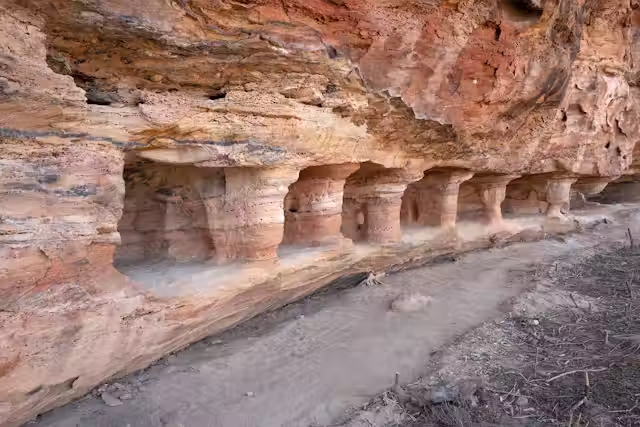
Part of the Teniky site has been known for well over 100 years, as we know from names and dates scratched on the rocks there. Various visitors in the 1950s and 1960s with an interest in archaeology described an amphitheatre-shaped location with man-made terraces, a rock shelter with neatly constructed sandstone walls, a chamber cut into the rock with pillars and benches, and a large number of niches cut in the steep cliffs. Recesses are still visible around some of the niches, suggesting that they could be closed off by a wooden or stone slab.
Among the suggested interpretations were that these structures had been made by shipwrecked Portuguese sailors, or Arabs, or even Phoenicians.
No similar rock-cut architecture is known anywhere else in Madagascar or on the east African coast, 400km away.
And until recently, no detailed archaeological studies had ever been carried out at Teniky.
Madagascar’s past is still the subject of considerable debate. Situated in the south-western Indian Ocean, it is one of the last big islands to have been settled by humans. Genetic studies have identified the people of Madagascar as having come mainly from Africa and from Southeast Asia. Archaeology suggests that the first settlers arrived about 1,500 to 1,000 years ago. The earliest settlements studied have been located along the coast, close to river estuaries.
Our archaeological study of Teniky, however, points to a new possibility: a former Persian presence in southern Madagascar about 1,000 years ago.
What we found at Teniky, Madagascar
Our study of high-resolution satellite images revealed the Teniky site was much larger than previously known. It showed there were more terraces and stone walls on a hill 2km to the west. This led us to take a closer look, hoping to get a better sense of who had lived there and when.
During field prospecting on this hill we discovered niches, cut in the walls of a rock shelter, that had not been described before.
Excavations at this rock shelter revealed more archaeological structures, including carved sandstone walls and a large stone basin.
Radiocarbon dating of charcoal samples from the site dated to the late 10th to mid-12th centuries AD. Pieces of ceramic items of southeast Asian and Chinese origin found there have been dated by a specialist to the 11th to 14th centuries AD.
We also found sandstone quarries from which the stones used to build the walls at the rock shelters were extracted. And we found more stone basins on terraces.
The terraces cover a total area of about 30 hectares, indicating that Teniky must have been a fair-sized settlement. Water is available all year round in the valley below, where people might have been able to plant crops, fish for eels or even keep cattle.
Considering the dimensions, location and character of the rock-cut structures at Teniky, we think the niches and chambers served a ritual purpose.
Who were the people who lived at Teniky?
There is no other archaeological site like Teniky in Madagascar. So, the question arises as to what group of people settled there, far inland, and carved the niches and chambers in the cliff walls about 1,000 years ago. The presence of imported ceramics indicates that they took part in the Indian Ocean trade networks at the time but doesn’t tell us where they came from.
We think the answer may lie in the style of the rock-cut niches.
They are similar to rock niches of the first millennium or earlier in Iran (formerly Persia). Archaeologists have interpreted those as belonging to Zoroastrian communities, which used them as part of their funeral rites.
Zoroastrianism was the dominant state religion of the Persian Sasanian Empire (224-656 AD). After the conquest of the Sasanian Empire by the Arabs in the mid-seventh century AD, Islam was imposed.
Zoroastrian funeral rites do not allow direct burial in the ground, so as not to pollute the earth. Instead, dead bodies are left in places of exposure not touching the ground. Once the flesh has decomposed or been removed by animals, the bone remains are dried and placed in bone receptacles (ossuaries).
We tentatively interpret the rock-cut architecture at Teniky as having been made by a community with Zoroastrian origins.
The larger rock-cut niches might have been the places where the bodies of the dead were exposed, and the smaller niches with recesses might have served as ossuaries, closed off by a slab to protect the bones from the rain and thus to prevent them from polluting the earth.
The stone basins at Madagascar Teniky show stylistic similarities with those used in Zoroastrian ritual ceremonies to hold water or fire, both agents of ritual purity.
Zoroastrians abroad
There are few accounts of Madagascar written at the turn of the first and second millennia AD. Buzurg Ibn Shahriyar, a tenth-century Persian sailor and writer, collected stories from sailors in port towns on the Persian Gulf which suggest that Persian contacts with Madagascar may have existed then. The name Madagascar did not exist at that time but names like “Wak-wak” or “Qumr”/“Komr” may have referred to the island.
Historical documents, archaeological excavations and genetic studies indicate that Zoroastrians left Iran and settled in western India in the late eighth century AD.
Did they settle on the island of Madagascar too? If the rock-cut architecture and associated stone basins at Teniky are the work of a community with Zoroastrian origins, this would strongly point to a former Persian presence in southern Madagascar about 1,000 years ago.
Many questions remain. We hope future studies will answer some of them.
Guido Schreurs, Professor in Geology, University of Bern and Chantal Radimilahy, Senior Lecturer, Archaeology, University of Antananarivo, Université d’Antananarivo
This article is republished from The Conversation under a Creative Commons license. Read the original article.


