
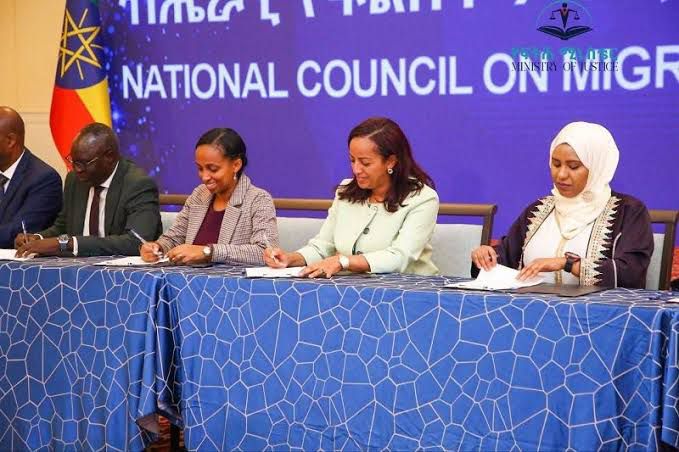

Ethiopia has signed a new cooperation agreement with the International Organization for Migration (IOM) to support the safe return and reintegration of thousands of its citizens stranded abroad, as irregular migration continues to surge across Africa and the Gulf region.
The deal was signed in Addis Ababa by State Minister of Women and Social Affairs Huria Ali during the annual session of the National Migration Council, chaired by Deputy Prime Minister Temesgen Tiruneh. The meeting brought together federal ministries, regional officials, and local administrators to coordinate a growing repatriation effort involving multiple countries and migration corridors.
The move comes amid mounting concerns over the increasing number of Ethiopians—many of them children—taking dangerous migration routes across the continent. Reports of mass detentions, trafficking, and abuse have spiked, particularly on the southern route through Kenya, Tanzania, and into South Africa.
In February 2024, Kenyan authorities intercepted a truck near the Tanzanian border carrying 90 Ethiopian migrants, including 53 minors. In early 2025, more than 100 Ethiopian migrants were apprehended while being smuggled through East Africa. In Tanzania alone, over 5,000 Ethiopians were arrested between 2020 and 2023, with many receiving multi-year prison sentences.
South Africa remains a key destination for irregular migrants. In January 2025, Johannesburg police rescued 26 Ethiopian migrants—some reportedly abused and held naked—in a raid that led to the arrest of three suspects. A broader operation uncovered nearly 60 trafficked Ethiopians.
In response to these growing threats, Ethiopia has intensified its repatriation initiatives. In March 2025, 287 Ethiopian nationals imprisoned in Kenya were returned via the Moyale border, as part of a wider campaign that has brought home over 33,000 Ethiopians in just six months.
The situation is equally severe in the Gulf. Since 2017, more than 500,000 undocumented Ethiopian migrants have been deported from Saudi Arabia alone. Despite a temporary ban on labor migration to Gulf states in 2013, Ethiopia later signed bilateral labor agreements with Saudi Arabia, the UAE, Qatar, and Jordan in an effort to legalize and protect labor migration.
Yet, the challenges persist. In May 2024, over 27,000 Ethiopians were repatriated from Saudi Arabia, with flights arranged daily by the government in coordination with IOM. Between late 2023 and early 2024, an estimated 130,000 Ethiopians returned from South Africa and the Gulf. IOM also helped facilitate the return of nearly 20,000 migrants from Tanzania, Djibouti, and Yemen since 2020.
While the new agreement aims to improve coordination, provide reintegration support, and reduce risky migration, the root causes of migration—including unemployment, insecurity, and human trafficking networks—remain unaddressed.
The Ethiopian government and its international partners now face growing pressure to expand protection, create economic alternatives, and establish a durable framework for managing migration across volatile regions.


