
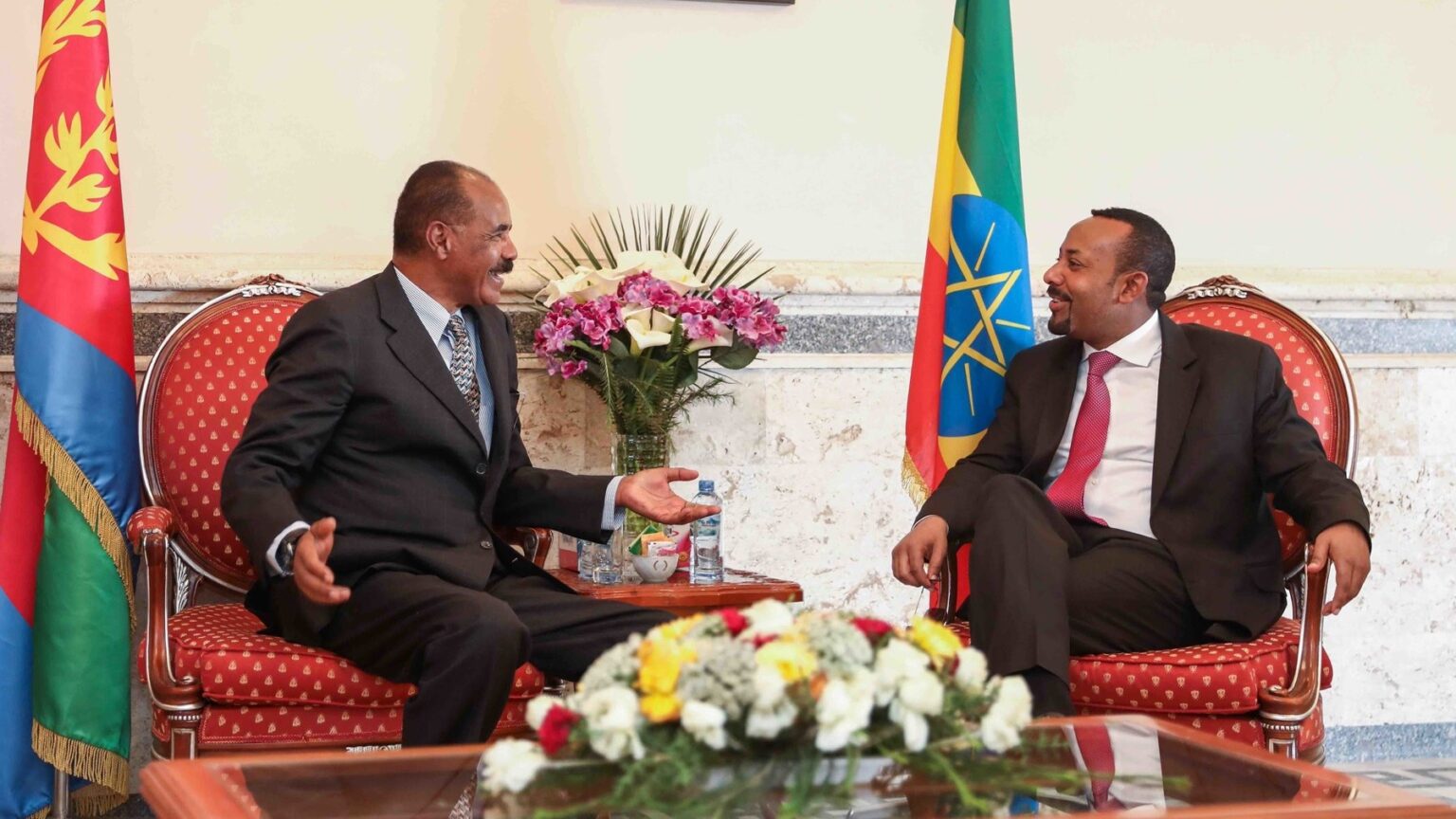

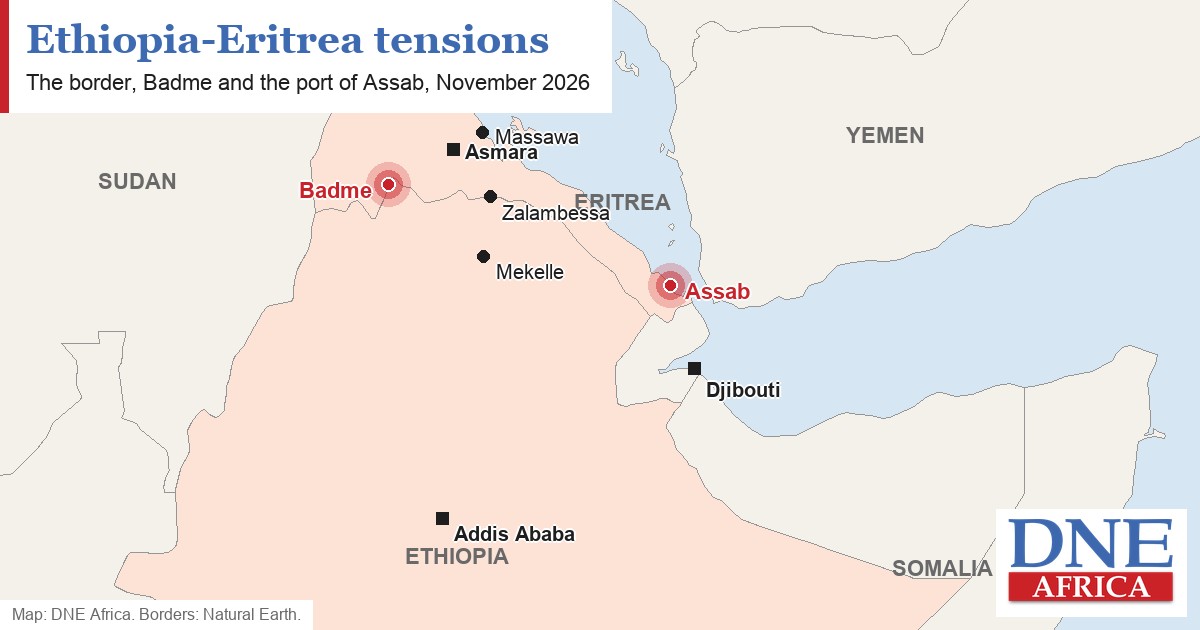
Ethiopia-Eritrea tensions over Ethiopia’s demand for a Red Sea port and its accusation that Eritrea backs Tigrayan forces have brought the neighbours to their worst point since 2018, with fighting near their border this week.
Last updated: 27 November 2026
The Ethiopia-Eritrea tensions matter beyond the two countries. Ethiopia, with about 130mn people by World Bank estimates, has been landlocked since Eritrea’s independence in 1993; Eritrea’s coast, including the port of Assab, faces one of the world’s busiest shipping lanes. The two governments cut diplomatic ties on 1 October, and the G7, the African Union and the US have warned of a regional war.
In brief
- Prime Minister Abiy Ahmed told parliament this week that Ethiopia “will not wage an invasion” and wants sea access “peacefully and through dialogue”, and asked Eritrea to stop arming his government’s opponents, Addis Standard reported on 27 November.
- Eritrea’s government says Ethiopia has declared “a war of aggression” to seize Assab, and has asked the UN Security Council to act.
- Assab lies inside Eritrea, a UN member since 1993 whose borders Ethiopia recognised; the UN Charter bars the threat or use of force against any state’s territorial integrity.
- Around Badme, ACLED reported clashes on 25 and 26 November involving the Ethiopian army and, it said, Eritrean forces.
What is happening in the Ethiopia-Eritrea tensions now?
The border is the most dangerous point of the Ethiopia-Eritrea tensions. Villagers near Badme told BBC Tigrinya that fighting with heavy weapons, air strikes and drones began early on 25 November and went on into the next day, as DNE Africa reported. The Armed Conflict Location and Event Data project (ACLED) said the Ethiopian army and the government-allied Tigray Peace Force took Gual Gemhalo on 26 November after fighting through the night with Eritrean Defence Forces and Tigray Defence Forces. Residents believed the fighting was mainly between federal and Tigrayan forces. No government has commented, and the accounts could not be independently verified.
In remarks to the House of Peoples’ Representatives reported by Addis Standard on 27 November, Mr Abiy said: “Invasion is not needed; we want it peacefully and through dialogue.” He asked Eritrea to stop “arming Ethiopia’s enemies” and said Eritrea had turned down offers of electricity, roads and joint port development.
A day earlier, Eritrea’s information minister, Yemane Gebremeskel, told a retreat of the UN country team in Asmara that “Ethiopia is set to launch a massive war of aggression against Eritrea”, according to the text published by the Eritrean Ministry of Information.
Who are the parties to the Ethiopia-Eritrea tensions and what do they want?
Ethiopia’s federal government, led by Mr Abiy and his Prosperity Party, says sea access is a national necessity for a country of its size and that it will pursue it by negotiation. In October 2023 Mr Abiy called Red Sea access an existential question, and he has since said Ethiopia will regain Assab in “a matter of time”.
Senior commanders have gone further in the Ethiopia-Eritrea tensions. The navy commander, Vice Admiral Kindu Gezu, said in November that Ethiopia would pursue sea access through diplomacy, legal avenues or “other alternatives”, as DNE Africa reported. The army chief, Field Marshal Birhanu Jula, said in Mekelle in mid-November that historic sites including Dogali and Gundet in Eritrea, and Zeila in Somalia, were Tigrayan, remarks that drew protests in Somaliland and Eritrea.
Eritrea’s information minister says the deputy chief of staff, General Abebaw Tadesse, told local media on 27 September that the aim of the offensive was “to occupy Assab and install the Ethiopian flag in the Red Sea”; DNE Africa could not obtain the original interview, and the Ethiopian government has not commented on it.
Eritrea’s government, under President Isaias Afwerki, says the border was settled by international arbitration and that it “will not surrender an inch of its territory or maritime domain”, according to a foreign ministry paper of 26 November. It says it has never opposed commercial use of its ports, denies sending troops into Tigray, and calls Ethiopia’s accusations a pretext for war.
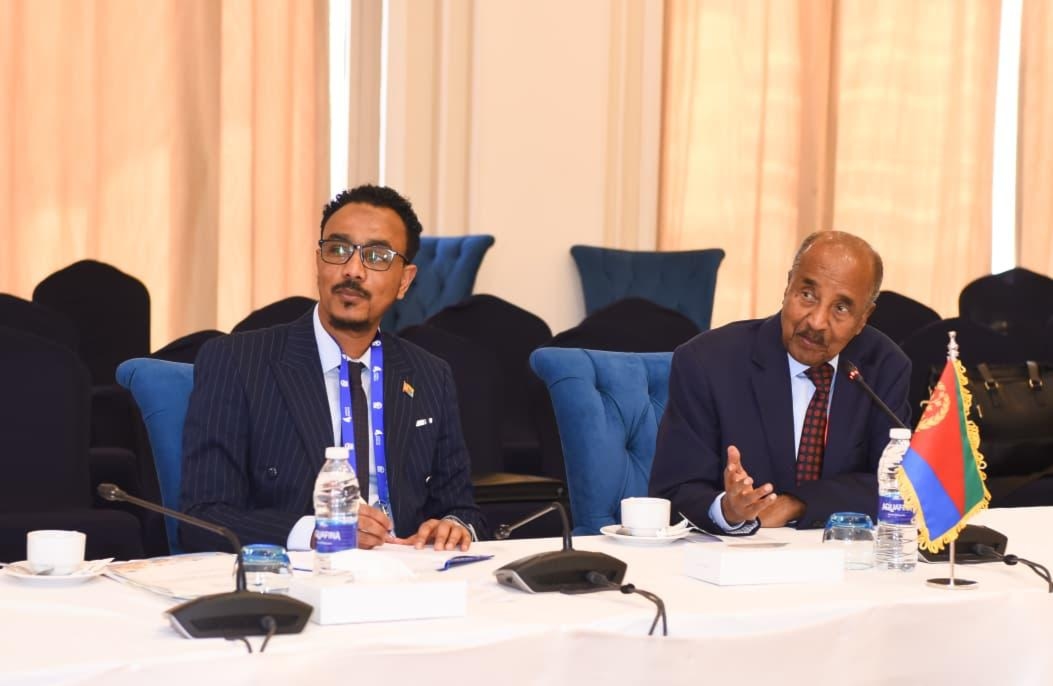
The Tigray People’s Liberation Front (TPLF), which governed Tigray until this autumn, says it is fighting to remove Mr Abiy’s government. In September it said it had entered a new war with the federal government, in effect ending the 2022 Pretoria agreement, and joined an alliance with Amhara Fano groups and the Oromo Liberation Army, according to African Narratives. The federal army accuses Eritrea of leading the TPLF’s offensive. The Tigray Peace Force, a Tigrayan group allied to the federal government, fights alongside the army.
What does international law say about Assab?
Eritrea became a UN member state in May 1993 after a UN-observed referendum in which 99.8% of voters chose independence, and Ethiopia recognised it. Assab lies well inside Eritrea’s internationally recognised territory and was not in dispute in the 1998-2000 war. The UN Charter, in Article 2(4), requires all members to “refrain in their international relations from the threat or use of force against the territorial integrity or political independence of any state”. The ban covers threats as well as the use of force.
The African Union’s Constitutive Act commits members to “respect of borders existing on achievement of independence”, and under the 2000 Algiers Agreement both countries accepted the boundary commission’s ruling as final and binding.
Governments have cited these principles in the Ethiopia-Eritrea tensions. Britain warned Ethiopia in October against rhetoric threatening a nation’s sovereignty, the European Union said the sovereignty and territorial integrity of all states must be respected, and the G7 stressed the same in November. Mr Rubio urged Mr Abiy to respect territorial sovereignty and to settle disputes under the 2018 peace framework. Ethiopia’s government says it is not seeking territory by force and wants sea access through a negotiated deal, such as a port lease or joint development.How did the Ethiopia-Eritrea tensions begin?
- May 1993: Eritrea becomes independent after a referendum, leaving Ethiopia without a coastline.
- May 1998 to June 2000: a border war, centred on Badme, kills tens of thousands; the Algiers Agreement ends it in December 2000.
- April 2002: an international boundary commission awards Badme to Eritrea; Ethiopia does not withdraw, and a “no war, no peace” standoff follows.
- June-July 2018: Mr Abiy accepts the ruling and signs a peace declaration with Mr Isaias; he wins the 2019 Nobel Peace Prize.
- November 2020 to November 2022: Eritrean troops fight alongside federal forces in the Tigray war; Eritrea is not a party to the Pretoria agreement that ends it.
- October 2023: Mr Abiy calls Red Sea access an existential matter, which Eritrea reads as a threat.
- January 2024: Ethiopia signs a sea-access memorandum with Somaliland; Somalia rejects it.
- September 2026: fighting resumes in Tigray; the opposition alliance is formed; on 27 September an Ethiopian general names Assab as the offensive’s aim, according to Eritrea.
- 1 October 2026: Ethiopia closes its embassy in Asmara and expels Eritrean diplomats, citing “acts of hostility”; Eritrea severs relations.
- Early October 2026: federal and allied forces enter Mekelle; on 10 October Eritrea asks the UN Security Council for measures against Ethiopia.
- November 2026: the Ethiopia-Eritrea tensions reach Badme, with drone strikes and shelling; the G7 warns of “regional escalation”.
What is the human cost of the Ethiopia-Eritrea tensions?
No overall casualty figure exists for the fighting linked to the Ethiopia-Eritrea tensions since September, and access to Tigray is restricted. About 1mn people remain displaced in Tigray and nearly 4mn need urgent help, according to figures released in October and cited by Agenzia Fides. Amnesty International said on 23 November that it had verified 14 civilian deaths from four artillery strikes on Alamata in late September; the TPLF rejected its findings and the army did not respond, as DNE Africa reported.
Near Badme, a drone strike wounded at least four displaced people on 16 November, BBC Amharic reported, and ACLED said a strike on 23 November injured at least eight civilians. The 2020-2022 war, which the African Union’s envoy, Olusegun Obasanjo, has said may have killed as many as 600,000 people, still leaves many displaced.
How are the AU, the UN and outside powers responding to the Ethiopia-Eritrea tensions?
The African Union Commission urged Ethiopia, Eritrea and Egypt in early October to show maximum restraint and offered to help with dialogue. The United Nations voiced grave concern as fighting spread in September, and its Horn of Africa envoy, Guang Cong, has met both sides. The G7 foreign ministers urged “maximum restraint” on 11 November, and five US senators asked Secretary of State Marco Rubio to say Washington would not accept the seizure of Assab by force, as DNE Africa reported.
Ethiopia has also accused Egypt of supplying Tigrayan forces. Egypt rejects the accusation: its foreign ministry spokesman, Nader Zaki, rejected the claims in October, Ahram Online reported, and Cairo has said it does not interfere in other countries’ internal affairs. Egypt, Sudan and Eritrea said in Aswan on 21 November that Red Sea security is for the coastal states.
Analysts differ on how close the Ethiopia-Eritrea tensions are to war. ACLED has assessed the risk of a full-scale confrontation on the Badme front as high. The Critical Threats project said in October it could not confirm Ethiopian claims of an Eritrean build-up from satellite images. African Narratives, in a study by Farouk Hussein Abu Deif, assessed that the Pretoria deal had only paused the conflict and that diplomatic expulsions and mutual accusations raise the risk of proxy war or direct interstate conflict. For the wider stakes at sea, see our Red Sea shipping explainer.
What to watch next in the Ethiopia-Eritrea tensions
- Whether the army’s advance near Badme reaches the town, which Eritrea administers, and whether the two national armies clash directly.
- Whether Mr Abiy’s offer of talks leads to contact with Asmara.
- Any Security Council meeting on Eritrea’s request, and further statements from Washington and the G7.
FAQ
What are the Ethiopia-Eritrea tensions about?
The Ethiopia-Eritrea tensions centre on Ethiopia’s demand for access to the Red Sea, which Eritrea sees as a claim on its port of Assab, and on Ethiopia’s accusation that Eritrea backs Tigrayan forces, which Eritrea denies.
Are Ethiopia and Eritrea at war?
Neither government has declared war. ACLED reported clashes near Badme involving Eritrean forces in late November, while residents described fighting mainly between federal and Tigrayan forces; Eritrea denies any incursion.
Why is Assab important in the Ethiopia-Eritrea tensions?
Assab is the Eritrean port closest to Ethiopia, about 70 kilometres from the border. Ethiopia used it before 1998 and now relies mainly on Djibouti.
Can Ethiopia lawfully claim Assab?
Assab is part of Eritrea, a UN member state whose independence and borders Ethiopia recognised. The UN Charter bars the threat or use of force against any state’s territory, so sea access could lawfully come only through an agreement with Eritrea, which Ethiopia says it seeks.


