
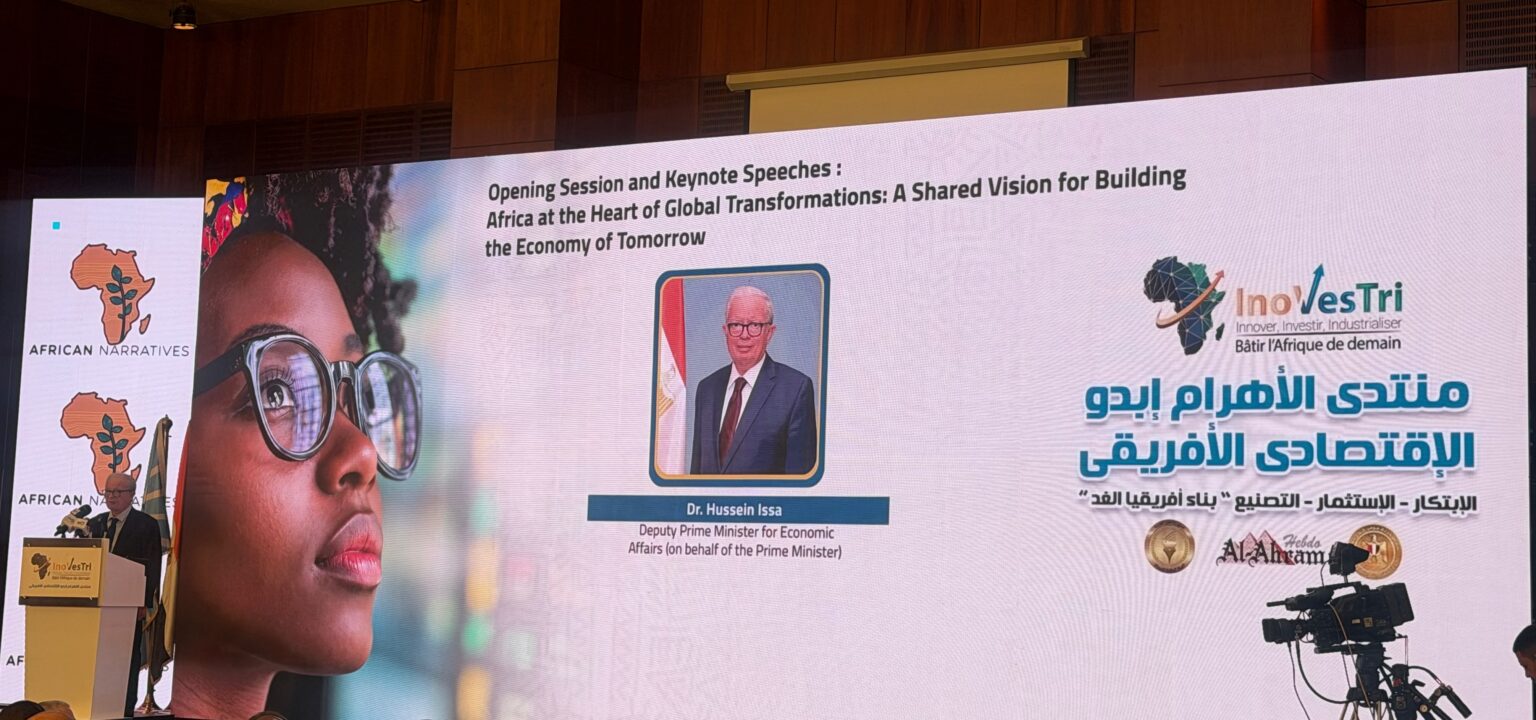

CAIRO – Nov. 28, Africa must move from exporting its wealth to manufacturing it and turn its borders into bridges for trade, production and investment if it is to achieve economic sovereignty. Dr Hussein Eissa, Deputy Prime Minister for Economic Affairs, made the call as he opened the second Al-Ahram Hebdo African Economic Forum, InoVesTri 2026, on behalf of Prime Minister Mostafa Madbouly.
The forum’s title is “Africa’s Economy: From Confronting Geopolitical Turbulence to Economic Sovereignty”. Eissa said the title captures a defining moment for the continent and raises a question that can no longer wait: how Africa moves from owning the ingredients of wealth to owning the tools of economic power.
The pandemic, supply chain disruption, geopolitical conflict, volatile food and energy prices, and rising debt and financing costs have exposed economies that lack productive capacity and cannot secure their strategic needs, he said.
Economic sovereignty means engaging with the world from a position of strength, Eissa said, and joining the global economy as a partner able to produce and compete. Africa is young and rich in natural resources, minerals, farmland and energy, with a vast market. “The real challenge lies in our ability to turn what we have into added value, jobs and competitive industries,” he said.
He described the forum’s three pillars:
•	Innovation: speeds up development and closes technology gaps.
•	Investment: turns opportunities into projects and production.
•	Industrialisation: raises added value, creates jobs and diversifies the economy.
Eissa said the African Continental Free Trade Area must become a real market where goods and investment flow and production chains connect. “Africa will not achieve economic sovereignty while its markets operate in isolation from one another,” he said.
He said Egypt met its economic challenges with reform. It built roads, ports, airports, energy projects and new cities, and carried out structural reforms to improve the investment climate, empower the private sector and localise technology. Its location linking Africa, Asia and Europe, the Suez Canal and its Economic Zone, and its network of trade agreements give Egypt a distinctive role in regional and international trade.
He said the government is preparing to announce a National Programme for Economic Transformation to 2030. It aims to drive growth based on productivity, competitiveness and sustainability, with the private sector as the main partner. Egypt’s experience can open wide prospects for sharing expertise with African countries, he added.
African economic sovereignty requires shared political will, real partnership between governments and the private sector, and a united African position, Eissa said. That position should press for a fairer international economic and financial system and development finance on fairer terms. He called for the forum to become a launch pad from dialogue to action, so that Africa becomes an active partner in shaping the future of the global economy.
The remarks came during his participation in the Al-Ahram Hebdo African Economic Forum, InoVesTri 2026. The forum is held under the patronage of Prime Minister Mostafa Madbouly and Abdel Sadeq Al-Shorbagy, Chairman of the National Press Authority, under the slogan “Innovation, Investment, Industrialisation: Building Tomorrow’s Africa”. More than 500 participants from over 30 African countries are attending, with African Narratives and DNE Africa taking part as strategic and media partners.


