
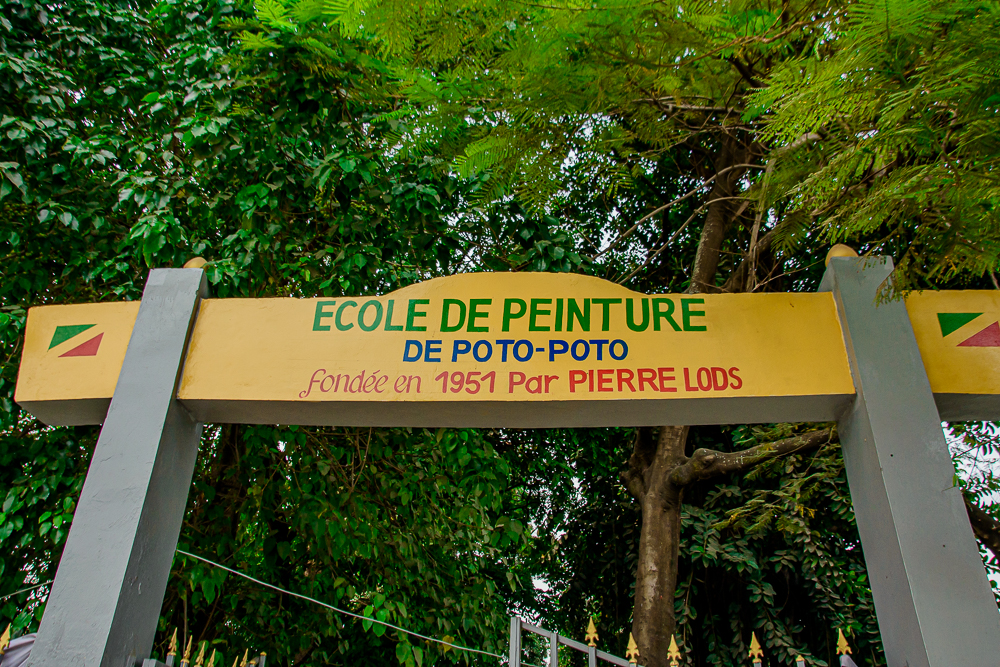

The Poto-Poto School of painting in Brazzaville, one of Central Africa’s first art schools, turns 75 this year; the French amateur painter Pierre Lods founded it in 1951.
The workshop in the Republic of the Congo’s capital trained painters who went on to exhibit in Europe and the United States, and it still operates as a cooperative, according to a history of the school published by Rhodes College in the US, which holds a collection of its early paintings.
How did the Poto-Poto School begin?
Lods (1921-1988) arrived in Brazzaville after time in French Indochina, Rhodes College says. The story he later told was that a member of his household staff, Félix Ossali, caught his eye by painting blue birds on a map, and that Lods then invited Ossali and his relatives to paint in an informal workshop. The college notes that this account has never been proven.
Another early recruit was Nicolas Ondongo (1933-1990), who had gone to France in 1949 to work for Lods’s mother and returned with him to Brazzaville. Ondongo became one of the school’s first students and, later, its head.
Lods considered the academic painting then practised in Brazzaville too close to European models, according to a 2021 article in Les Dépêches de Brazzaville (in French). He gave his recruits, many of whom had little formal schooling, paper, brushes and gouache, and no technical instruction.
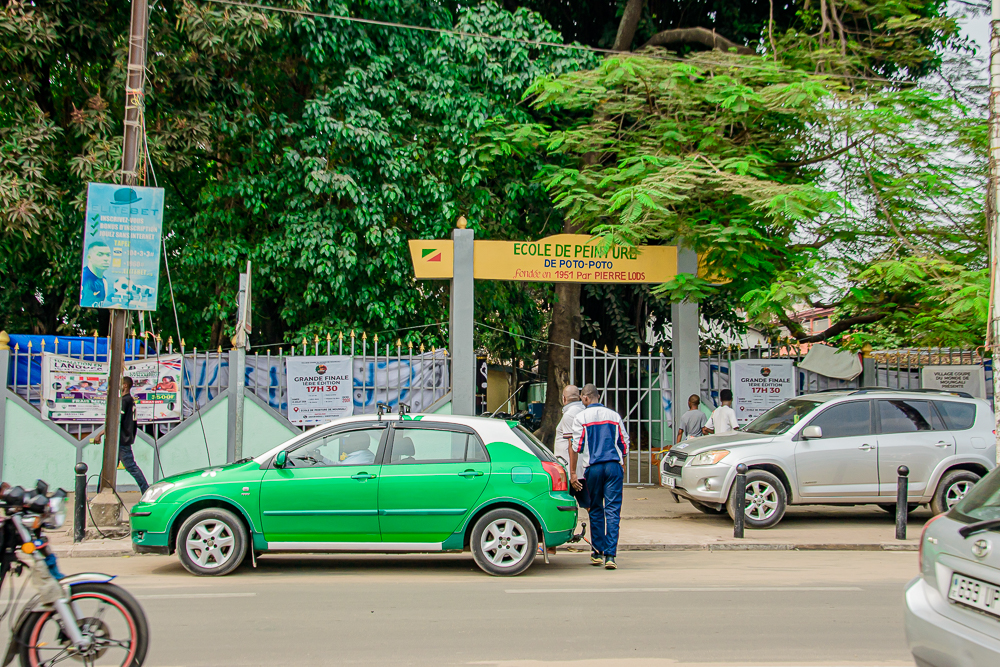
Despite its name, the Poto-Poto School stands in the Moungali district; it takes its name from the neighbouring Poto-Poto quarter, and “poto-poto” means mud in Lingala, Africanews reported at the time of the school’s 70th anniversary.
What does Poto-Poto painting look like?
The first recognisable style, popular in the 1950s, was known as “Mickeys”, after Mickey Mouse. Rhodes College describes it as simplified, elongated figures drawn with black lines that suggest movement, much like an animator’s sketches, and traces it to Ossali’s early work.
Rhodes College describes the school’s paintings as oil and gouache works. It says work from the workshop was shown at the Museum of Modern Art in New York in 1956, where audiences described it as avant-garde. Ondongo’s paintings are now in the collection of the Musée du quai Branly in Paris.
Who led the school after independence?
When the Republic of the Congo became independent in 1960, Lods left for Dakar at the invitation of Senegal’s President Léopold Sédar Senghor, who wanted him to teach there. Two former students, Ondongo and Guy Léon Fylla, took over, and Ondongo became head of the cooperative in 1962, according to Rhodes College.
The school still works as a cooperative in which former students become teachers. A second generation of painters, among them François Iloki, Marcel Gotène, Jacques Zigoma and Philippe Ouassa, built international careers, according to Les Dépêches de Brazzaville and Africanews.
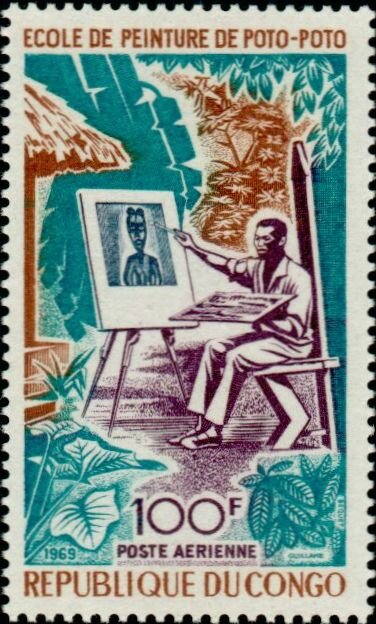
In 1970 the Republic of the Congo issued a postage stamp honouring the school.
What is the Poto-Poto School doing now?
At its 70th anniversary in June 2021, the school’s director, Parfait Mbon, told Africanews that it had trained about 60 well-known painters and had submitted a project to UNESCO to sell its paintings online. Mbon has also written a book on the school, published by L’Harmattan in 2022.
In February this year the workshop hosted a two-day master class on managing a painter’s career, organised by Alphonse Chardin N’Kala, director general of arts and letters, Les Dépêches de Brazzaville reported.
Rhodes College, in Memphis, Tennessee, has mounted an exhibition, “Surface Tension: Paintings from the Poto-Poto School, 1950-1970”, from a collection bought in Congo by the Presbyterian missionary William Pruitt.
Congolese rumba, music shared by the Republic of the Congo and DR Congo, was inscribed on UNESCO’s intangible heritage list in 2021; DNE Africa reported on its five years on the list this month. Ghana’s highlife music nears its first year on the same list.
FAQ
When was the Poto-Poto School founded?
Pierre Lods, a French amateur painter, founded it in Brazzaville in 1951, so it turns 75 in 2026. It is also known as the Centre des Arts Africains.
Where is the Poto-Poto School?
It is in the Moungali district of Brazzaville, the capital of the Republic of the Congo. It takes its name from the neighbouring Poto-Poto quarter.
What is the “Mickey” style?
It is the school’s best-known early style, popular in the 1950s: simplified, elongated figures drawn with black lines that suggest movement. It was named after Mickey Mouse.
Is the Poto-Poto School still open?
Yes. It operates as a cooperative in which former students teach, and it hosted a master class for painters in February 2026.


