
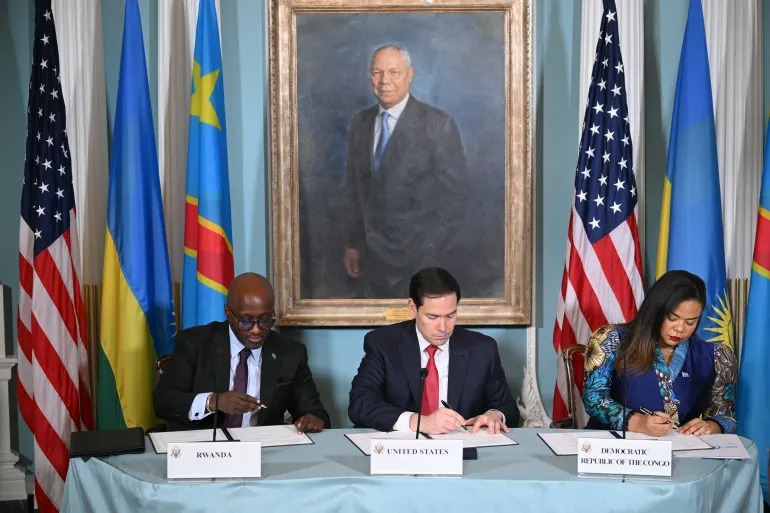

The United States has brokered what it hails as a historic peace agreement between the Democratic Republic of the Congo (DRC) and Rwanda, aimed at ending decades of deadly conflict in eastern Congo. Yet while the signing ceremony in Washington was framed as a diplomatic breakthrough, the deal has triggered mixed reactions, particularly from those most affected by the violence.
Just five months ago, US President Donald Trump came under fire for abruptly terminating USAID’s operations in Congo, leaving over half a million people at risk. Today, the same administration is touting its success in bringing an end to what many consider the most violent conflict since World War II — one that has killed thousands this year alone and displaced hundreds of thousands.
Under the terms of the agreement, Rwanda is to withdraw thousands of troops from Congolese territory within three months, while both sides will establish a joint security coordination mechanism within 30 days. The deal also outlines a regional economic integration framework to be launched within 90 days, and includes provisions for dismantling the Democratic Forces for the Liberation of Rwanda (FDLR) — a group accused of links to the 1994 Rwandan genocide.
In exchange, the DRC has pledged to cease any support for the FDLR, while Rwanda has promised to halt support for the M23 rebel group, despite repeated denials of such ties.
Local distrust and strategic omissions
While Rwandan Foreign Minister Olivier Nduhungirehe hailed the deal as a “turning point,” his Congolese counterpart Thérèse Kayikwamba Wagner was more reserved, describing the agreement as “a chance to restore dignity and hope” — though it could not erase the scars of war.
President Trump, who personally oversaw the deal, praised his role in bringing the two sides together, going so far as to suggest the accord merits a Nobel Peace Prize.
However, major concerns remain. The exclusion of M23 from the agreement has drawn criticism from analysts, given the group’s control over large parts of North and South Kivu. Critics argue that the deal’s effectiveness will be limited without directly addressing M23’s presence and demands.
Michael Odiambo, a peace expert with the IRIN network, noted that displaced populations in eastern Congo have seen no improvement in daily life — especially after the US cut humanitarian aid. He warned that the agreement risks becoming a “peace by force” model, potentially reigniting violence under the guise of economic cooperation.
Other analysts, such as Rwandan commentator Gatete Nyiringabo Ruhumuliza, contend that the M23 issue is an internal Congolese matter to be addressed in the upcoming Doha dialogue. He emphasized Rwanda’s focus on neutralizing the FDLR, which many Rwandans view as an existential threat rooted in the genocide era.
Strategic interests and sovereignty concerns
The agreement has also raised eyebrows due to its timing, coinciding with ongoing talks between Kinshasa and Washington over a controversial “minerals-for-security” deal. The proposed arrangement would grant US firms privileged access to Congo’s vast reserves of gold, cobalt, and lithium, seen as critical in the global tech and EV supply chains — and part of a broader strategic competition with China.
Critics, including Nobel Laureate Dr. Denis Mukwege, have denounced the deal as a “compromise of sovereignty”, warning that it fails to deliver justice or accountability. Others have accused the US of leveraging peace negotiations as a cover for resource extraction.
Civil society actors have also voiced frustration over being excluded from the negotiation process, warning that bypassing victims and local communities risks entrenching a model that has repeatedly failed to deliver lasting …


