
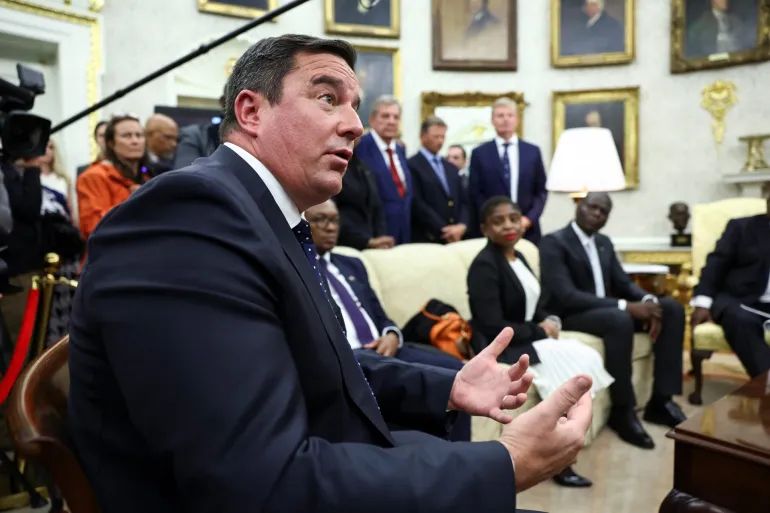

South Africa’s Minister of Agriculture and leader of the Democratic Alliance, John Steenhuisen, has called on the government to reconsider aspects of its Black Economic Empowerment (BEE) policy and other race-based legislation, arguing that such changes could help mend relations with the United States and lead to the removal of steep tariffs on South African exports.
In an interview with Reuters, Steenhuisen said the 30% tariffs imposed by US President Donald Trump earlier this year will likely remain in place unless Pretoria sends a clear signal of willingness to adjust policies Washington views as discriminatory. He noted that talks with the Trump administration have moved beyond purely trade-related issues and now touch on politically sensitive matters, including the law allowing land expropriation without compensation, certain labor regulations, and South Africa’s alignment with the BRICS bloc — which the US sees as a strategic rival.
For months, the South African government — which presides over the continent’s most industrialized economy — has been trying to secure a trade agreement with Washington but failed to do so before the deadline set by Trump. As a result, South Africa now faces the highest tariff rates of any country in sub-Saharan Africa, dealing a significant blow to key export sectors such as agriculture and manufacturing.
The Democratic Alliance, South Africa’s second-largest party and part of the current governing coalition, has long opposed BEE and other race-based economic measures introduced after the end of apartheid in 1994. While acknowledging the country’s deeply entrenched racial inequalities, the party favors what it describes as race-neutral policies to stimulate growth, attract investment, and create jobs — such as reducing bureaucracy and streamlining business licensing processes.
Steenhuisen stressed that constitutional or legislative changes to these policies cannot be made overnight, as they require lengthy parliamentary debate and consensus-building. However, he argued that even a symbolic indication of intent could help improve Washington’s stance and possibly open the door to tariff relief. “What worries me,” he said, “is that we’ll keep negotiating over tariffs and trade while the 30% rate remains in place.”
President Cyril Ramaphosa and the ruling African National Congress (ANC) maintain that BEE and similar policies are non-negotiable, seeing them as vital to correcting the economic imbalances created by decades of white minority rule. While white South Africans remain the wealthiest demographic group, the vast majority of the country’s Black population continues to suffer from poverty.
The ANC has also downplayed US concerns over the new land expropriation law, which allows — in limited cases — for land to be seized and redistributed without compensation. The government points out that no land has yet been taken under the law and insists it is designed to address historic injustices in a measured way.
With the agricultural sector among the hardest hit by Trump’s tariffs, pressure is mounting on the government to find a compromise that safeguards South Africa’s economic interests without abandoning its core policy commitments. For now, however, the political and ideological divide between the ANC and its coalition partners appears to be slowing any significant policy shift, leaving trade relations with Washington in a precarious state.


