
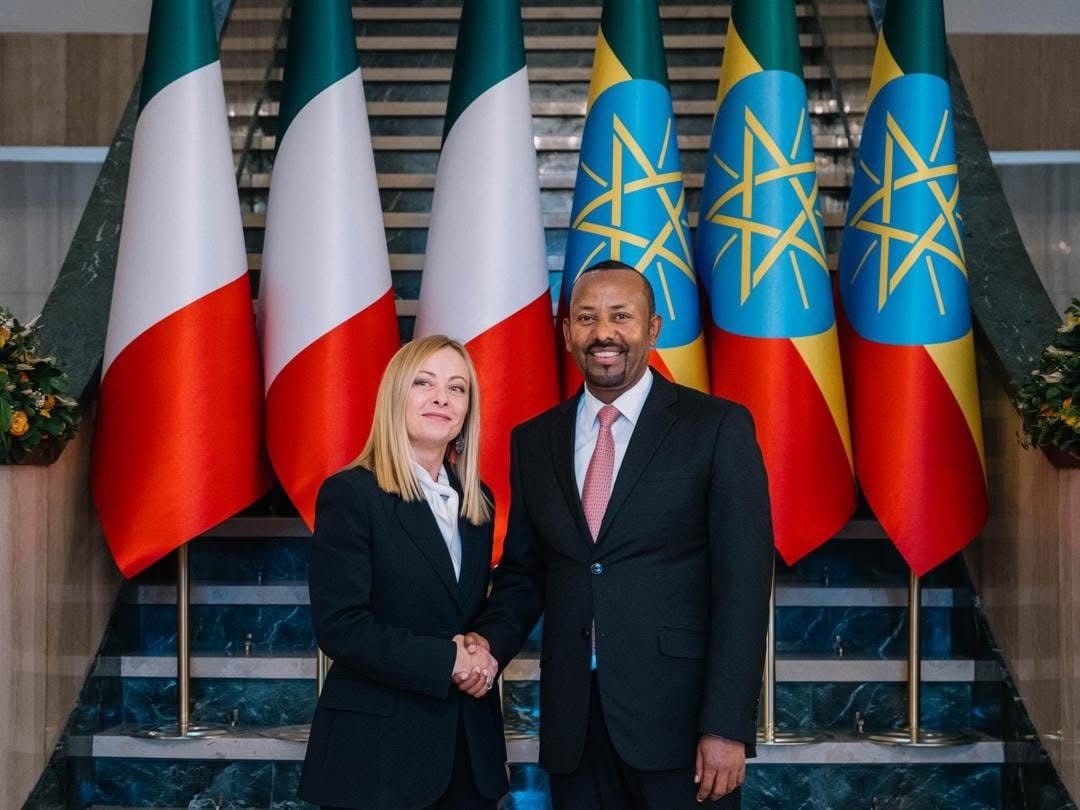

Italian Prime Minister Giorgia Meloni arrived in Addis Ababa on Sunday for an official visit to attend the UN Food Systems Summit +4, a three-day international conference co-hosted by Italy and Ethiopia. Her visit signals a renewed effort by Italy to deepen strategic partnerships across Africa, with a strong focus on food security, sustainable development, and regional stability.
Meloni was received at Bole International Airport by Ethiopian Prime Minister Abiy Ahmed. The two leaders later held a bilateral meeting at the historic Jubilee Palace — a venue steeped in Ethiopian statecraft and diplomacy. The meeting concluded with the signing of a Joint Declaration on the Ethiopian–Italian Cooperation Framework, outlining a new chapter of collaboration between the two countries.
In a statement posted to social media, Prime Minister Abiy described the discussions as “productive,” covering a broad range of bilateral and multilateral issues. “Our longstanding partnership was further reinforced,” he wrote, emphasizing that the new cooperation framework will strengthen joint work on agriculture, economic development, infrastructure, and peacebuilding.
The Italian Prime Minister has yet to release a formal statement on the visit, and there was no immediate coverage of her remarks in either local or international media. Her most recent public communication was about unrest in Italy’s Susa Valley, where protests erupted shortly before her departure for Ethiopia. This has left some observers speculating on the degree of domestic pressure Meloni faces even as she looks to expand Italy’s diplomatic presence abroad.
The UN Food Systems Summit +4, which opens Monday in Addis Ababa, brings together heads of state, UN agencies, development banks, and civil society groups to address global food system challenges. This year’s summit is particularly focused on mobilizing investments and partnerships to transform food systems in vulnerable regions, especially across the Global South.
Italy’s co-hosting role at the summit is being closely watched as part of Rome’s broader Africa strategy. Over the past year, Meloni’s government has sought to position Italy as a bridge between Europe and Africa — a theme central to the Mattei Plan for Africa, launched by her administration to promote development cooperation and curb irregular migration.
Ethiopia, for its part, sees the summit — and the Italian Prime Minister’s visit — as an opportunity to attract foreign investment, boost agricultural transformation, and reassert its role in continental diplomacy following years of internal conflict and economic strain.
With both countries facing complex challenges at home and abroad, the Meloni-Abiy meeting and newly signed framework are being viewed as a symbol of pragmatic cooperation — linking Mediterranean Europe with the Horn of Africa in the pursuit of mutual development goals.


