
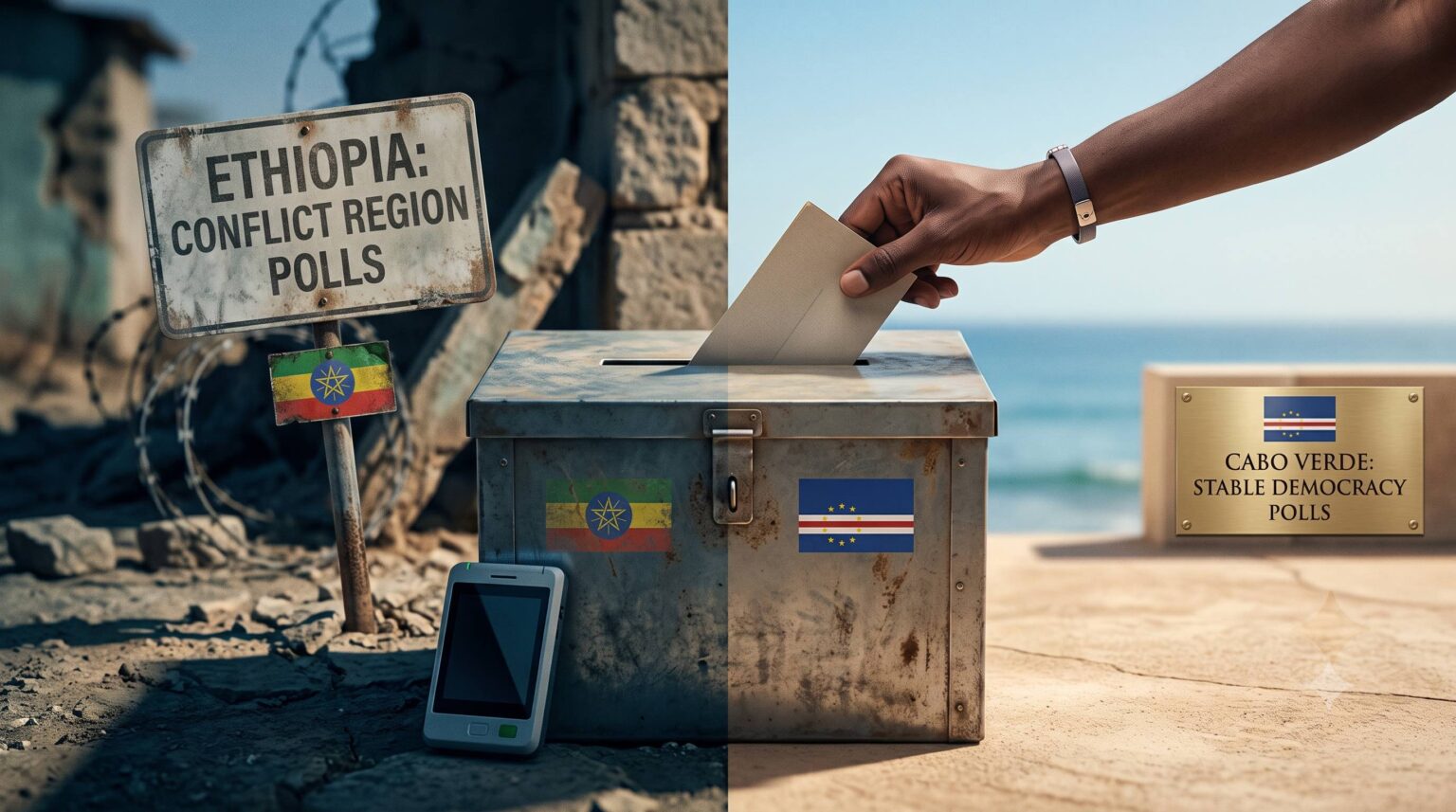

The success of Africa’s digital electoral modernisation relies fundamentally on institutional stability and baseline security, according to a comprehensive study released by African Narratives comparing the 2026 elections in Ethiopia and Cabo Verde.
The research concluded that procedural and technological advancements cannot substitute for a secure political environment, contrasting Ethiopia’s conflict-disrupted polls with Cabo Verde’s peaceful transition of power. The African Narratives study evaluated how divergent political, institutional, and security environments shaped the execution and integrity of the two processes.
The Ethiopian General Elections
According to the African Narratives study, Ethiopia’s June 1 general elections highlighted a tension between administrative advancement and severe geographical exclusion.
Federal authorities and the National Election Board of Ethiopia (NEBE) introduced digital voter registries and piloted the “Fayda” national electronic identity verification system. This infrastructure supported approximately 54m registered voters and between 48,000 and 52,000 polling stations. Financially, the state allocated a budget of 10.5bn Ethiopian Birr, supported by a 7m USD fund managed by the United Nations Development Programme (UNDP).
Despite these procedural investments, localised conflicts and political rifts in the Amhara, Oromia, and Tigray regions forced NEBE to postpone or suspend voting in 46 constituencies. As a result, only 501 of the 547 constitutional parliamentary seats were contested. Unresolved administrative gridlocks following the 2022 Pretoria Peace Agreement prevented voting in Tigray, while active warfare disrupted polling in rural swathes of Amhara and Oromia.
The ruling Prosperity Party, led by Prime Minister Abiy Ahmed, campaigned on a centralist national integration vision known as “Synergy” (Medemer). It faced a fragmented opposition landscape advocating for regional autonomy, including the Ethiopian Citizens for Social Justice (EZEMA) led by Berhanu Nega, the National Movement for Amhara (NaMA), and the Oromo Federalist Congress (OFC).
Operating under a first-past-the-post (FPTP) system, opposition movements faced severe administrative and security restrictions outside Addis Ababa. Following boycotts by the Oromo Liberation Front and the legal exclusion of the Tigray People’s Liberation Front for compliance failures, the Prosperity Party ran uncontested in approximately 75 constituencies, winning 65 seats in Oromia and 10 in Amhara by acclamation. The final result secured a legislative landslide for the Prosperity Party, reducing opposition representation to marginal levels.
African Union (AU) and Intergovernmental Authority on Development (IGAD) observation missions commended the technical administration but explicitly noted that insecurity deeply impacted geographical inclusivity. African Narratives researchers concluded that the resulting parliamentary hegemony grants the ruling party the leverage to execute sweeping constitutional transformations, while leaving structural security challenges unaddressed.
Cabo Verde’s Legislative Elections
Conversely, the African Narratives study presented Cabo Verde’s May 17 legislative elections as a model of pluralistic party competition and constitutional durability. The process facilitated an orderly transfer of the parliamentary majority to the centre-left opposition African Party for the Independence of Cabo Verde (PAICV) from the incumbent centre-right Movement for Democracy (MpD), led by Prime Minister Ulisses Correia e Silva. The conservative Independent and Democratic Cabo Verdean Union (UCID) maintained its position as a balancing third bloc.
The 72-seat National Assembly structure includes 69 domestic seats and three permanent diaspora seats representing Africa, the Americas, and Europe and the Rest of the World.
Operating with a voter registry of approximately 416,000 citizens, the elections were jointly managed by the General Directorate in Support of the Electoral Process (DGAPE) and the National Elections Commission (CNE). Technical execution was led by the Operational Information System Nucleus (NOSI). Although the abstention rate exceeded 50%, biometric verification and real-time encrypted data transmission ensured full acceptance of the results.
The African Narratives study highlighted several structural pillars supporting Cabo Verde’s electoral integrity:
- Constitutional Oversight: A 1992 Constitution that mandates a 40% candidate Gender Quota Law and strictly separates executive and legislative competencies.
- Financial Integrity: Strict financial caps on campaign expenditures, monitored by the Constitutional Court and independent auditing bodies to prohibit foreign or anonymous donations.
- Diaspora Integration: Extensive registration and voting facilities across diplomatic missions, formally connecting expatriate citizens to the legislative framework.
President José Maria Neves will now navigate a political cohabitation dynamic with the PAICV parliamentary majority. AU monitors praised the logistical precision, recording zero systemic infractions capable of compromising the results.
Comparative Findings and Regional Implications
The African Narratives study cross-examined both nations to extract macro-level policy implications for African governance, concluding that democratic consolidation does not rely merely on the mechanical execution of periodic voting.
Structural Comparative Matrix of the 2026 Elections
| Comparative Indicator | Ethiopia | Cabo Verde |
| System Type | Ethnic federalism transitioning toward centralisation | Stable semi-presidential system |
| Competitiveness | Restricted; clear dominance by the ruling party | Equitable; balanced two-party system |
| Geographical Inclusivity | Fragmented; exclusion of Tigray and parts of Amhara and Oromia | Comprehensive; complete coverage across all islands and diaspora |
| Electoral Management | Technically advanced but faces security and political challenges | High organisational efficiency and institutional independence |
| Legitimacy Outputs | Procedural legitimacy leaving structural crises unresolved | Consensual legitimacy reinforcing peaceful transfers of power |
The research established that while the integration of digital tools is a growing continental trend, the utility of this technology is fundamentally contingent upon independent judiciaries and strong statutory guardrails. The African Narratives report concluded that comprehensive political strategies are required to address structural regional disparities and manage pluralism under the rule of law.


