
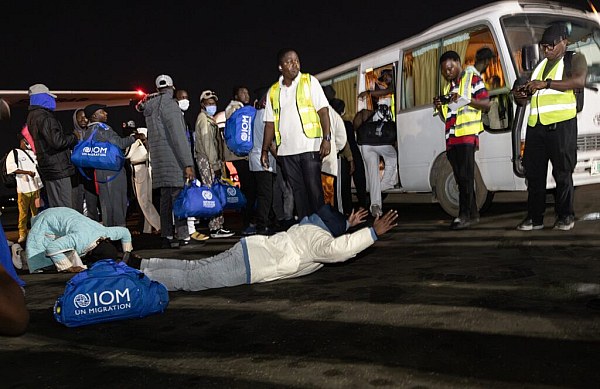

About 180 Libya returnees, West Africans stranded in the North African country, landed in Lagos on 24 November on the first return flight backed by ECOWAS, the regional bloc said, with the International Organization for Migration (IOM) running the operation.
The flight marks ECOWAS’s first concrete step on a summit order to bring home citizens stranded in North Africa, and comes with a proposed $1mn plan to help 600 Libya returnees rebuild their lives in Nigeria, Ghana and Côte d’Ivoire.
Who organised the return of the Libya returnees?
A delegation of the ECOWAS Commission led by its Commissioner for Human Development and Social Affairs joined IOM and Nigerian authorities to receive the group at the airport in Lagos, according to a statement from the ECOWAS Commission. IOM arranged the voluntary return under its Migrant Protection, Return and Reintegration (MPRR) programme, which is funded by the European Union, the statement said.
On arrival, IOM and Nigerian officials gave the Libya returnees EU-funded reception, counselling, referrals and transport to their final destinations, with attention to women, children and people with particular needs, ECOWAS said. The statement did not give the returnees’ nationalities.
Why does ECOWAS call it a first step?
ECOWAS said the flight was the first practical step in carrying out decisions of its 68th and 69th summits of heads of state on the voluntary return of community citizens stranded in North Africa, notably Libya, Tunisia and Algeria. An ECOWAS assessment mission to Libya in June found that resources were not enough to meet the number of stranded migrants, according to the bloc.
The Commission said protecting citizens on the move is part of its mandate under the ECOWAS Protocol on Free Movement, and that lessons from the first flight would shape future returns and a regional reintegration framework. It gave no date for the next flight.
What support will Libya returnees get at home?
ECOWAS and IOM are advancing a proposed $1mn initiative for the reintegration of eligible returnees in Nigeria, Ghana and Côte d’Ivoire, the statement said. It is expected to help 600 people, 200 in each country, with economic, social and psychosocial support. The plan is described as proposed: the statement did not say when it would start or who would fund it.
The EU funds protection for migrants in vulnerable situations along the Central Mediterranean route, voluntary returns from transit countries such as Libya and reintegration in countries of origin, ECOWAS said.
What is the background?
Libya is the main departure point for migrants trying to reach Italy and, increasingly, the Greek island of Crete, where arrivals have risen this year. Many West Africans who fail to make the crossing, or run out of money, end up stranded in Libyan towns and detention centres. IOM has for years run voluntary return flights from Libya to Nigeria and other West African countries.
West African governments have also organised their own repatriations, such as Côte d’Ivoire’s return of 135 migrants from Niger with IOM support in August.
FAQ
How many Libya returnees arrived in Lagos?
About 180 stranded ECOWAS citizens arrived in Lagos on 24 November 2026, according to the ECOWAS Commission.
Who paid for the return flight?
IOM arranged it under its Migrant Protection, Return and Reintegration programme, which is funded by the European Union, ECOWAS said.
What help will Libya returnees receive?
ECOWAS and IOM propose a $1mn plan to support 600 returnees, 200 each in Nigeria, Ghana and Côte d’Ivoire, with economic, social and psychosocial help.
Will there be more ECOWAS return flights?
ECOWAS said lessons from the first flight would shape future returns, but it gave no date for the next one.


