
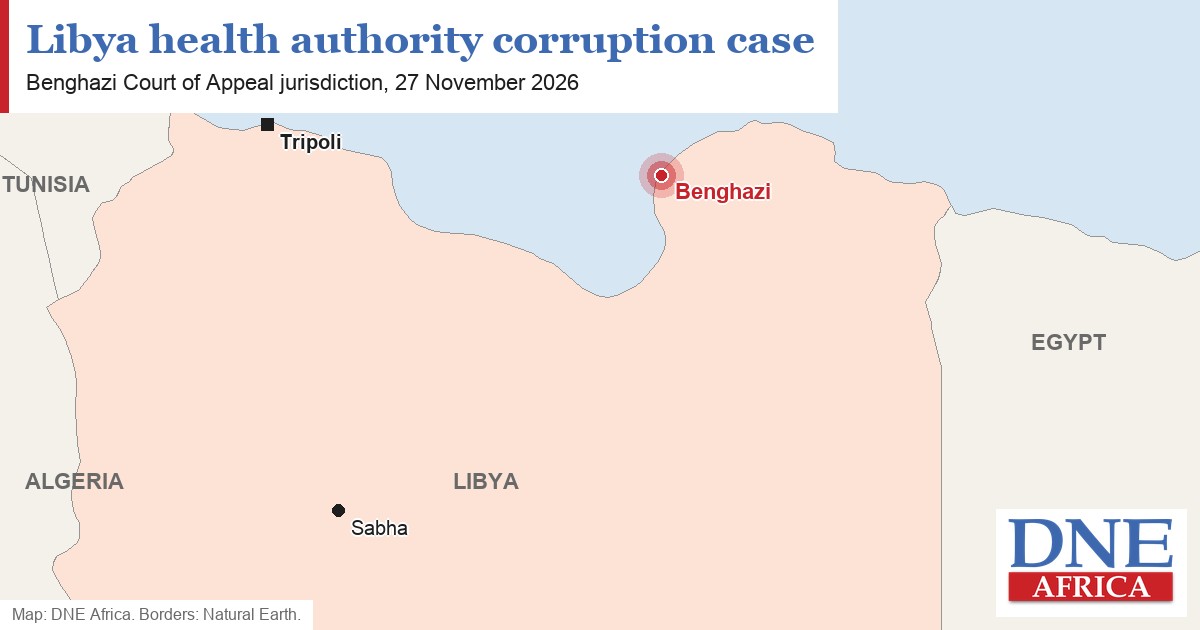

Libya’s Attorney General’s office has ordered four former officials of the country’s health accreditation authority held in a Libya corruption case over forged contract data and inflated supply deals worth more than 5mn dinars, it said on Friday.
The case is the latest in a series of Libya corruption prosecutions in the health sector, where public money for equipment and medicines has repeatedly been the target of investigations, and prosecutors say they have already frozen 3.8mn dinars linked to the contracts.
What are the officials accused of in the Libya corruption case?
The four detained are the former financial controller of the Authority for the Accreditation and Monitoring of Health Institutions, its former internal auditor, the former head of its finance section, who also sat on its tenders committee, and its former storekeeper, the Attorney General’s office said in a statement carried by LANA, the state news agency. It did not name them.
Investigators from the anti-corruption prosecution in the jurisdiction of the Benghazi Court of Appeal found that the accused had forged data on contract awards and used it to obtain a government order, the statement said. That order assigned contractors to supply equipment worth more than 5,038,610 dinars.
The accused also signed contracts priced 1,289,670 dinars above the value of the goods, and two of them abused their positions to obtain illegal gains for themselves and others, prosecutors said. Contracts were awarded to relatives of the former financial controller, which breaches the rules governing public servants, according to the statement.
Prosecutors confronted the four with the evidence and ordered them held in pre-trial detention pending further investigation. The accused have not commented publicly, and it was not known whether they had lawyers.
How much money has been recovered in the Libya corruption case?
Tracing the money paid under the contracts, prosecutors seized 3,805,000 dinars and ordered it frozen, the statement said. The office said it was pursuing others suspected of involvement, including the representatives of the contractors hired to carry out the work.
Why does the Libya corruption case matter?
The health sector has been at the centre of several high-profile cases. In January 2022 the Attorney General ordered the detention of the then health minister, Ali al-Zanati, over financial irregularities flagged by the Audit Bureau. In May 2025 prosecutors announced the detention of Ramadan Abu Janah, health minister in the Tripoli-based Government of National Unity, in a case linked to cancer drug imports.
Libya scored 13 out of 100 in Transparency International’s Corruption Perceptions Index for 2025, ranking 177th of 182 countries, among the lowest in the world. The country has been divided between rival administrations in the west and east for most of the past decade, which has weakened oversight of public spending.
The Attorney General’s office, whose prosecutors work in both the west and the east, as this Benghazi case shows, has announced a steady stream of Libya corruption detentions of serving and former officials. DNE Africa has also reported on how Libya’s divisions affect state institutions, such as the closure of Zintan airport that blocked a session of parliament.
What happens next?
The four remain in detention while the investigation continues. Prosecutors said they were still pursuing other suspects in the Libya corruption case; any trial would follow the end of the investigation.
FAQ
Who was detained in the Libya corruption case?
Four former officials of the Authority for the Accreditation and Monitoring of Health Institutions: its financial controller, internal auditor, head of finance and storekeeper, according to the Attorney General’s office. They were not named.
What are they accused of?
Forging contract award data to obtain a government order for equipment worth over 5mn dinars, signing contracts priced 1.29mn dinars above their value and awarding contracts to relatives, prosecutors said. The charges have not been tested in court.
Has any money been recovered?
Prosecutors said they seized and froze 3,805,000 dinars linked to the contracts.
How does Libya rank on corruption?
Libya scored 13 out of 100 in Transparency International’s 2025 Corruption Perceptions Index, ranking 177th of 182 countries.


