

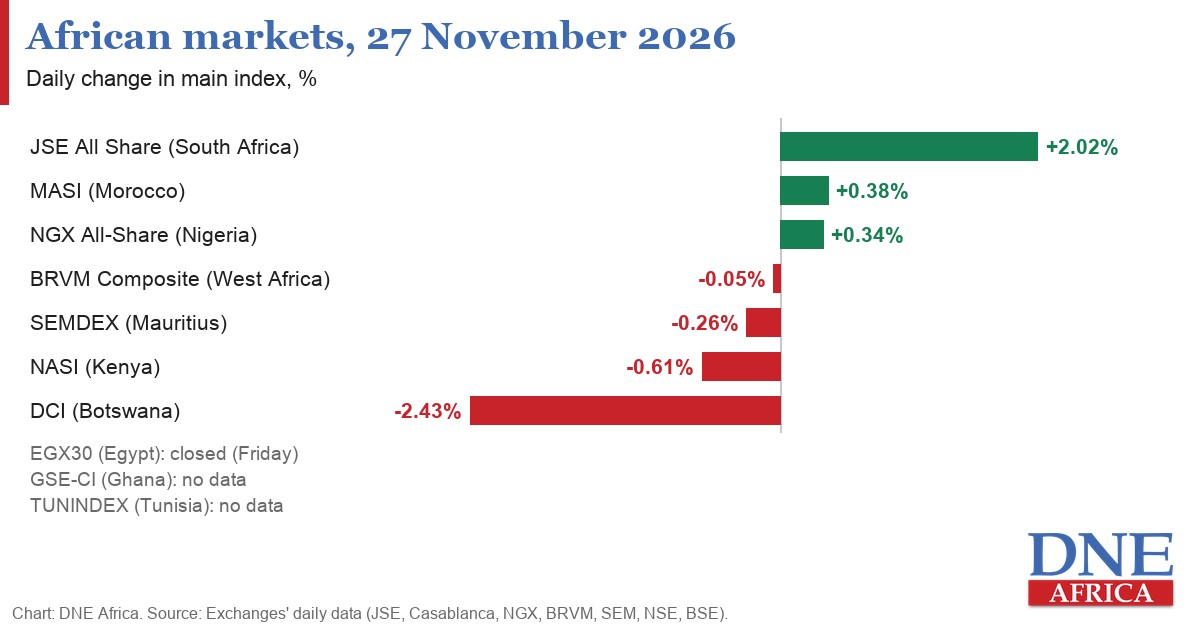
African stock markets ended the week mixed on Friday 27 November as Johannesburg’s All Share rose 2.02 per cent and its Top 40 passed 100,000 points, led by miners, while Botswana’s main index fell 2.43 per cent.
Among other African stock markets, Casablanca and Lagos gained, while Nairobi, Mauritius and West Africa’s BRVM slipped. Cairo was closed for the Egyptian weekend. Gold rose 2.44 per cent and Brent crude fell 2.55 per cent, and the naira and the rand each firmed by more than 1 per cent against the dollar on central bank rates.
Why did Johannesburg lead African stock markets higher?
The JSE All Share index, the largest of the African stock markets, rose 2,151 points to 108,783, according to JSE data, adding to Thursday’s 1.80 per cent gain. The Top 40 index of the biggest companies rose 2.25 per cent to 100,815, from 98,596 on Thursday.
Platinum and gold miners made the biggest gains on African stock markets. Impala Platinum rose 8.63 per cent, Valterra Platinum 7.81 per cent, Northam Platinum 6.62 per cent, Gold Fields 6.52 per cent and AngloGold Ashanti 6.02 per cent. Sibanye-Stillwater gained 5.89 per cent and Harmony 5.59 per cent. Naspers, the technology investor, rose 4.47 per cent, and Glencore and Anglo American gained 2.75 per cent and 2.30 per cent. British American Tobacco fell 1.47 per cent and AB InBev 1.38 per cent.
The gains came as Comex gold rose and silver jumped 7.64 per cent, according to Asharq Business market data. Gold rose on a weaker dollar and a recovery in technology shares, Asharq Business reported.
Why did Botswana’s index fall?
The Domestic Company Index of the Botswana Stock Exchange fell 276.21 points to 11,082.60, the steepest fall among African stock markets on the day and its first move after four unchanged sessions, according to the exchange’s daily market report. The only domestic share to change price was Engen, which traded ex-dividend and closed at BWP4.34, against BWP14.25 on Thursday.
A single trade of 111.66mn Engen shares at that price, worth BWP484.6mn, accounted for almost all of the day’s turnover of BWP499.8mn, the report shows. Engen has about 159.7mn shares in issue, according to the same report.
How did African stock markets in Casablanca and Lagos trade?
The Casablanca Stock Exchange MASI index rose 63.77 points, or 0.38 per cent, to 16,634.29, and the MASI 20 gained 0.20 per cent, according to the exchange. Trading was worth MAD405.8mn ($40.5mn), three times Thursday’s MAD135.9mn. Wafa Assurance rose 7.24 per cent and Jet Energy 6.33 per cent, while Jet Contractors fell 4.67 per cent and Delta Holding 3.10 per cent. Attijariwafa Bank, the most traded stock, gained 1.50 per cent.
Fineopolis Capital, a Moroccan investment bank specialising in Islamic finance, launched the first index of Moroccan shares that comply with Islamic finance principles, Asharq Business reported. The company said the index, MESI FC, holds 36 stocks worth MAD591.2bn, or 60.7 per cent of the exchange’s market value.
The Nigerian Exchange All-Share index rose 822.70 points, or 0.34 per cent, to 244,912.17. Turnover fell to N32.15bn ($23.5mn) from N102.99bn on Thursday, on 468.2mn shares in 28,642 deals, according to the exchange’s market snapshot.
Which African stock markets fell?
The Nairobi All Share Index (NASI) of the Nairobi Securities Exchange fell 1.42 points, or 0.61 per cent, to 232.57, while the NSE 20 rose 11.63 points to 4,103.55. Equity turnover was KSh953.7mn ($7.3mn).
The SEMDEX of the Stock Exchange of Mauritius fell 5.94 points, or 0.26 per cent, to 2,251.94, on trading worth Rs32.9mn. The NewGold exchange-traded fund was the top gainer, up 2.73 per cent.
The Composite index of the BRVM, the regional exchange based in Abidjan, slipped 0.23 points, or 0.05 per cent, to 453.34, its ninth fall in a row, though the BRVM-30 rose 0.06 per cent. BOA Burkina Faso and SAFCA each rose more than 7 per cent, while Société Ivoirienne de Banque and Servair Abidjan lost more than 7 per cent. Trading was worth CFA1.33bn.
Of the other African stock markets, the Egyptian Exchange does not trade on Fridays; the EGX30 last closed at 50,311.78 on Thursday. The Ghana Stock Exchange and the Tunis bourse had not published Friday’s figures by 17:00 GMT.
| Exchange | Index | Close | Change % | Turnover |
|---|---|---|---|---|
| Johannesburg | JSE All Share | 108,783 | +2.02 | n/a |
| Casablanca | MASI | 16,634.29 | +0.38 | MAD405.8mn ($40.5mn) |
| Egypt | EGX30 | closed (Friday) | closed | closed |
| Nigeria | NGX All-Share | 244,912.17 | +0.34 | N32.15bn ($23.5mn) |
| BRVM | BRVM Composite | 453.34 | -0.05 | CFA1.33bn |
| Nairobi | NASI | 232.57 | -0.61 | KSh953.7mn ($7.3mn) |
| Mauritius | SEMDEX | 2,251.94 | -0.26 | Rs32.9mn |
| Ghana | GSE-CI | no data | no data | no data |
| Botswana | DCI | 11,082.60 | -2.43 | BWP499.8mn |
| Tunis | TUNINDEX | no data | no data | no data |
Turnover on African stock markets is as published by each exchange; dollar figures use the central bank rates below. “n/a” means no confirmed figure. For the previous sessions, see Thursday’s African stock markets report and Wednesday’s report.
How did African currencies and commodities move?
The naira and the rand led African currencies higher. The naira strengthened 1.47 per cent to N1,367.45 per dollar on the official market rate of the Central Bank of Nigeria, from N1,387.89 on Thursday. The rand firmed to R17.35 from R17.53 on the South African Reserve Bank‘s weighted average rate. The birr weakened 0.42 per cent and the dirham 0.20 per cent.
Brent crude fell 2.55 per cent to $94.11 a barrel, according to Asharq Business market data. Asharq Business reported in the morning that oil was heading for its first weekly gain in November on fears of supply disruption in the Middle East. Comex gold rose 2.44 per cent to $3,651.70 an ounce.
| Currency or commodity | Rate or price | Change | Source |
|---|---|---|---|
| Egyptian pound | 54.77 buy / 54.91 sell per $ (26 Nov) | no Friday rate | CBE official, latest published |
| Nigerian naira | 1,367.45 per $ | -1.47% (stronger) | CBN official market rate |
| South African rand | 17.35 per $ | -1.03% (stronger) | SARB weighted average |
| Kenyan shilling | 130.14 per $ | +0.06% (little changed) | CBK daily rate |
| Ghanaian cedi | 11.84 per $ (mid) | +0.08% (little changed) | Bank of Ghana interbank rate |
| Moroccan dirham | 10.031 per $ | +0.20% (weaker) | Bank Al-Maghrib reference rate |
| Ethiopian birr | 161.45 per $ | +0.42% (weaker) | NBE indicative rate |
| Tunisian dinar | 3.0610 per $ (26 Nov) | -0.39% on 25 Nov (stronger) | BCT interbank average, latest published |
| CFA franc | 655.957 per euro (fixed peg) | no data per $ | BCEAO peg |
| Brent crude | $94.11 a barrel | -2.55% | Asharq Business |
| Gold (Comex) | $3,651.70 an ounce | +2.44% | Asharq Business |
| Cocoa | no data | no data | no reliable source |
| Arabica coffee | no data | no data | no reliable source |
| Wheat | no data | no data | no reliable source |
| Copper | no data | no data | no reliable source |
Brent and gold prices are as quoted by Asharq Business at about 16:50 GMT on 27 November, after most African stock markets had closed. Central bank rates are those published for 27 November, including by the Central Bank of Kenya, the Bank of Ghana, Bank Al-Maghrib and the National Bank of Ethiopia, against 26 November. The Central Bank of Egypt publishes no rate on Fridays, and the dinar rate is the Central Bank of Tunisia‘s latest published average.
FAQ
How did African stock markets perform on 27 November 2026?
They were mixed. Johannesburg’s All Share rose 2.02 per cent and Casablanca 0.38 per cent, while Botswana’s DCI fell 2.43 per cent and Nairobi 0.61 per cent. Cairo was closed, and Ghana and Tunis had not published data.
Why did Johannesburg shares rise?
Platinum and gold miners led the gains, with Impala Platinum up 8.63 per cent, according to JSE data, as gold and silver prices rose. The Top 40 index closed at 100,815.
Why did Botswana’s index fall the most among African stock markets?
Engen, trading ex-dividend, closed at BWP4.34 from BWP14.25, according to the Botswana Stock Exchange, and was the only domestic share to change price.
How did African currencies and commodities move?
The naira firmed 1.47 per cent and the rand 1.03 per cent against the dollar on central bank rates. Brent crude fell 2.55 per cent and Comex gold rose 2.44 per cent.


