
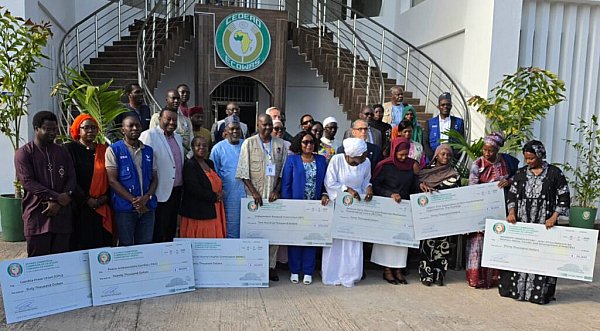

The Gambia election commission and eight other institutions and civil society groups have received $480,000 from the Economic Community of West African States (ECOWAS) for the 5 December presidential vote, the regional bloc said.
The grant, presented in Banjul on Wednesday, will pay for training 8,851 polling staff, according to the head of the Independent Electoral Commission (IEC), as President Adama Barrow seeks a third term in what will be the country’s fourth presidential vote since the end of Yahya Jammeh’s 22-year rule.
Who receives the ECOWAS money for the Gambia election?
Namizata Meite Sangare, the ECOWAS resident representative in The Gambia, handed over cheques totalling $480,000 at a ceremony in her office on 25 November, according to a statement from the ECOWAS Commission. She urged the recipients to “utilise the grant prudently and responsibly”.
Besides the IEC, the recipients are the National Human Rights Commission, the Gambia Bar Association, the National Coordination Centre for Response Mechanism, Peace Ambassadors, the Gambia Press Union, the West Africa Network for Peacebuilding (WANEP), the Association of NGOs (TANGO) and the Gambian chapter of the Inter-Africa Network for Women, Media, Gender and Development (FAMEDEV). The statement did not say how the money was split between them.
IEC chairman Joseph Colley said the commission would use its share to train 8,851 polling staff for the Gambia election. FAMEDEV said it would set up a women-led election observatory and early warning mechanism to help prevent conflict and to encourage women, young people and people with disabilities to take part.
Why is ECOWAS funding the vote?
The support was authorised by Birame Diop, the president of the ECOWAS Commission, under the bloc’s 2001 Supplementary Protocol on Democracy and Good Governance, which provides for assistance to member states holding elections, the statement said.
Serigne Ka, the commission’s head of electoral assistance, said the grant was one of several forms of help to The Gambia, alongside technical and logistical support, training on tabulating and transmitting results, and voter education. ECOWAS undertook a fact-finding mission in June with the African Union and the UN Office for West Africa and the Sahel ahead of the vote.
The bloc has had a stabilisation force in the country, known as ECOMIG, since January 2017, when West African troops entered The Gambia after Mr Jammeh refused to accept his defeat by Mr Barrow in the December 2016 election. Mr Jammeh then left for exile in Equatorial Guinea.
Who is standing in the Gambia election?
The IEC this month cleared five candidates, among them Mr Barrow, who was re-elected in 2021, and Ousainou Darboe, the veteran leader of the United Democratic Party. Mr Barrow has said he would support presidential term limits; an attempt to adopt a new constitution with a two-term limit failed in the National Assembly in 2020.
The Gambia election comes as several West African states face political strain. Neighbouring Guinea-Bissau’s transitional government has delayed elections to 2028, while Cape Verde completed a presidential vote this month.
What happens next?
ECOWAS long-term observers have been deployed in the country since 10 November and will be joined by short-term observers before polling day, the statement said. The combined observation mission is led by José Ulisses Correia e Silva, a former prime minister of Cape Verde. About 8,851 polling staff are due to be trained before 5 December.
FAQ
When is the Gambia election?
The presidential election is on 5 December 2026.
How much has ECOWAS given for the Gambia election?
ECOWAS presented cheques totalling $480,000 to the electoral commission and eight other institutions and civil society groups on 25 November, the bloc said.
What will the electoral commission use the money for?
The IEC chairman said it would pay for training 8,851 polling staff.
Who leads the ECOWAS observer mission?
Former Cape Verdean prime minister José Ulisses Correia e Silva heads the combined ECOWAS election observation mission.


