
By using this site, you agree to the Privacy Policy and Terms of Use.
Accept
DNE Africa
  • Home
  • Politics
    Fantasia: An Algerian Cavalcade by Assia Djebar: Africa's 100 Best Books, No. 6 of 100, DNE Africa series card with a photo of the author
    Culture

    Fantasia: An Algerian Cavalcade, the conquest in its victors’ words

    By DNE Africa 17 Min Read
    Top 100 companies ceremony in Maputo: President Daniel Chapo speaks at the KPMG Top 100 Companies in Mozambique event
    Business

    Mozambique’s top 100 companies’ sales fall 2.3%, Chapo presses on jobs

    By DNE Africa November 27, 2026
    Africa news today: map of Ethiopia, Eritrea and South Sudan showing fighting near Badme and Addis Ababa, where a South Sudan task force launches
    Politics

    Africa news today: Ethiopia’s Badme clashes, Uganda’s Lubero exit

    By DNE Africa November 27, 2026
  • Business
    Faleme iron ore map of Senegal showing Kedougou near the borders with Mali and Guinea, with Dakar and Tambacounda
    Business

    Senegal starts $933mn Faleme iron ore project with UAE’s Planet One

    President Bassirou Diomaye Faye launched the mine-to-steel complex in Kedougou, where earlier…

    By DNE Africa 6 Min Read
    South Sudan Block B2: officials and delegates on stage at the South Sudan Oil & Power 2026 closing session in Juba
    Business
    South Sudan Block B2 deal to be revised as South Africa urged to drill
    Zimbabwe tax survey: the New Parliament Building at Mount Hampden, where the 2027 budget was presented
    Business
    Zimbabwe tax survey shows 65% back paying, but many fear graft
    Cameroon unemployment survey: a busy street with shops and taxis in Douala, Cameroon's largest city
    Business
    Cameroon unemployment tops public concerns in Afrobarometer survey
    Morocco China Strengthening air services 1 1210x642 1
    BusinessWorld
    Morocco, China Sign Aviation Deal to Expand Air Connectivity, Remove Tax Barriers
  • Culture
  • Opinion
  • Technology
  • Sports
  • World
  • My Bookmarks
Reading: Afrobarometer climate survey finds Africans look to rich nations
Sign In
  • About us
DNE AfricaDNE Africa
Font ResizerAa
  • Home
  • Politics
  • Business
  • Culture
  • Opinion
  • Technology
  • Sports
  • World
  • My Bookmarks
Search
  • Home
  • Politics
  • Business
  • Culture
  • Opinion
  • Technology
  • Sports
  • World
  • My Bookmarks
Have an existing account? Sign In
Follow US
© 2026 DNE Africa. All rights reserved.
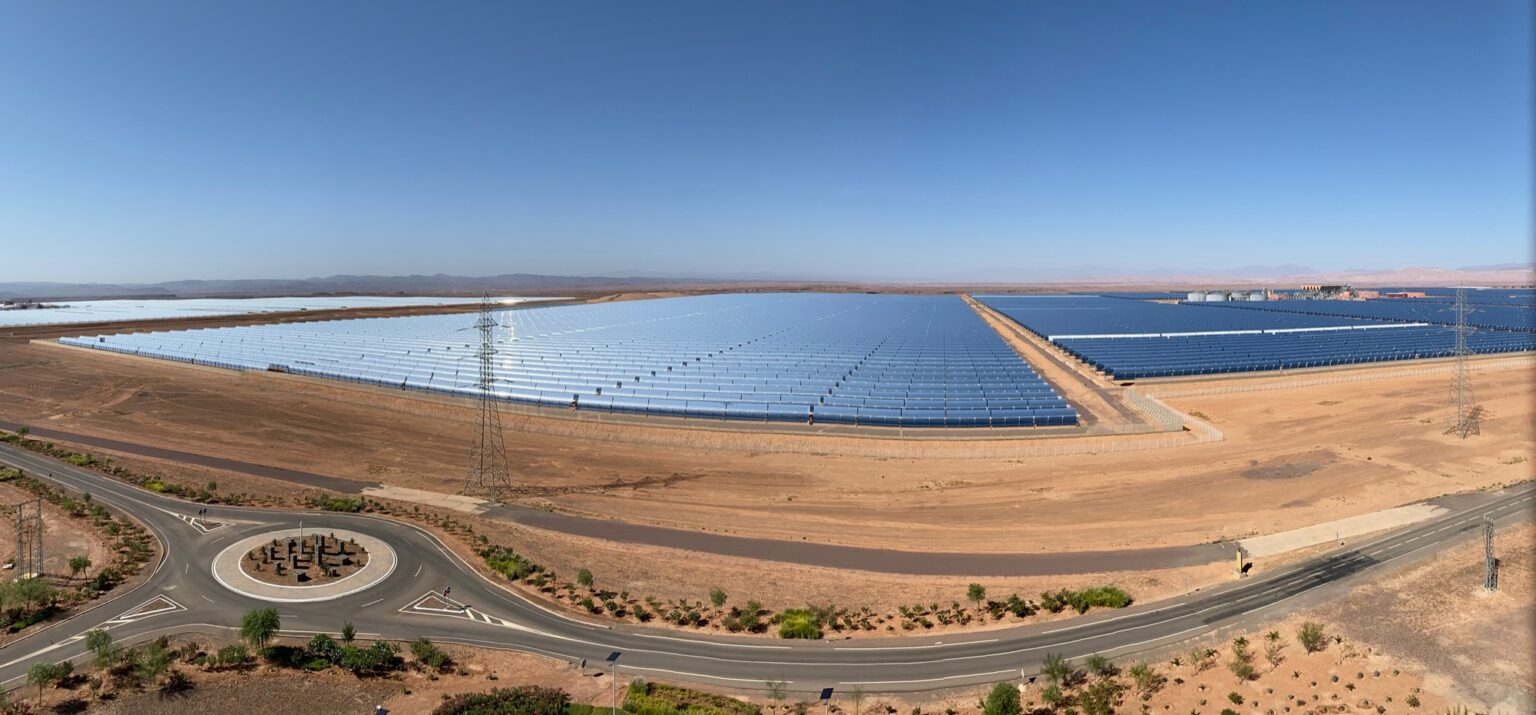
Afrobarometer climate survey: the Noor Ouarzazate solar power station in Morocco, where the survey recorded the biggest shift towards rich nations

Afrobarometer climate survey finds Africans look to rich nations

DNE Africa
Last updated: November 27, 2026 10:30 am
By DNE Africa 8 Min Read
Share
The Noor Ouarzazate solar power station, Morocco (file photo, 2019). Photo: Richard Allaway / Wikimedia Commons, CC BY 2.0
SHARE

The share of Africans who say rich countries should take primary responsibility for limiting climate change has doubled from 13% to 27%, according to an Afrobarometer climate survey of 35 countries released in Accra on 26 November.

Contents
What does the Afrobarometer climate survey show?Who do Africans say should act on climate change?How do the results compare with last year?What does it mean for climate finance talks?FAQWhat is the Afrobarometer climate survey?How many Africans say rich countries should lead on climate change?Which country saw the biggest change in the Afrobarometer climate survey?Do Africans still expect their own governments to act?

The findings put a number on a shift in African public opinion just after the COP31 talks in Antalya, where Afrobarometer said countries failed to agree on parts of climate finance. Large majorities across 38 countries say wealthy nations must cut emissions now and help poorer countries pay to adapt.

What does the Afrobarometer climate survey show?

The Afrobarometer release compares two rounds of face-to-face surveys. Across the 35 countries polled in both 2021/2023 and 2024/2025, the proportion of people aware of climate change who say rich or developed countries should bear primary responsibility for limiting it rose from 13% to 27%.

The rise was widest in North Africa and a handful of small states. The Afrobarometer climate survey recorded the largest increases in Morocco (42 percentage points), Eswatini (33 points), Seychelles (32 points) and Mauritania (32 points). Only two countries moved the other way, and only slightly: Guinea, down 3 points, and Mali, down 2.
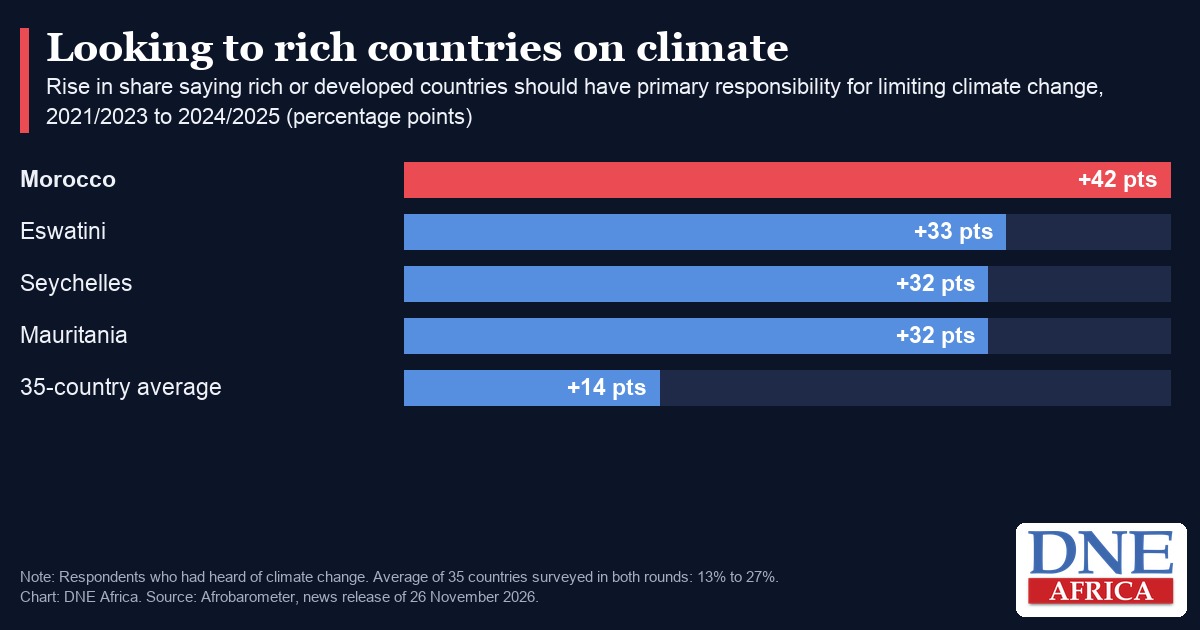
Afrobarometer climate survey chart: share saying rich countries should lead on climate rose 42 points in Morocco and 14 points on average
Chart: DNE Africa. Source: Afrobarometer

The survey network, which is based in Accra, interviews nationally representative samples in the language of each respondent’s choice. It gives country-level margins of error of plus or minus 2 to 3 percentage points at a 95% confidence level, and weights each country equally in multi-country averages.

Who do Africans say should act on climate change?

National governments are still named most often. Among respondents in the Afrobarometer climate survey who are “climate-change literate”, meaning they know human activity contributes to climate change, 37% across 38 countries say their own government should have primary responsibility.

Views differ sharply by country. Majorities in Nigeria (64%), Guinea (60%) and Chad (57%) look first to their own governments. In Morocco, Seychelles and Tunisia, 64% each say wealthy, developed countries should lead. Ordinary citizens are the most frequent answer in Uganda (48%), Zambia (44%), Togo (40%) and Ghana (37%).

Support for action is broad in the Afrobarometer climate survey. Among climate-literate respondents, 83% say rich countries must act now to limit climate change even if it is costly for them, and 85% say those countries have an obligation to help developing nations cover the cost of adapting. Some 73% say their own government should act now, even if it causes job losses or other harm to the economy.

How do the results compare with last year?

The 38-country averages match those in Afrobarometer’s pan-African climate profile published in November 2025, which drew on the same 2024/2025 round. That profile found that 56% of Africans had heard of climate change and 43% were climate-change literate, with awareness ranging from 27% in Nigeria to 91% in Seychelles.

The 2025 profile also found that half of respondents said droughts and crop failure had become more severe in their area over the past decade, and that 80% of climate-literate citizens said climate change was making life in their country worse. It noted that the belief that developed nations should lead “appears to be on the rise”. The new release measures that change across two survey rounds for the first time.

What does it mean for climate finance talks?

The Afrobarometer climate survey figures arrive as African governments press for more money for adaptation. The finance goal agreed at COP29 in Baku in 2024 aims to triple finance to developing countries to $300bn a year by 2035, from the previous goal of $100bn, according to the UN climate change secretariat. African negotiators sought a separate commitment to triple adaptation finance at COP31 but did not secure one.

Afrobarometer said citizens’ views “continue to back action” after the Antalya conference, which it said made progress on a just transition and adaptation but failed to reach agreement on aspects of climate finance and fossil fuels. The next round of talks, COP32, is due to be held in Addis Ababa, as DNE Africa reported after COP31. Afrobarometer also released a survey on Cameroon unemployment this week.

FAQ

What is the Afrobarometer climate survey?

It is part of Afrobarometer’s Round 10 surveys, carried out face to face in 38 African countries in 2024/2025. The 26 November release compares responses on climate responsibility with the previous round in 35 countries.

How many Africans say rich countries should lead on climate change?

Across 35 countries, 27% of people aware of climate change say rich or developed countries should bear primary responsibility for limiting it, up from 13% in 2021/2023, according to Afrobarometer.

Which country saw the biggest change in the Afrobarometer climate survey?

Morocco, where the share naming rich countries in the Afrobarometer climate survey rose by 42 percentage points. Eswatini, Seychelles and Mauritania followed with rises of 32 to 33 points.

Do Africans still expect their own governments to act?

Yes. Governments are the most common answer, at 37% across 38 countries, and 73% of climate-literate respondents say their government should act now even if it is costly for the economy.


You Might Also Like

UNESCO Creative Cities conference opens in Morocco’s Essaouira

Morocco, Senegal and Ivory Coast reach U-17 World Cup last 32

South Africa’s DSTI annual report shows 89% of targets met

Morocco, China Sign Aviation Deal to Expand Air Connectivity, Remove Tax Barriers

Algeria rain alert covers 22 provinces on eve of local elections

TAGGED:Climate ChangeCOP31Morocco
Share This Article
Facebook Twitter Pinterest Whatsapp Whatsapp LinkedIn Reddit Telegram Email Copy Link

You Might Also Like

Gabon cement map showing the CIMAF plant at Owendo, next to Libreville
Business

Gabon cement capacity grows as CIMAF opens line before clinker ban

By DNE Africa 3 Min Read
Morocco defence industry: official portrait of King Mohammed VI, who chaired the signing of the financing agreements in Rabat
Business

Morocco defence industry gets 22bn dirhams as DIFAA agency is named

By DNE Africa 8 Min Read
CAF Player of the Year finalists Achraf Hakimi of Morocco and Sadio Mané of Senegal in their national team jackets
Sports

CAF Player of the Year final five all from Morocco and Senegal

By DNE Africa 8 Min Read

More Popular from DNE AFRICA

Africa news today: map of Ethiopia, Eritrea and South Sudan showing fighting near Badme and Addis Ababa, where a South Sudan task force launches
Politics

Africa news today: Ethiopia’s Badme clashes, Uganda’s Lubero exit

By DNE Africa 10 Min Read
Lubero withdrawal map of North Kivu showing Lubero, Butembo, Beni, Lake Edward, Goma and Kampala

Uganda to start Lubero withdrawal from DR Congo town within two weeks

By DNE Africa
Fantasia: An Algerian Cavalcade by Assia Djebar: Africa's 100 Best Books, No. 6 of 100, DNE Africa series card with a photo of the author
Culture

Fantasia: An Algerian Cavalcade, the conquest in its victors’ words

By DNE Africa 17 Min Read
Ad imageAd image
Business

South Korea says K-Rice Belt doubled rice yields on African farms

Seoul's Rural Development Administration reports the results for Ghana, Senegal, Uganda and five other countries; seed…

By DNE Africa
Politics

Badme fighting in Ethiopia’s Tigray drives villagers from homes

Residents describe two days of shelling and air strikes near the 1998 war's flashpoint, and ACLED…

By DNE Africa
Politics

Gambia election gets $480,000 from ECOWAS for 5 December vote

The money will train 8,851 polling staff as President Adama Barrow seeks a third term, the…

By DNE Africa
Sports

South Africa’s Carling Knockout final heads to Durban for Soweto derby

The PSL picks Moses Mabhida Stadium for the first Soweto derby in a Knockout final since…

By DNE Africa
Sports

Egypt’s Marmoush and Ahly’s Mansour join donors after Warraq fire

Donations, blood drives and a minute's silence at Saturday's CAF Champions League games follow the Giza…

By DNE Africa
DNE Africa

News by Africans, For Africans

Categories

  • Science
  • Health
  • Entertainment
  • Business
  • The Escapist

Quick Links

  • Advertise with us
  • Newsletters
  • Complaint

DNE Africa.All Rights Reserved.

Welcome Back!

Sign in to your account

Username or Email Address
Password

Lost your password?