
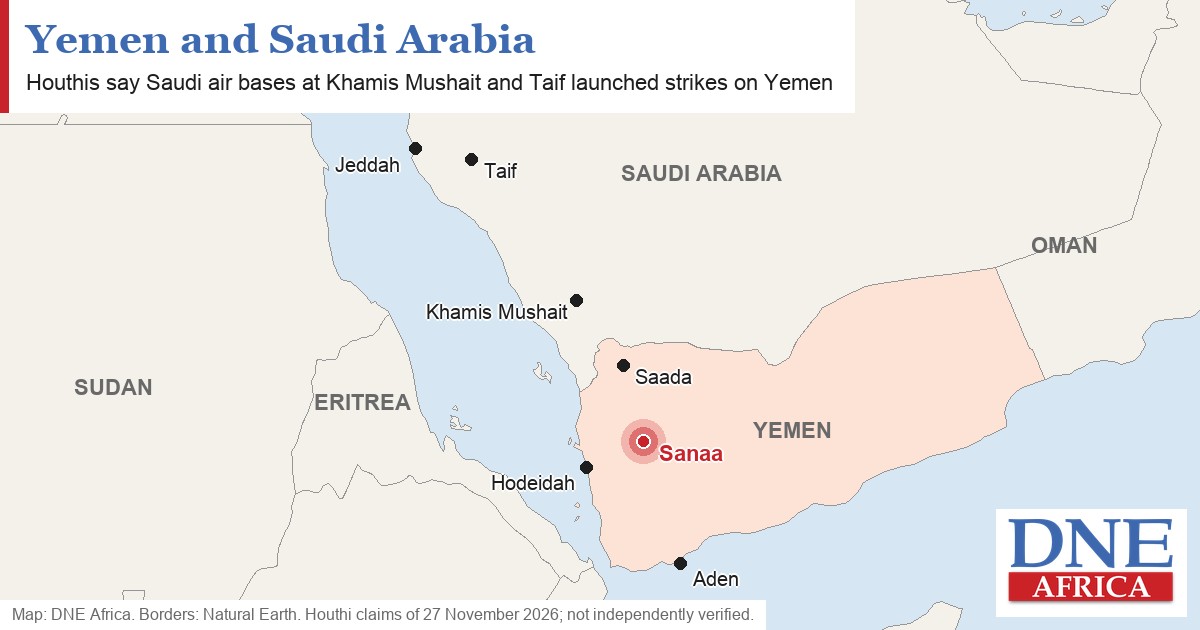

Yemen’s Houthis said on Friday that Saudi strikes had hit Sanaa and nine provinces 104 times in 24 hours, killing and wounding dozens of civilians, most of them children, a claim that could not be independently verified.
The statement points to a further escalation of the war between the Houthis and the Saudi-led coalition, which has spread to missile and drone attacks on Saudi cities and keeps shipping through the Red Sea, the main route to the Suez Canal, under threat.
What did the Houthis say about the Saudi strikes?
Yahya Saree, the Houthis’ military spokesman, said in a statement on the group’s Telegram channel that Saudi F-15 and Typhoon aircraft flying from bases at Khamis Mushait and Taif, and missiles fired from Najran, had struck the capital and the provinces of Al-Jawf, Taiz, Amran, Hajjah, Saada, Hodeidah, Lahj, Al-Bayda and Al-Dhale.
He said the Saudi strikes had left “dozens of martyrs and wounded among civilians, most of them children”, without giving figures, and that the coalition had carried out 6,038 air strikes and missile attacks since the start of what the group calls the escalation.
The Houthis’ Al-Masirah television later reported three further strikes on Sahar district in Saada province, and said a man wounded in a strike on a sewage plant in Hodeidah port on Thursday had died. The Saudi-led coalition had not commented on the figures by Friday evening.
How has the war escalated?
The coalition said on 18 November that it had hit 60 Houthi military sites, including tunnels used to make and store ballistic missiles, as Houthi forces advanced towards Aden and fought government forces in Taiz, Al Jazeera reported. The Houthis have fired missiles and drones at Riyadh and at oil sites, including the Ras Tanura area, which we covered this week.
Casualty figures from the Saudi strikes and from Houthi attacks are contested. Houthi health authorities have reported dozens of deaths in single strikes near Sanaa this month, while Yemen’s internationally recognised government has blamed the Houthis for most civilian casualties. Neither side’s figures have been independently confirmed.
Al-Masirah also reported on Friday that India’s IndiGo had extended its suspension of flights to and from Riyadh and Dammam until 7 December. The airline had earlier suspended Saudi services until 30 November, Gulf News reported; DNE Africa could not confirm the new date on IndiGo’s own advisory.
What do the Saudi strikes mean for Africa?
The Saudi strikes and Houthi attacks are taking place across the Red Sea from Eritrea, Sudan and Djibouti. Houthi attacks on shipping since late 2023 have forced many carriers to sail around Africa instead of using the Bab el-Mandeb strait and the Suez Canal, cutting Egypt’s canal revenue sharply, as our Red Sea shipping explainer sets out.
Saudi Arabia is also home to large communities of workers from Egypt, Sudan, Ethiopia and other African countries, and the BBC has reported growing fear among residents of Riyadh as Houthi missile and drone attacks increase. No African government had commented on Friday’s claims.
FAQ
How many Saudi strikes did the Houthis report?
Houthi military spokesman Yahya Saree said Saudi strikes and missiles hit Yemen 104 times in the 24 hours to Friday evening, and 6,038 times since the escalation began.
Have the Houthi figures been verified?
No. The Saudi-led coalition had not commented, and the figures could not be independently verified.
Which areas did the Houthis say were hit?
Sanaa and the provinces of Al-Jawf, Taiz, Amran, Hajjah, Saada, Hodeidah, Lahj, Al-Bayda and Al-Dhale.
How does the Yemen war affect Africa?
It threatens shipping through the Bab el-Mandeb strait and the Suez Canal, which affects Egypt’s revenues and trade with East Africa, and puts African workers in Saudi Arabia at risk from attacks.


