
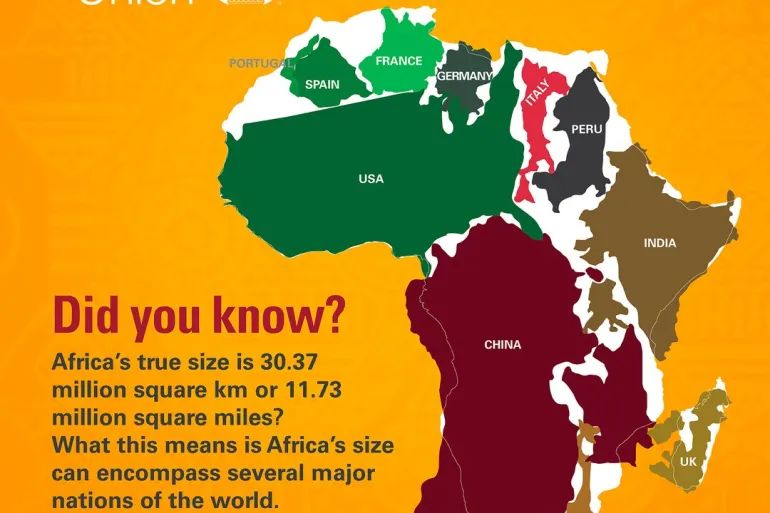

In a bid to challenge centuries of cartographic distortion, the African Union (AU) has called for the global adoption of the “Equal Earth Map,” which more accurately reflects the true size of the world’s continents.
Speaking to Reuters, Salma Malika Haddadi, Deputy Chairperson of the AU Commission, said the issue goes beyond geography. “It is not just about a map, but about a mindset that has been entrenched for decades,” she explained, noting that the popular Mercator projection—created in the 16th century—grossly inflates the size of regions near the poles such as North America and Greenland, while drastically shrinking Africa’s scale.
Despite being the world’s second-largest continent, home to over 1.4 billion people, Africa often appears diminished on school maps and global charts. Advocates argue this distortion reinforces perceptions of marginality and undermines Africa’s global standing.
Campaign for justice through cartography
The AU’s stance comes as part of the broader “Correct the Map” campaign, spearheaded by advocacy groups Africa No Filter and Speak for Africa. The initiative promotes the Equal Earth Map—introduced in 2018—as a fairer representation of countries’ actual proportions.
Moky Makura, Executive Director of Africa No Filter, described the Mercator projection as “the longest-running misinformation campaign in history.” Similarly, Farah N’Diaye, co-founder of Speak for Africa, stressed that distorted maps negatively affect African children from an early age, weakening their sense of identity and pride.
Education and international adoption
The AU and its partners aim to integrate the Equal Earth Map into school curricula across the continent while lobbying international organizations—such as the World Bank and United Nations—to adopt the projection in their own materials.
“This aligns with the AU’s mission to restore Africa’s rightful place in the international arena,” Haddadi emphasized, linking the effort to ongoing global conversations on reparations for colonialism and slavery.
Some progress is already visible. Google, for instance, shifted its desktop Earth view to a 3D globe in 2018, though its mobile version still relies on Mercator. Meanwhile, the World Bank says it is gradually phasing out Mercator in favor of alternative projections like Winkel-Tripel and Equal Earth in its electronic maps.
Beyond Africa, the initiative has also drawn support from the Caribbean Community’s Reparations Commission, which views the adoption of Equal Earth as a symbolic rejection of the dominance-oriented worldview embedded in Mercator’s projection.
Toward a fairer global map
Although the Mercator map continues to dominate classrooms, publications, and international charts, campaigners insist that shifting to a fairer map is more than a technical correction—it is a matter of cultural justice.
As Haddadi put it, the Equal Earth Map represents an overdue step toward “reshaping how Africa is seen, and how Africans see themselves.”


