
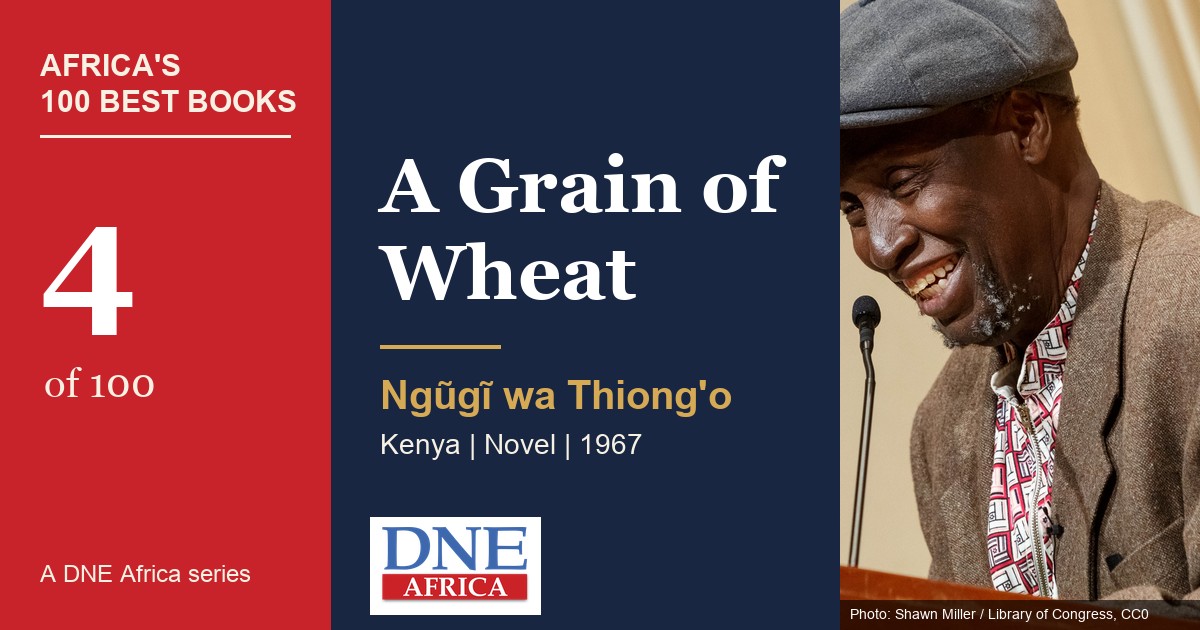

A Grain of Wheat, the 1967 novel by Kenya’s Ngũgĩ wa Thiong’o about a village in the days before independence on 12 December 1963, exists in two versions: in 1986, in exile in London, the author rewrote it.
Africa’s 100 Best Books, No. 4 of 100. See the full list and every article in the series.
The changes matter because A Grain of Wheat is a central novel of how Kenya became free and who paid for it. Ngũgĩ, who died in May 2025, revised it to fit the politics he had reached by the 1980s. Weeks before Kenya marks the 63rd anniversary of independence, his family has opened a cultural centre in his old Limuru home, and Kenyan writers are still arguing over the languages he chose.
The standard account is well known. Ngũgĩ, then publishing as James Ngugi, wrote A Grain of Wheat as a postgraduate student at the University of Leeds, and Heinemann published it in 1967, according to James Currey, who ran Heinemann’s African Writers Series from 1967 to 1984. The jury that chose Africa’s 100 best books in 2002 placed it in its top 12, according to the African Studies Centre Leiden. Penguin’s 2012 edition carries an introduction by Abdulrazak Gurnah, the Tanzanian-born Nobel laureate, according to the publisher.
A note on method: DNE Africa found no legal free copy of the text of A Grain of Wheat, which is in copyright. This article draws on Kenyan critics and press, the author’s letters to his publisher and published scholarship, and quotes none of the novel’s lines.
Table of Contents
In this article
What is A Grain of Wheat about?
The novel is set in Thabai, a village in central Kenya, in the days before Uhuru, the independence celebrations of 12 December 1963. Writing to his editor Keith Sambrook from Leeds in April 1965, he said that “the whole action is supposed to be contained within 10 days around independence in Kenya”, a letter Currey quotes in his history of the series.
At its centre is Mugo, a solitary man whom Thabai has chosen as its hero for his conduct in the detention camps, and who carries a secret he cannot tell, as the publisher’s description puts it. Around him are Gikonyo, a carpenter who comes home after six years in camps; his wife Mumbi; Karanja, who sided with the colonial authorities and became chief; and the memory of Kihika, a young fighter who went to the forest and was killed, according to a summary in EBSCO’s research guide.
The story moves back and forth between 1963 and the years of the Emergency, the state of emergency Britain declared in 1952 during the Mau Mau uprising, which lasted until 1960. The book’s question is who betrayed Kihika, and what a village should do with the answer; DNE Africa will not give it away.
The title comes from St John’s Gospel, the verse about a seed that must fall into the ground and die before it bears fruit. In A Grain of Wheat, sacrifice and betrayal grow from the same soil.
What did Ngũgĩ change in A Grain of Wheat in 1986?
By 1986 James Ngugi had become Ngũgĩ wa Thiong’o, a former detainee living in exile who now wrote fiction in Gĩkũyũ. The revised A Grain of Wheat came out under his new name, according to Gale’s reference entry on the author, which lists the novel as “1967; revised 1986”.
The clearest change concerns the forest fighters. In the 1967 text a fighter called Koinandu rapes Dr Lynd, a white woman who had employed him. In 1986 he is renamed Koina, the rape is gone, and in its place he kills her dog, according to the scholar Jacqueline Bardolph, whose essay is reprinted in Gale’s entry. Brendon Nicholls of the University of Leeds also refers to the rape in “the original 1967 version” in a 2026 paper in African Studies Review.
Bardolph found two more shifts. General R, a former tailor whose violence the 1967 text traces to a quarrel with his own father, becomes an articulate anti-colonial fighter. And the Reverend Jackson, a minister killed by the fighters, is recast in 1986 as an informer whose execution the text treats as just. Bardolph read the revisions as a turn to a more didactic book, though she judged that it still “remains complex, alive and fraught with deep contradictions”. Carol Sicherman argued in 1989 that they reflected his growing condemnation of neocolonialism.
The original manuscript is held at SOAS in London, among the Heinemann African Writers Series papers, according to Bardolph and the SOAS library. Readers who want to know which A Grain of Wheat they hold should check the date on the copyright page.
What do Kenyan critics say about A Grain of Wheat?
Simon Gikandi, the Kenyan scholar at Princeton who has written widely on Ngũgĩ, places the novel at the hinge of the author’s career. In a tribute in The Conversation after Ngũgĩ’s death, he wrote that A Grain of Wheat and Petals of Blood sit in a zone where the new nation is caught between its hopes and the possibility of failure and betrayal. In his 2000 study of Ngũgĩ, Gikandi described two earlier short stories as working prototypes of the novel, as Nicholls notes.
It is a novel of independence that refuses to celebrate: the price of Uhuru is counted in broken marriages and unspoken guilt as much as in the dead.
Peter Kimani, the Kenyan novelist and journalist, has traced how the state answered that refusal. Writing in The Conversation in 2022, he recalled that after Ngũgĩ’s detention in 1977 and 1978, his books were not banned but were not taught in Kenyan schools for two decades.
Scholars abroad have pressed the point further. Nicholls argues that the novel tries to imagine sovereignty after independence yet stays bound to colonial relationships, which Ngũgĩ’s later fiction set out to break.
Why did the novel turn Ngũgĩ away from English?
A Grain of Wheat is written in English, with shifting points of view, delayed revelation and long passages inside characters’ heads, a method critics have often compared to Joseph Conrad’s. Currey wrote that Ngũgĩ developed his characters “with Conradian skill”.
After finishing the book, Ngũgĩ later wrote, he fell into a crisis. Kimani quotes him: “I knew whom I was writing about but whom was I writing for”. Ngũgĩ’s answer, in the 1970s, was to write plays and then fiction in Gĩkũyũ, starting with the novel he drafted on prison toilet paper, Caitaani Mũtharaba-Inĩ (Devil on the Cross).
The 1986 revision belongs to the same turn: Ngũgĩ did not translate A Grain of Wheat into Gĩkũyũ, he corrected it in English, from exile.
How is Ngũgĩ read in Kenya today?
On 8 August 2026 the Ngũgĩ wa Thiong’o Cultural and Arts Centre opened at his family home at Gitogoothi in Limuru, Kiambu County, according to his son Tee Ngũgĩ, writing in the Daily Nation, and Kimani in The Standard. At the launch the family introduced Gĩkũyũ translations of his first two novels, Tiga Kurira, Mwana (Weep Not, Child) and Ruui Rwa Muoyo (The River Between), which Tee Ngũgĩ said his father worked on in his last years. DNE Africa found no announced Gĩkũyũ edition of A Grain of Wheat.
His language choices are still argued over. In January, Enock Matundura, who teaches Kiswahili at Chuka University, accused Ngũgĩ in his Taifa Leo column of paying only lip service to Kiswahili, as Mbugua Ngunjiri reported in The Standard.
The novel asks who gets to tell the national story; Kenyan readers now ask in which language.
Who was Ngũgĩ wa Thiong’o?
Ngũgĩ was born in Limuru in 1938 and educated at Alliance High School, Makerere University College in Uganda and Leeds, according to Gale. He was detained without trial at the end of 1977 and held at Kamiti Maximum Security Prison for most of 1978, after a play he co-wrote in Gĩkũyũ, Ngaahika Ndeenda, was staged in his home village, according to Currey and Kimani.
He went into exile in 1982 and taught in Britain and the United States; on a visit home in 2004 he and his wife were attacked, Kimani wrote. His 1986 essays, Decolonising the Mind, made the case for African-language literature. He died in the United States on 28 May 2025, aged 87, and his remains were cremated there in line with his wishes, Kenyan media reported. Chinua Achebe, author of Things Fall Apart, was among the first to back the young Ngũgĩ as adviser to the African Writers Series, Currey recounts.
Questions for discussion
- Thabai chooses Mugo as its hero before it knows him. What does the novel suggest about how communities make heroes?
- Gikonyo comes home from the camps to a changed marriage. Is his story one of betrayal, of survival, or both?
- Ngũgĩ cut a rape and recast a minister when he revised A Grain of Wheat in 1986. Should an author be free to rewrite a classic, and which version should schools teach?
- Ngũgĩ later asked whom he had been writing for. Would A Grain of Wheat be a different book in Gĩkũyũ or Kiswahili?
Read next in the series
- Things Fall Apart by Chinua Achebe (Nigeria), No. 1: the novel that opened the African Writers Series.
- Caitaani Mũtharaba-Inĩ (Devil on the Cross) by Ngũgĩ wa Thiong’o (Kenya), No. 30: the Gĩkũyũ novel written in prison (coming soon).
- Facing Mount Kenya by Jomo Kenyatta (Kenya), No. 57: the anthropology of the Gĩkũyũ by the man who became Kenya’s first president (coming soon).
Also in the series: The Cairo Trilogy by Naguib Mahfouz.
More from Africa’s 100 Best Books
- Previous, No. 3: So Long a Letter by Mariama Bâ (Senegal)
- Next, No. 5: Nervous Conditions by Tsitsi Dangarembga (Zimbabwe) (coming next in the series)
- All 100 books in the series
FAQ
Who wrote A Grain of Wheat?
Ngũgĩ wa Thiong’o, the Kenyan novelist, playwright and essayist (1938-2025). The first edition, published by Heinemann in 1967, appeared under the name James Ngugi.
What is A Grain of Wheat about?
It follows the people of Thabai, a Kenyan village, in the days before independence on 12 December 1963, as they prepare to honour the heroes of the war against British rule and confront who betrayed one of them.
Are there two versions of A Grain of Wheat?
Yes. Ngũgĩ published a revised edition in 1986. According to scholars including Jacqueline Bardolph, he renamed a fighter, removed a rape and recast a church minister as an informer.
Was A Grain of Wheat written in English?
Yes. It was one of Ngũgĩ’s English novels. After it, he said he faced a crisis over whom he was writing for, and from the late 1970s he wrote his fiction in Gĩkũyũ.


