
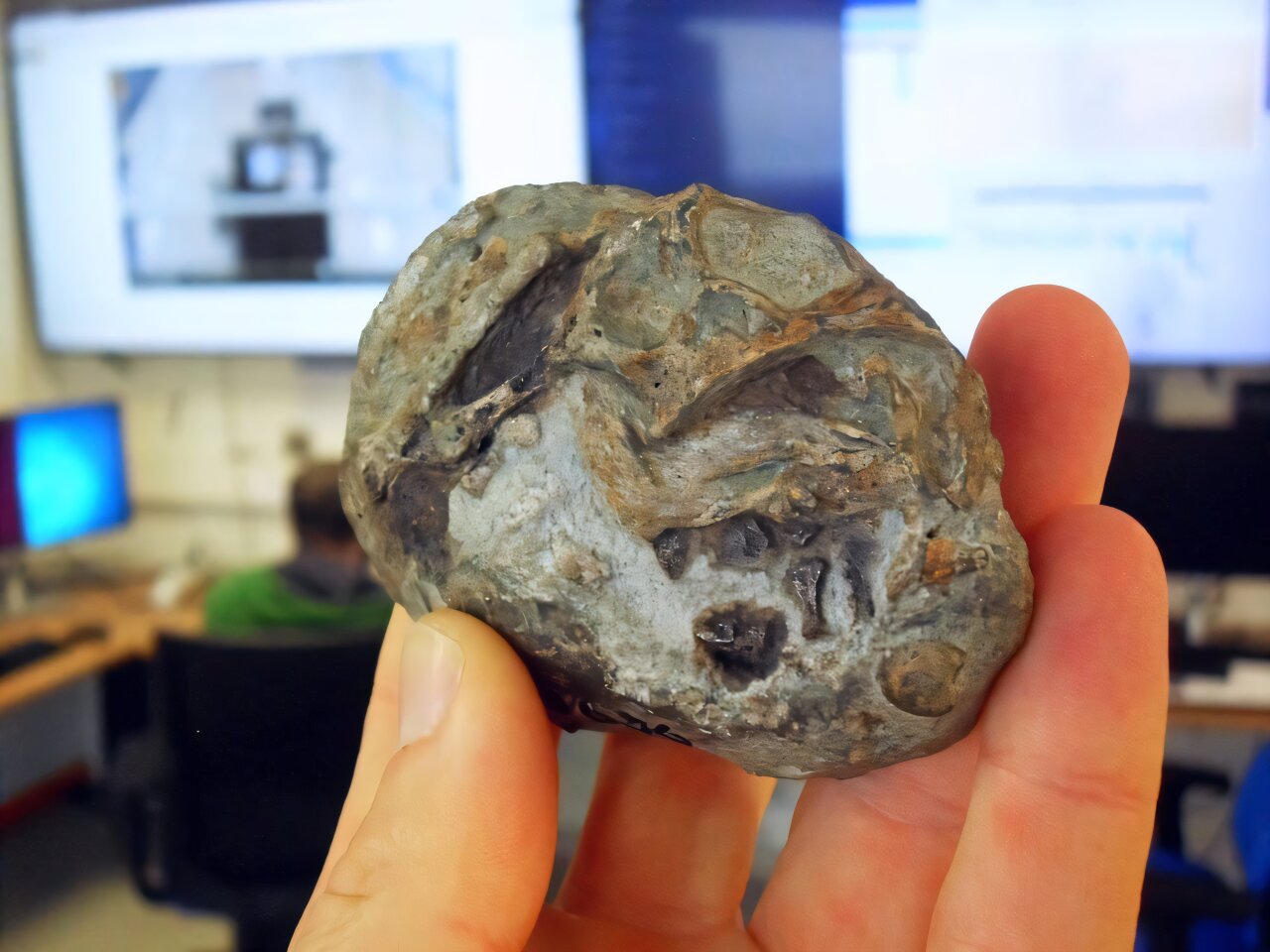

Scientists have discovered the first fossilized egg containing an embryo from a distant ancestor of mammals, helping to settle a long-standing question about how these ancient animals reproduced.
The study focuses on Lystrosaurus, a plant-eating animal that lived about 250 million years ago and belonged to a group called Therapsids—early relatives of mammals, including humans.
The findings reveal that these ancient animals laid eggs, rather than giving birth to live young as many modern mammals do.
A long-standing mystery
Therapsids lived between 280 and 200 million years ago and were first identified more than a century ago from fossils found in South Africa. Over time, scientists discovered thousands of their fossils.
But one thing remained missing: their eggs.
Even famous fossil hunter James Kitching, who collected many therapsid fossils from South Africa’s Karoo region, never found a single egg. This led some scientists to wonder if these animals might have given birth to live young instead.
Now, researchers say they have clear evidence that at least some therapsids laid eggs.
A rare fossil discovery
The fossil at the center of the study was discovered in 2008 near Oviston in South Africa’s Eastern Cape by paleontologist John Nyaphuli. It has been stored at the National Museum in Bloemfontein.
At first glance, the fossil did not look like an egg. It contained only a curled-up embryo, with no visible shell. This made it difficult to confirm how the animal reproduced.
To solve this puzzle, scientists used advanced imaging technology at the European Synchrotron Radiation Facility in France. This powerful X-ray system allowed them to study the tiny bones inside the fossil without damaging it.
The scans revealed an important clue: the lower jaw bones of the embryo were not fully fused.
In modern animals like turtles and birds, jaw bones fuse before hatching so that newborns can feed immediately. The unfused jaw in this fossil suggested that the embryo had not yet reached that stage.
This meant the animal died before hatching—inside an egg.
What the egg reveals
The discovery provides new insights into how Lystrosaurus lived and survived.
Scientists believe the eggs were relatively large for the animal’s size and likely had soft, leathery shells rather than hard ones. Hard-shelled eggs did not appear until tens of millions of years later.
Large eggs would have offered two key advantages.
First, they would lose less water in dry conditions. This was crucial because Lystrosaurus lived during and after one of the harshest periods in Earth’s history—the Permian-Triassic mass extinction, often called the “Great Dying.”
Around 252 million years ago, this event wiped out about 90% of all species on Earth.
In such a dry and unstable environment, eggs that retained moisture better would have improved survival chances.
Second, large eggs mean that babies likely hatched at a more advanced stage. These young animals could move, feed themselves, and avoid predators soon after hatching.
A survival strategy
Lystrosaurus is famous for surviving the mass extinction that killed most other species.
The new findings suggest that its reproductive strategy may have played a key role in that survival.
By producing well-developed young that could grow quickly and reproduce early, the species may have been able to recover faster than others.
Growing fast, reproducing early, and spreading quickly may have been the secret to its success.
Why it matters today
The discovery does more than solve a fossil mystery. It also helps scientists understand the early evolution of mammals, including how traits like reproduction and milk feeding developed over time.
Some modern mammals, such as the platypus and echidna, still lay eggs. Studying ancient species like Lystrosaurus helps explain how these unusual traits evolved.
Researchers say the findings may also offer lessons for today.
As Earth faces what many scientists call a sixth mass extinction, understanding how past species survived extreme environmental change could help explain how modern animals might cope.
This rare fossil, hidden for millions of years, is now helping scientists piece together one of the most important chapters in the history of life.


