
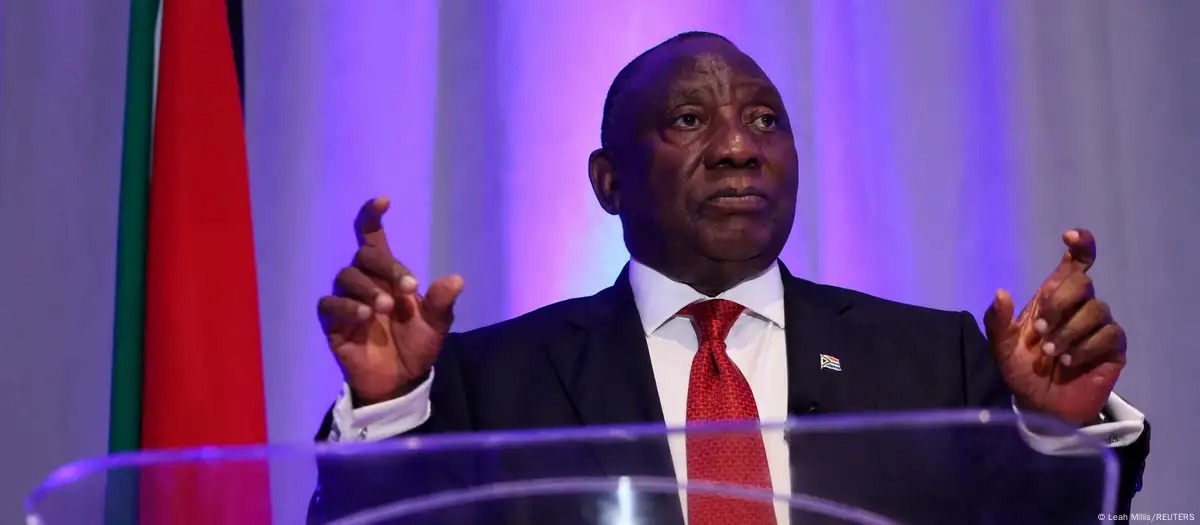

South African President Cyril Ramaphosa has suspended Police Minister Senzo Mchunu and announced the formation of a high-level commission of inquiry following serious allegations of interference in investigations and alleged links to organized crime.
The decision comes after KwaZulu-Natal Police Commissioner, Lieutenant General Nhlanhla Mkhwanazi, publicly accused Mchunu of obstructing a special police task force investigating political assassinations and criminal syndicates.
In a national address on Sunday, Ramaphosa said the allegations raised “serious concerns around the Constitution, the rule of law, and national security,” stressing the need for urgent and thorough investigation.
Mchunu, who has denied the allegations, was placed on immediate leave. Ramaphosa appointed Professor Firoz Cachalia, a legal academic at the University of the Witwatersrand, as Acting Minister of Police. Cachalia is expected to assume office by the end of July.
The newly announced commission, to be led by South Africa’s Deputy Chief Justice, will investigate whether criminal groups have infiltrated the police, intelligence services, and broader justice system.
According to the presidency, the inquiry will assess whether senior officials facilitated criminal operations, ignored internal warnings, or benefited politically or financially from syndicate activity.
The commission is expected to deliver its first interim report within three months, with final findings due within a year.
Opposition parties criticize scope of inquiry
Despite the announcement, opposition parties expressed skepticism. Ian Cameron, a member of the Democratic Alliance (DA) and Chair of Parliament’s Police Committee, described the move as insufficient.
“Parliament and SAPS [South African Police Service] leadership cannot wait for another prolonged process while trust in policing collapses,” he said.
The Economic Freedom Fighters (EFF) also criticized the arrangement, stating that Mchunu remains on full salary while allegedly retaining influence behind the scenes. The party further questioned the effectiveness of previous commissions initiated by the presidency.
The DA, EFF, and uMkhonto weSizwe Party have already laid criminal charges against Mchunu based on Mkhwanazi’s allegations.
Allegations linked to political killings unit
The controversy centers around a special task team formed in 2018 to investigate political killings. The unit handled over 600 cases, made 436 arrests, and recovered 156 firearms—more than 50 linked to political crimes.
At the end of 2024, Mchunu reportedly requested the unit be disbanded. When the request was denied, the unit’s case dockets were seized, allegedly under the direct orders of Mchunu and Deputy National Commissioner Shadrack Sibiya.
Mkhwanazi alleged that the task team uncovered links between politicians, prosecutors, and criminal networks, and that Mchunu received political funding from a businessman implicated in corruption.
Mchunu has dismissed the claims as “baseless,” but has expressed support for the inquiry.
The latest developments are expected to increase pressure on Ramaphosa’s government, which is already facing scrutiny over rising crime, governance challenges, and the effectiveness of institutional reforms in the post-Zondo Commission era.


