
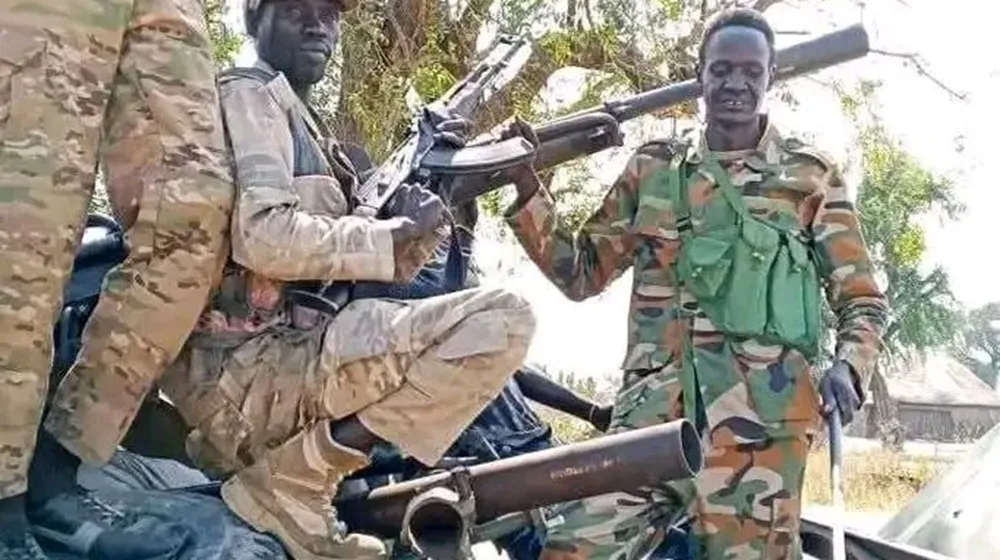

South Sudan government and opposition forces have issued contradictory claims over the control of strategic territories in Jonglei State, as humanitarian organizations warned that nearly 400,000 civilians are at risk due to blocked aid and escalating violence.
The South Sudan People’s Defence Forces (SSPDF) Deputy Spokesperson, Ateny Wek Ateny, announced in a Facebook video on Saturday that the national army had recaptured areas previously controlled by the Sudan People’s Liberation Army in Opposition (SPLA-IO) and the White Army militia. However, the SPLA-IO refuted the claim, stating that the SSPDF had failed to seize the Yuai and Payai bases.
The territorial dispute follows a statement on Thursday from Honson Chuol James, spokesperson for the Jikany Nuer White Army, who alleged that the militia alongside SPLA-IO elements had seized heavy weapons and military vehicles from the national army. James claimed the clashes occurred in Jikmir Payam, Nasir County, after South Sudanese government troops advanced from their positions in Buol at 03:30 local time. “The genocidal and tribal forces of Gen. Kiir moved out from their trenches in Nasir’s Buol,” James said, adding that the task force was intercepted and engaged immediately.
Amid the military escalation, Lt. Gen. Johnson Olony, Deputy Army Chief for Disarmament and Mobilisation, warned Jonglei State leaders on Friday against the involvement of non-combatants in the conflict. Speaking to Jonglei State Governor Riak Gai Kok in Poktap, Duk County, Olony stated that the growing involvement of civilians risked catastrophic consequences, particularly for the Nuer community.
Olony, who also commands the Agwelek forces, questioned the strategic objective of the ongoing military campaign across locations including Bor, Poktap, Duk Padiet, Pathai, and Yuai. “The conflict is fundamentally between the government and the SPLA-IO, not civilians,” Olony said, adding that no single community could rule South Sudan on the basis of tribal identity. He revived a proposal suggesting that lasting peace would only be possible if the Nuer community were granted their own state or country to govern themselves.
The remarks follow a week after Olony reportedly issued orders to troops to “spare no lives,” including civilians, ahead of a government offensive. Olony’s Agwelek forces, primarily drawn from the Shilluk community, have not been fully integrated into the SSPDF and are currently operating alongside government troops.
Humanitarian situation defoliate in South Sudan
The humanitarian situation has deteriorated alongside the fighting. The United Nations World Food Programme (WFP) issued an urgent appeal on Friday for a ceasefire and the opening of humanitarian corridors. Adham Effendi, WFP’s Acting Country Director in South Sudan, warned that 60 percent of Jonglei’s population is projected to experience crisis-level hunger during the upcoming lean season. “This escalation in fighting could not have come at a worse moment,”Effendi stated.
Further concerns were raised by Médecins Sans Frontières (MSF) on Friday, which reported that the government is blocking humanitarian aid to opposition-held areas. The organisation warned that nearly 400,000 people could be left without healthcare if the restrictions continue, as they are currently unable to reach the most vulnerable populations in the region.


