
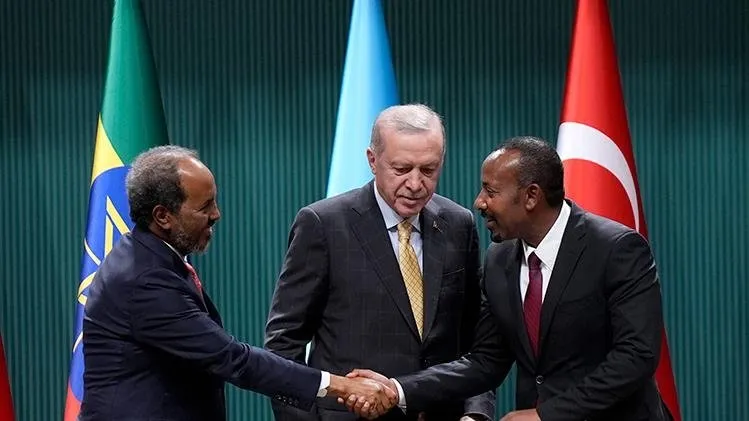

A new analysis by the African Narratives think tank indicates that a reconciliation agreement between Somalia and Ethiopia, announced by Turkey on 11 December 2024, has raised questions about the potential benefits and, crucially, the significant challenges that lie ahead for the accord.
The agreement, brokered in Ankara, also has implications for Egypt’s interests within the complex regional and international landscape, according to the report, launched on Thursday.
The report underscores that the success of the deal is far from guaranteed and will depend on future negotiations and careful navigation of numerous obstacles.
The African Narratives report explained that relations between Somalia and Ethiopia deteriorated at the start of 2024 after Ethiopia signed a memorandum of understanding with the breakaway Somaliland region.
This agreement granted Ethiopia access to establish commercial ports and naval military bases in Somaliland in exchange for Ethiopia initiating the process of recognising Somaliland’s independence. Tensions between Mogadishu and Addis Ababa escalated following the memorandum’s issuance in January. This culminated in Somalia’s decision to exclude Ethiopian forces from the African Union mission, and the declaration of a new mission set to begin in early 2025.
The agreement, known as the “Ankara Declaration,” seeks to de-escalate tensions between the two countries, the report stated.
However, the accord does not directly address contentious issues between Somalia and Ethiopia. Instead, it calls for technical negotiations to take place, with a deadline set for the end of February 2025. These discussions, expected to last four months, aim to establish a practical framework for cooperation and to resolve outstanding issues. The report makes it clear that the specifics of these negotiations will be critical for the success of the entire agreement.
According to the official Turkish statement, the Ankara agreement is limited to an exchange of mutual understandings regarding the principles governing Somalia and Ethiopia’s bilateral relations. The statement emphasised Ethiopia’s commitment to Somali unity and sovereignty, in return for Somalia’s recognition of Ethiopia’s right to access Somali coasts for economic purposes. The agreement, the statement added, also highlights mutually beneficial solutions that do not infringe on Somalia’s sovereignty.
African Narratives notes that while the agreement is a positive step, it is essentially a framework that needs to be fleshed out in future talks.
Despite the agreement being limited to an exchange of mutual understandings, and not addressing specific contentious issues, it does represent a gain for all parties involved, according to the African Narratives report. However, its true value depends on whether the planned technical negotiations are fruitful.
Turkey’s interests were the primary driver of its mediation efforts, the report stated, as it has become a significant geopolitical player in the Horn of Africa. Turkey maintains strong economic ties with Addis Ababa and has established security agreements with Mogadishu. Ankara’s influence in Somalia is substantial, ranging from humanitarian and economic assistance to infrastructure development and military support.
Through this agreement, Turkey has reinforced its role as a mediator in the Horn of Africa, showcasing its ability to bring together conflicting parties and facilitate agreements to resolve various issues. This presents significant opportunities for Turkey to enhance its military, security, and economic presence in the region. However, the report also notes that Turkey’s role as a mediator will be important in ensuring the success of future talks.
For Ethiopia, the agreement secures access to Somali ports, and strengthens its regional and international trade, given its landlocked status, the report said.
It also helps Ethiopia to reduce regional tensions, allowing Prime Minister Abiy Ahmed’s government to focus on domestic challenges, particularly armed conflicts in the Amhara and Oromia regions, as well as renewed tensions in the northern Tigray region.
Furthermore, the agreement mitigates security threats along Ethiopia’s Somali border. The change in leadership in Somaliland has also motivated Ethiopia to realign its priorities with Mogadishu, aiming for more comprehensive and sustainable settlements that generate fewer regional tensions. However, it remains unclear if Ethiopia has abandoned the agreement signed with Somaliland, an issue that underscores a potential challenge for future negotiations.
The Somali government views improved relations with Ethiopia as an opportunity to strengthen regional and internal stability, ease domestic tensions, and create avenues for economic cooperation, the report said. This could also help in addressing shared challenges, such as terrorism and the proliferation of armed groups. While the reconciliation agreement focuses primarily on economic and trade cooperation, Mogadishu remains cautious about granting military privileges to Addis Ababa in its ports, considering such actions a potential violation of its sovereignty. This caution highlights a key area where negotiations will be complex.
Dr. Ghada Kamal, a researcher at African Narratives, an expert in African affairs at the Egyptian Cabinet’s Information and Decision Support Center, and the report author, argues that several challenges may hinder Somali-Ethiopian reconciliation.
The presence of terrorist organisations, particularly Al-Shabaab, poses significant threats, especially if Somalia relies on ports in central and southern regions, such as Mogadishu.
The increasing activity of ISIS, which has expanded its operations this year, also presents challenges if Somalia depends on northern ports in Puntland, such as the Bosaso port. This makes securing a long land route from Somali coasts to the economic centre of Addis Ababa a difficult task. The report also cited growing international competition in the Horn of Africa, which could disrupt the fragile stability currently in place, and the instability in the Middle East, as potential challenges that could derail the agreement.
Following Ankara’s announcement of the reconciliation agreement, a question arises regarding its impact on Egypt, the report stated. Egypt recently supported the Somali government by providing military equipment after signing a military cooperation protocol with Mogadishu last August. Egyptian President Abdel Fattah El-Sisi reaffirmed Egypt’s support for “the unity and sovereignty of Somalia over its territory and its readiness to defend it with full strength.” The report indicates that Egypt’s concerns will need to be taken into account for the region to be truly stable.
Despite improving relations between Somalia and Ethiopia, Egypt remains a strategically important partner, particularly in military aspects, such as training programs and arms deals.
However, Somalia appears to be aiming for a neutral approach, seeking to benefit from Ethiopia to strengthen its economy while considering Egypt as a potential military ally. Thus, improving relations with Ethiopia might reflect a diplomatic balancing act rather than a concession to one party at the expense of another. This balancing act highlights another complex dynamic that will require careful management.
Several challenges may confront Egypt in the coming period, the report stated. Ethiopia’s presence on the Red Sea coasts could enable it to control the Bab el-Mandeb Strait and the Gulf of Aden, potentially threatening the Suez Canal.
This could effectively encircle Egypt. The rapprochement between Somalia and Ethiopia could limit economic and investment cooperation with Somalia, potentially causing Egypt to lose economic and investment opportunities in the region, especially given Turkey’s growing influence in the Horn of Africa. The reconciliation could also impact Egypt’s regional influence, though not drastically, as Egypt’s presence in Africa remains significant. These concerns highlight that the agreement has the potential to reshape the regional power dynamics.
Despite concerns over the potential consequences of the reconciliation between Mogadishu and Addis Ababa, it is believed that “Somalia will not risk its relationship with Egypt, Eritrea, and Djibouti,” and that Mogadishu will refuse to grant Ethiopia a military port on its coasts.
Furthermore, Turkey, having recently improved its relations with Egypt, is unlikely to risk a new confrontation and will be cautious to prevent Ethiopia from gaining a military foothold in the Bab el-Mandeb Strait. These are concerns Egypt has previously expressed to Horn of Africa countries. Egypt is unlikely to be excluded from the Horn of Africa equation, as it has recently succeeded in strengthening its ties with regional countries like Djibouti, Eritrea, and Somalia.
The report suggests this as a potential foundation for further diplomatic efforts.
In light of these expected challenges, an opportunity exists for Egypt to formulate a cooperation agreement with Somalia and Ethiopia to achieve economic integration, counter regional terrorist threats, and promote stability in the Horn of Africa, the report suggested. Each of the three parties would aim to safeguard its interests while considering the interests of others, ensuring Egypt is not threatened from the sea, and that navigation through the Suez Canal remains secure. Turkey, being an acceptable partner for all three countries, could potentially sponsor this cooperation. This cooperation is presented in the report as a vital route for securing lasting stability.
While the Ankara Agreement represents an achievement, its success will depend on the implementation of its provisions, the report concluded. The technical negotiations scheduled for 2025 will be crucial in translating the agreement into concrete results.
Both Somalia and Ethiopia will need to address internal political dynamics that may affect their commitment to the agreement. For Somalia, maintaining territorial integrity while accommodating Ethiopia’s economic interests will require careful navigation.
Similarly, Ethiopia must navigate both internal and external pressures as it seeks to enhance its maritime access. Turkey’s role as a mediator will be vital in ensuring these discussions remain productive and focused on mutual benefits. The report underscores that the deal is merely a starting point and the real work lies in future negotiations.
The success or failure of the Somali-Ethiopian reconciliation cannot be definitively determined at this stage. However, if successful, it will affect Egypt, requiring a reassessment of its position in the region and the adoption of proactive measures to ensure the continued preservation of its influence in Africa. The report concludes by emphasising that the agreement’s true impact will be revealed through future developments and the actions of all involved parties.
African Narratives for Strategic Studies is a Pan-African nonprofit policy research organisation committed to reshaping the global understanding of Africa while addressing the continent’s most pressing challenges. With a core focus on democracy, security, energy, economic development and human rights, they amplify African voices and perspectives to foster informed discourse, inspire innovative solutions, and promote sustainable progress.


