
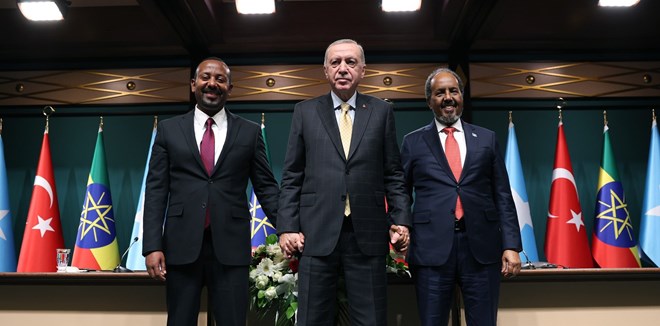

On Dec. 12, 2024, Somalia’s President Hassan Sheikh Mohamud, Ethiopian Prime Minister Abiy Ahmed, and Turkish President Recep Tayyip Erdoğan met in Ankara to sign a joint declaration intended to resolve a yearlong dispute over Ethiopia’s controversial Memorandum of Understanding (MoU) with the self-declared separatist administration in Hargeisa.
The agreement, framed as a milestone in regional diplomacy, sought to address Ethiopia’s ambitions for secure access to the Somali coast while reaffirming the sovereignty of Somalia’s Federal Government. However, beneath this veneer of cooperation lies a more complex reality, as the agreement touches on unresolved issues and key strategic interests for both Somalia and Ethiopia.

The MoU, signed between Ethiopia and Somaliland, had been a source of contention since January 2024, with Somalia strongly opposing it on the grounds that it violated its territorial integrity. For nearly a year, Ethiopia insisted that the MoU was legal, despite international calls for its rescission. The Somali government, in turn, held firm, demanding the withdrawal of Ethiopian forces from Somalia’s peacekeeping mission and refusing to engage in any discussions until the MoU was revoked. But the Ankara Agreement, while affirming Somalia’s sovereignty, reveals significant nuances and leaves critical questions unanswered, particularly regarding Ethiopia’s strategic goals.
The Reality: Somalia’s Position of Strength, But a Missed Opportunity
While the Ankara Agreement reaffirmed Somalia’s sovereignty, it also highlighted a missed opportunity for the Somalia’s Federal Government to assert its position more strongly, particularly given its legal and political advantages. Somalia has been an independent state for more than six decades, and the reaffirmation of its sovereignty in the agreement should have been more than a rhetorical victory; it should have been the foundation of a more robust negotiating stance.
The reality, however, is that Ethiopia succeeded in securing a commitment to negotiate access to the Somalia’s coast. Importantly, the agreement makes no mention of the contentious MoU, nor does it call for the withdrawal of Ethiopian forces from Somalia. These were two major points of contention that Somalia had previously insisted upon. By failing to secure a firm commitment from Ethiopia on these issues, Somalia risks appearing as though it has compromised on core principles.
The question arises: Why did Somalia agree to these negotiations under these terms? On paper, Somalia had significant leverage: its sovereignty is well established, international law is clear, and it had broad global backing for its position. However, the political pressures to avoid escalating tensions with Ethiopia, the need to maintain regional stability, and the desire to preserve the ongoing peacekeeping efforts in Somalia likely weighed heavily on the decision-making process. Somalia’s leadership may have feared that further confrontation could isolate the country diplomatically as international partners, including the United States, the United Kingdom and Turkey, were pushing for negotiations. Nonetheless, this raises a deeper issue: Could Somalia have held out longer in these negotiations to ensure more favorable terms and a more clearly defined agreement?
Yes, it could have. Given the legal strength of Somalia’s position and its international support, there was room for the Somali leadership to stand firm longer and push for more clearly defined outcomes. Ethiopia’s reliance on the MoU with Somaliland and the contentious nature of that agreement provided Somalia with an opportunity to negotiate from a position of legal strength. Somalia could have delayed talks, potentially increasing diplomatic pressure on Ethiopia, or it could have insisted on a clearer stance on the MoU and the Ethiopian forces in Somalia before agreeing to negotiations. Instead, Mogadishu reversed course on previous statements, paying tribute to Ethiopian forces.
MoU and Commercial Agreements: A Potential Gateway to Future Challenges
A critical aspect of the agreement is the clause that discusses “finalizing commercial agreements” related to Ethiopia’s access to the coast. While this language may seem innocuous, it hints at the broader issue of Ethiopia’s continued interest in coastal access, which has been a point of contention for Somalia. The phrase could be interpreted as a gateway for Somalia to engage in future talks that formalize Ethiopia’s sea access, perhaps under commercial and logistical arrangements from the coast to the land. However, the risk is that these negotiations could evolve into a tacit recognition of the MoU with Somaliland, especially if Ethiopia seeks to build upon this framework to secure a permanent or more formalized arrangement for port access in the future.
This aspect of the agreement suggests that the MoU with Somaliland, while not directly addressed, could be revisited or even subtly and indirectly formalized as part of the broader commercial discussions. Ethiopia could use this as leverage to finalize an agreement that grants it the access to the coast it has long desired, which could increase its political influence over Somalia’s territorial integrity. Somalia may find itself in a difficult position if it is forced to make further concessions in the form of allowing Ethiopia to set terms that might conflict with its sovereignty.
Thus, the opportunity for a more robust, clearly defined agreement that prioritized Somalia’s territorial integrity has been missed. While the Somali government was undoubtedly concerned with maintaining stability and securing the regional peacekeeping efforts, it must now consider the long-term implications of this deal, particularly regarding Ethiopia’s access to Somali ports and the unresolved status of Somaliland. The negotiation over “commercial agreements” may ultimately play a pivotal role in either preserving or eroding Somalia’s sovereignty over its coastal territory in the future.
Somalia’s New African Union Mission and Egypt
The continued presence of Ethiopian forces in Somalia, as outlined in the Ankara Agreement, could complicate Somalia’s security dynamics, particularly with the looming Egypt-Somalia security pact. As Somalia seeks to bolster its security ties with Egypt, including the potential deployment of Egyptian forces as part of the new African Union mission (AUSSOM) in 2025, Ethiopia’s role in Somalia could become a major point of contention. The prospect of Egyptian forces operating alongside Ethiopian troops, particularly in sensitive regions, could create friction. Somalia may find it challenging to balance its security agreements with Egypt while managing Ethiopia’s expanding influence in the region.
The Ethiopian National Defense Force (ENDF) remaining in Somalia, particularly under the framework of a broader AU mission, could undermine Somalia’s strategic alignment withEgypt. This dynamic could also pose risks to Somalia’s sovereignty, as Ethiopia might use its position within the AU mission to exert political and military leverage, creating potential complications for the integration of Egyptian forces into Somalia’s security framework. In this context, Somalia’s ability to maintain full control over its security decisions and future alliances could be increasingly constrained.
Conclusion: Somalia’s Strategic Crossroads
As Somalia enters technical negotiations in February 2025, the Federal Government must carefully consider the strategic consequences of this agreement. While regional cooperation and stability are crucial, Somalia cannot afford to appease expanding influence by offering access to its ports without ensuring that its sovereignty is unequivocally upheld.
The next steps in these negotiations will be vital, and Somalia’s leadership must be vigilant to ensure that the country’s territorial integrity is preserved, and that the legacy of Somaliland’s separatist agenda does not find further international validation under the guise of commercial agreements.
Somalia’s leadership must also consider the broader geopolitical implications, particularly regarding its relations with Ethiopia and the potential role of foreign forces like the Egyptian military, which may be influenced by the ongoing Ethiopian presence in Somalia. The balance of power in the Horn of Africa is delicate, and any missteps in these negotiations could have long-lasting repercussions for Somalia’s sovereignty and regional stability. Therefore, Somalia must approach the next phase of negotiations not just with diplomacy but with a strategic vision that safeguards its interests and territorial integrity.
Suldan I. Mohamed, MA is a Somali political analyst, journalist and former governance advisor at the Office of the Prime Minister, Somalia. He has extensive experience on Somalia and the wider Horn of Africa region.


