
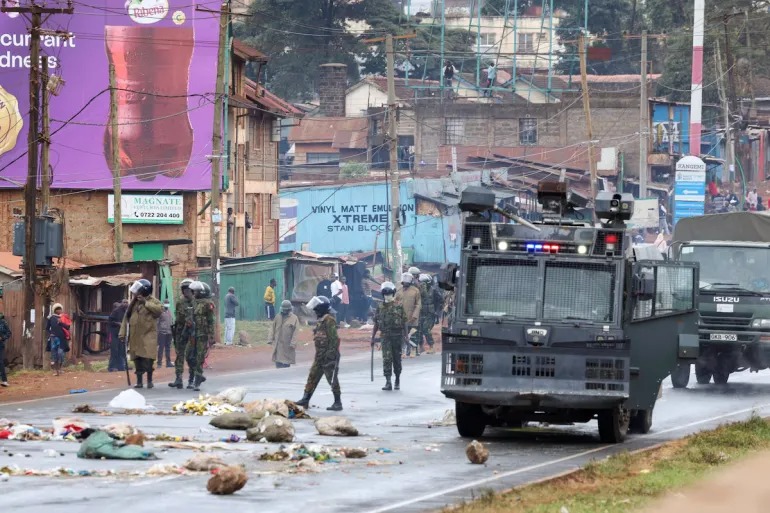

Kenya’s independent National Commission on Human Rights announced on Friday that at least 38 people were killed and 131 others injured during violent anti-government protests earlier this week, marking the deadliest day of unrest since demonstrations against President William Ruto’s administration began more than a year ago.
The protests, held on July 7 (Saba Saba Day)—a symbolic date marking the 1990 pro-democracy uprising—were met with heavy-handed police response across major urban centers, particularly Nairobi, Kiambu, and Kajiado. Roads leading into the capital were barricaded and key streets remained deserted as police deployed in large numbers. Violent clashes erupted in the suburbs, where most of the casualties were reported.
The Commission, though state-affiliated, operates independently and had initially reported 31 deaths earlier in the week. However, updated figures released Friday suggest the true toll is higher. The Commission also documented extensive injuries, many of them caused by gunfire and blunt force trauma, and reiterated its concern over “excessive and unlawful use of force” by security forces.
The United Nations earlier this week expressed “deep concern” over the violence, calling for restraint and accountability, while rights organizations blamed Kenyan police for the brutality, extrajudicial killings, and alleged cases of enforced disappearances during the crackdown.
President Ruto, addressing the nation on Wednesday, dismissed the protests as attempts to destabilize the country and warned that security forces would shoot what he termed “looters and troublemakers.” He accused unnamed groups of exploiting youth frustrations to provoke unrest.
The recent wave of demonstrations follows a similar protest movement in 2024 that erupted in response to a controversial finance bill that introduced sweeping tax increases. That earlier wave left over 100 people dead, mostly young protesters who had once supported Ruto’s reform promises. Many say those promises have gone unfulfilled.
In a statement, the Kenyan government claimed to have foiled an attempted coup, alleging that the protests were part of an illegal plot to overthrow the government. Protest leaders and civil society groups rejected the accusation, instead accusing the government of hiring armed gangs to infiltrate and discredit the demonstrations.
Observers warn that the growing authoritarian tilt and escalating use of force threaten Kenya’s reputation as one of East Africa’s most stable and democratic nations. Many fear the unrest could spiral further unless the government opens dialogue with its critics and addresses the root causes of public discontent—chief among them, rising poverty, youth unemployment, and declining trust in institutions.


