
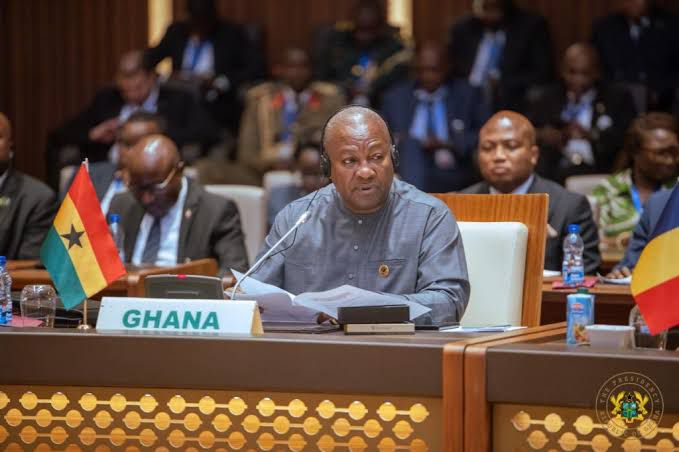

Former Ghanaian President John Dramani Mahama on Monday issued a strong appeal for reparations from former colonial powers that were historically involved in the transatlantic slave trade, asserting that such a move is essential to restore the full dignity and humanity of the African continent and its people.
Mahama, who currently serves as the African Union’s Advocate for Reparative Justice for Africans and People of African Descent, made his remarks during a high-level event focused on historical accountability and post-colonial justice.
He emphasized that the legacies of slavery—economic exploitation, systemic racism, and cultural erasure—continue to shape the realities of millions across Africa and the diaspora. “This is not just about financial compensation,” Mahama said. “It is about acknowledgment, healing, and the restoration of our collective memory. It is about the dignity of Africa and her people, both on the continent and abroad.”
Mahama urged the international community to take a moral stand in support of Africa’s call for justice, saying, “The world cannot claim to believe in equality, fairness, and human rights while ignoring one of the greatest injustices in human history.”
He added that reparations should be seen not only as a historical responsibility, but also as a catalyst for global reconciliation and development. “We must build a new chapter in international relations—one rooted in justice and shared humanity,” he said.
His comments come as momentum grows globally around reparative justice. A number of Caribbean nations, under the CARICOM Reparations Commission, have also been pushing for formal apologies and compensation from European nations, while prominent institutions, including universities and churches, are beginning to acknowledge and atone for their historical roles in the slave trade.
Mahama concluded by calling on the United Nations, the African Union, and civil society across the globe to unite behind the demand for reparations. “Africa has waited for centuries. The time for justice, dignity, and reparation is now.”
The transatlantic slave trade, which lasted for over 400 years, forcibly removed an estimated 12–15 million Africans from the continent and contributed to the profound economic and structural underdevelopment that continues to impact African nations today.


