
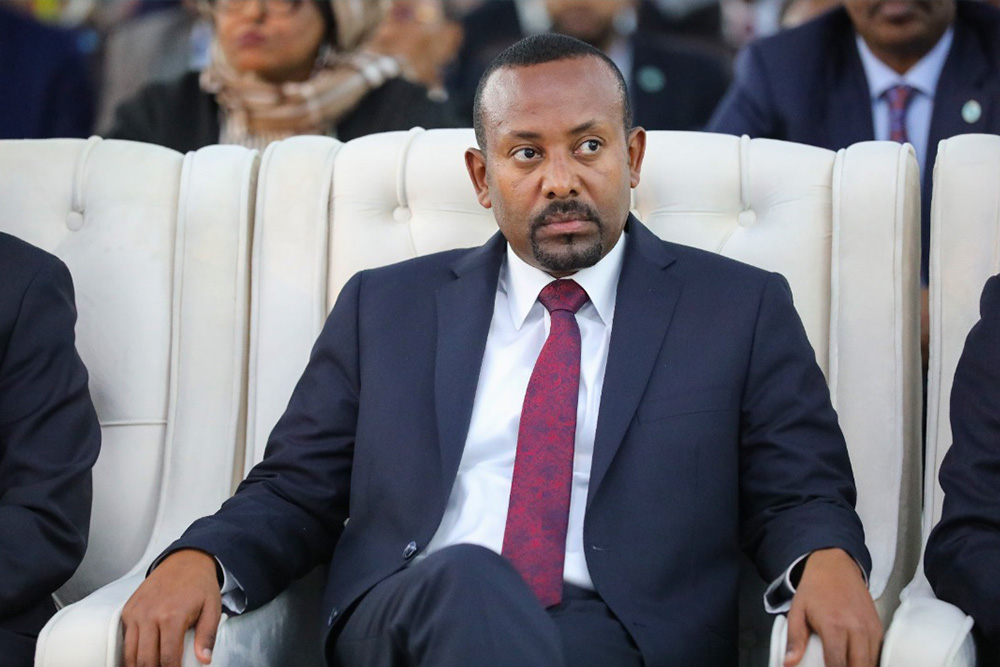

In a statement that has drawn both criticism and concern, Ethiopian Prime Minister Abiy Ahmed recently compared the country’s current situation to a plane flying at high speed, claiming that turbulence is normal. The remark, made during a visit to the Somali region of Ethiopia, has raised eyebrows, with many questioning the PM’s grasp on the country’s pressing challenges. While some dismiss the comment as political rhetoric, others are probing deeper, suggesting the PM might be out of touch with the reality of his nation’s ongoing crises.
The prime minister, who has been at the helm of Ethiopia since 2018, was in Gode, Shebelle Zone, inaugurating an irrigation project aimed at boosting agricultural development in the region. The government reports that this irrigation system, powered by a dam, will help irrigate 10,000 hectares of land, benefiting plantation agriculture projects. The initiative is part of the broader “Gebeta Lehager” (Dine for the Nation) program, which Abiy Ahmed has championed to foster economic and infrastructure development.
After promoting the project and the ongoing “corridor development” in the region, the prime minister spoke to state-run Fana Broadcasting Corporate, where he offered an optimistic and symbolic explanation of Ethiopia’s situation.
“People who are on board the plane called Ethiopia do not feel the speed with which it is flying. The person who can see the speed is outside of the plane. But the people in the plane understand the speed of the plane or their situation when there is turbulence due to unfavorable weather,” said Abiy Ahmed, adding a poetic touch to his political discourse.
However, his metaphor has been met with criticism, especially from those who are well aware of the ongoing security, economic, and social crises that continue to plague the country. While the prime minister attempts to paint an image of progress and optimism, many view his comments as detached from the harsh realities that millions of Ethiopians are experiencing daily.
Ongoing Security Crisis and Humanitarian Struggles
The security situation in Ethiopia has been dire, especially since Abiy Ahmed assumed power. His tenure has seen increasing ethnic violence, with the most significant tensions between the Oromia and Benishangul Gumuz regions. Thousands of lives, especially among the ethnic Amhara community, have been lost in the ongoing conflict.
Moreover, the brutal war between the Tigray People’s Liberation Front (TPLF) and the federal government under Abiy’s leadership continues to leave deep scars. The conflict, which erupted in 2020, has claimed an estimated one million lives, devastating families in the Tigray, Amhara, and Afar regions. As the Ethiopian government remains embroiled in this protracted conflict, the country’s humanitarian situation has worsened.
In the Amhara region, the situation remains particularly dire as the government attempts to disarm the Fano militia, a force that had supported Abiy Ahmed’s rise to power but later became a perceived threat as the federal government’s authority weakened. Drone strikes, reportedly targeting civilian areas, have been a hallmark of the government’s efforts to quell opposition. According to the Amhara Association of America, there have been over 150 drone strikes in the region since the military operation began in August 2023. The violence has left over 5 million children and youth unable to attend school for over two years, exacerbating an already dire situation.
Further complicating the situation is the ongoing war in the Oromo region. The Oromo Liberation Army (OLA), a rebel group that Abiy Ahmed’s government initially allowed into Ethiopia as part of the peace process, has since turned its efforts against the federal government. Despite the government’s military response, the OLA continues to engage in conflict, and Abiy has struggled to achieve a decisive victory due to reported internal support for the rebels from within Ethiopia’s regional structures.
Economic Crisis and Rising Starvation
Economically, Ethiopia is grappling with severe challenges. The country’s currency, the Ethiopian birr, has been devalued by more than 100 percent in a matter of months. This dramatic devaluation has led to widespread inflation and significantly reduced purchasing power for ordinary Ethiopians. Those who were once able to maintain a relatively decent standard of living are now struggling to meet basic needs.
Furthermore, the country faces a looming food crisis, with over 22 million Ethiopians reportedly at risk of starvation due to ongoing droughts, displacement, and the combined effects of conflict. The agricultural sector, which is vital to the economy, has been disrupted by both climate challenges and continuing violence. Many regions are facing acute food insecurity, and humanitarian organizations are struggling to address the growing needs.
Public Perception and the Plane Metaphor
Despite Abiy Ahmed’s soaring metaphor, many Ethiopians view the country’s “flight” as far from smooth. For those on the ground, the turbulence is far from normal – it is a constant and overwhelming force. From the security crisis to the economic hardships, Ethiopians have been enduring a relentless series of challenges. For some, the image of the country “flying high” is a cruel distortion of their lived reality.
Critics of the PM’s comments argue that the comparison of Ethiopia’s situation to a plane in flight ignores the ongoing suffering and instability. The metaphor of a “flying” nation feels more like a disconnect between the government’s rhetoric and the people’s experiences. While the prime minister may be speaking to promote a sense of progress, many Ethiopians feel that their country is, instead, in freefall, beset by internal conflicts, poverty, and political disillusionment.
Some analysts have suggested that Abiy Ahmed’s remarks may reflect an attempt to maintain morale among his supporters, presenting the challenges as temporary setbacks rather than systemic issues. Others have speculated about the psychological implications of such comments, questioning whether the prime minister is truly in touch with the ground realities or if his remarks are part of a political narrative that overlooks the country’s deepening crises.
A Nation at a Crossroads
Abiy Ahmed’s statement comes at a time when Ethiopia is at a crossroads. While the government has pursued ambitious reforms, including economic diversification and infrastructure development, the country continues to face profound challenges. The PM’s “flying high” analogy contrasts sharply with the suffering felt by many Ethiopians, who are not just experiencing turbulence but are embroiled in a full-blown crisis that seems to have no end in sight.
The question now is whether the Ethiopian government can chart a course toward stabilization and peace or whether the turbulence will persist, pushing the country to the brink of further collapse. As Ethiopia continues to face a complex web of challenges, it remains to be seen if Abiy Ahmed’s vision for the future will be enough to steer the nation out of its current storm.
For now, the metaphor of a plane in flight may offer some comfort to those in power, but for millions of Ethiopians, it’s a far cry from the reality on the ground. The road ahead remains uncertain, and the turbulence is far from over.


