
By using this site, you agree to the Privacy Policy and Terms of Use.
Accept
DNE Africa
  • Home
  • Politics
    Ethiopia's Disrupted Polls and Cabo Verde's Transition Prove Security Dictates Elections, African Narratives Study Finds
    Politics

    Ethiopia’s Disrupted Polls and Cabo Verde’s Transition Prove Security Dictates Elections, African Narratives Study Finds

    By DNE Africa 7 Min Read
    Ethiopia Amhara Fano rebels claim 150+ ENDF deaths in 8-day Gojjam battle
    Politics

    Amhara Fano claim 150+ ENDF deaths in 8-day Gojjam battle

    By DNE Africa June 27, 2026
    Abdelmaksoud Elmallah Pic.jpg
    opinionTechnology

    Connected or Controlled: Is it time for Satellite Internet in Africa?

    By Abdelmaksoud Elmallah June 27, 2026
  • Business
    Nigeria, Egypt, South Africa Lead Africa’s Equity Markets, says AfDB
    Business

    Nigeria, Egypt, South Africa Lead Africa’s Equity Markets: AfDB

    Nigeria, Egypt, Morocco, and South Africa continue to dominate Africa’s equity markets,…

    By Ahmed Emam 4 Min Read
    Cheick-Oumar Sylla, Director for North Africa and the Horn of Africa at IFC
    Business
    IFC eyes over $2.2bn investments in North Africa this year
    Mahmoud Mohieldin: Africa’s share of global FDI does not exceed 6%
    Business
    Mahmoud Mohieldin: Africa’s share of global FDI does not exceed 6%
    africa
    BusinessScience
    Pandemic Financial Worries Slowed Digital Finance Adoption in Africa
    climate shocks vulnerability
    BusinessScience
    Climate Change Could Deepen Food Crisis in East Africa by 2050
  • Culture
  • Opinion
  • Technology
  • World
  • My Bookmarks
Reading: Ancient humans were so good at surviving the last ice age they didn’t have to migrate like other species – new study
Sign In
  • Join US
DNE AfricaDNE Africa
Font ResizerAa
  • Home
  • Politics
  • Business
  • Culture
  • Opinion
  • Technology
  • World
  • My Bookmarks
Search
  • Home
  • Politics
  • Business
  • Culture
  • Opinion
  • Technology
  • World
  • My Bookmarks
Have an existing account? Sign In
Follow US
© Foxiz News Network. Ruby Design Company. All Rights Reserved.
Ancient humans were so good at surviving the last ice age they didn’t have to migrate like other species – new study

Ancient humans were so good at surviving the last ice age they didn’t have to migrate like other species – new study

The Conversation
Last updated: October 21, 2024 5:23 pm
By The Conversation 6 Min Read
Share
Gorodenkoff:Shutterstock
SHARE

Humans seem to have been adapted to the last ice age in similar ways to wolves and bears, according to our recent study, challenging longstanding theories about how and where our ancestors lived during this glacial period.

Previous studies have supported the view of most archaeologists that modern humans retreated into southern Europe during the height of the last ice age and expanded during the later increase in global temperatures. But our study is the first to use genetic data to show that at least some humans stayed in central Europe, unlike many other animals and despite our species having evolved in the much warmer climate of Africa.

Scientists have known since the 19th century that the distributions of animals and plants across the world may fluctuate with the climate. But the climate crisis has made it more important than ever to understand these fluctuations.

Populations of the same species that live in different places often have different genetics to each other. More recently scientists have studied how climate change has altered the distribution of these genetically distinct populations of species.

Most of the studies in this field focus on individual species of animal or plant. They have shown that many species, including humans, expanded their geographical ranges since the height of the last ice age, approximately 20,000 years ago.

At this time, European ice sheets reached Denmark and south Wales. Europe was cold but mostly unglaciated, probably much like Alaska or Siberia today.

Our team’s new study, led by Oxala García-Rodríguez at Bournemouth University, took a different approach and reviewed the genetic history of 23 common mammals in Europe. In addition to humans, these included rodents such as bank voles and red squirrels, insectivores like shrews and hedgehogs, ungulates like red deer and wild boar, and carnivores like brown bears and weasels.

An important metric in our study was where the greatest diversity is today across Europe. This is because areas of high genetic variation are likely to be the areas of longest occupation by species.

These areas, known as refugia, are locations where species retreated to survive during periods when environmental conditions were unfavourable elsewhere. For the mammals we studied, these refugia would have been occupied since the height of the last glaciation, at least. These refugia were probably the warmest areas or places where it was easiest for the animals to find food.

The genetic patterns we found include cases where some mammals (such as red foxes and roe deer) were restricted to glacial refugia in southern areas such as Iberia and Italy, and that they expanded from these areas as global temperatures warmed following the ice age. Other mammals (such as beavers and lynx) expanded from glacial refugia to the east of Europe only to spread west.

Species such as pygmy shrew and common vole had been restricted to sheltered areas such as deep valleys in northern Europe, small enclaves in otherwise inhospitable glacial landscapes. These patterns have previously been documented by other scientists.

But we found a fourth pattern. Our study indicated some species (such as brown bears and wolves) were already widely distributed across Europe during the height of the last glaciation with either no discernible refugia or with refugia both to the north and south.
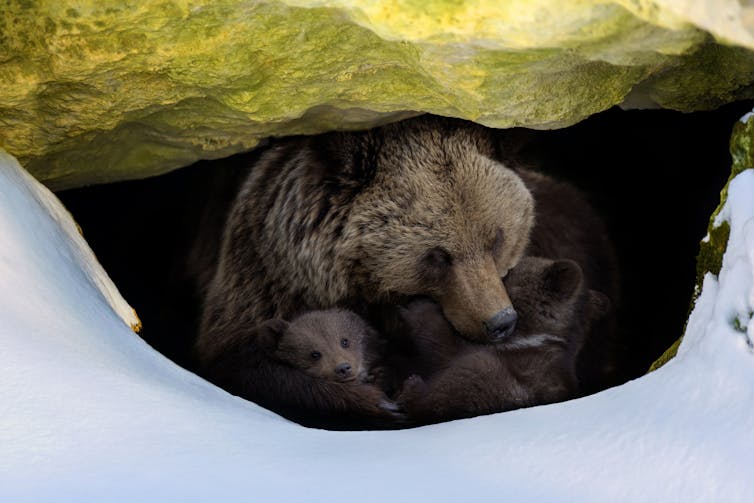
Brown bear with two cubs looking out of shelter
Humans seem to have followed the same distribution pattern as brown bears in the last ice age. Volodymyr Burdiak/Shutterstock

This pattern includes Homo sapiens too. Neanderthals had already been extinct for around 20,000 years by this point.

It’s not clear why ancient humans and other animals in this group lived in this seemingly harsh climate rather than explore more hospitable places. But they seemed able to tolerate the ice age conditions while other animals withdrew to refugia.

Perhaps most important of all is that among the species that seem to conform to this pattern, where little or no geographical contraction in population took place at the height of the last ice age, are modern humans. It is particularly surprising that humans are in this group as our ancestors originated in Africa and it may seem unlikely that they were resilient to cold climates.

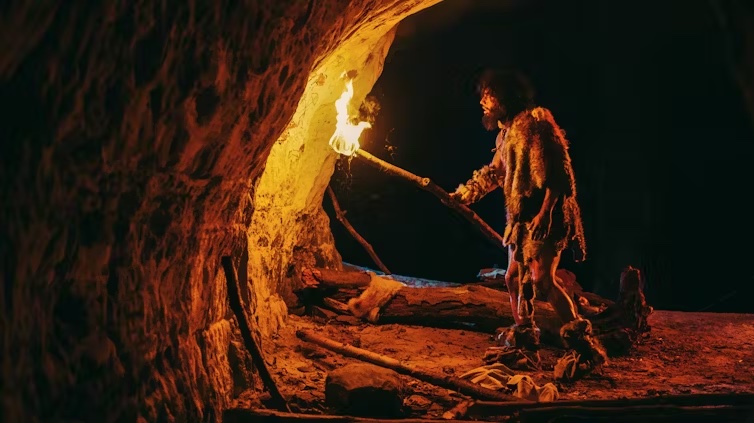
It is unclear whether these humans relied on ecological adaptation, for example the fact that they were omnivorous meant they could eat many different things, or whether they survived due to technology. For instance, it is well established that humans had clothing, built dwellings and controlled fire during the cold conditions of the last ice age.

This new pattern, and the inclusion of humans within it, could cause rethink of climate change and biogeography among scientists, especially for those studying human distribution changes. It could mean that some areas may be habitable for longer than expected as the climate changes.

John Stewart, Professor of Evolutionary Palaeoecology, Bournemouth University and Jeremy Searle, Professor of Ecology and Evolutionary Biology, Cornell University

This article is republished from The Conversation under a Creative Commons license. Read the original article.


You Might Also Like

Connected or Controlled: Is it time for Satellite Internet in Africa?

Why the Arab World Keeps Missing the Real Story About Somaliland 

EXCLUSIVE: IOM Highlights Risks Along Horn of Africa-Arabian Migration Route

RED SEA CHESS: The Egypt-Eritrea Axis Rewiring the Horn of Africa From Isolation to Influence: Why Every Player in This Alliance is Gaining

Ancient Lake Mud Shows 2012 Rwenzori Fire Was Unprecedented for 12,000 Years

TAGGED:Ancient humansIce Age
Share This Article
Facebook Twitter Pinterest Whatsapp Whatsapp LinkedIn Reddit Telegram Email Copy Link

You Might Also Like

Ayanda Holo, President of BRICS AFRICA CHANNEL
opinionPolitics

Africa Is No Longer a Promise. It Is a System Taking Shape

By Ayanda Holo 8 Min Read
Iran’s Geopolitical Strategy Against America: The $40,000 Drone That Could Change the Middle East
opinionPolitics

Iran’s Geopolitical Strategy Against America: The $40,000 Drone That Could Change the Middle East

By Abdiwahab Sheikh Abdisamad 17 Min Read
UAE, OPEC, and Somaliland- A Question of Timing, Not Direction Bashe Awil Omar
opinionPolitics

UAE, OPEC, and Somaliland: A Question of Timing, Not Direction

By Bashe Awil Omar 5 Min Read

More Popular from DNE AFRICA

Ad imageAd image
Business

Nigeria, Egypt, South Africa Lead Africa’s Equity Markets: AfDB

Nigeria, Egypt, Morocco, and South Africa continue to dominate Africa’s equity markets, according to the African…

By Ahmed Emam
Politics

Dozens of Orthodox Christians Reportedly Killed in Fresh Violence in Ethiopia’s Arsi Zone

At least 37 Orthodox Christian civilians have reportedly been killed in a new wave of violence…

By Taha Sakr
Business

South Africa to meet fiscal goals despite Iran war pressures

South Africa remains on track to meet its fiscal targets despite the conflict in the Middle…

By DNE Africa
Politics

Ethiopia elections open amid heavy fighting in Amhara region

Voting began in Ethiopia on Monday in parliamentary and regional elections expected to hand Prime Minister…

By DNE Africa
DNE Africa

News by Africans, For Africans

Categories

  • The Escapist
  • Entertainment
  • Business

Quick Links

  • Advertise with us
  • Newsletters
  • Complaint
  • Deal

DNE Africa.All Rights Reserved.

Welcome Back!

Sign in to your account

Username or Email Address
Password

Lost your password?