

HIV funding cuts in 2025 hit HIV prevention hardest in Africa, UNAIDS said in its Global AIDS Update 2026. International HIV aid fell 18% and resources in eastern and southern Africa dropped 10% in a year.
The report matters because the region is home to 51% of people living with HIV, and many of its health systems depend on donors for prevention. UNAIDS warned that the full effect of the cuts on infections and deaths has yet to show in its estimates.
What does the UNAIDS report say about HIV funding cuts?
The report, titled “Ending AIDS starts with access” and published on 24 November ahead of World AIDS Day on 1 December, said international financing for HIV in low- and middle-income countries fell by 18% in 2025. The fall came as overall official development assistance dropped by 23%, which the report called the steepest year-on-year decline on record.
United States bilateral contributions, the largest single source of international HIV money, fell by 26% between 2024 and 2025, UNAIDS said, while Global Fund disbursements dropped by 13% (the agency noted that 2025 was the third year of a Global Fund grant cycle, when disbursements typically decline). According to the agency’s press release, HIV resources in these countries fell by more than $1bn in 2025, leaving a $4.3bn annual gap against what is needed to end AIDS as a public health threat by 2030.
Brookings scholars Belinda Archibong and Louise Fox wrote in an August commentary that US spending on HIV activities fell 34% in the 2025 fiscal year, though congressional appropriations had fallen only about 4% since 2024. They said the Trump administration had made changes to improve country ownership of the programme, but argued that delivery bottlenecks were holding money back.
How have HIV funding cuts hit eastern and southern Africa?
Total HIV resources in eastern and southern Africa fell by 10% to $8.4bn in 2025, driven by an almost 20% cut in external financing, according to the regional fact sheet. That compares with the $9.9bn a year UNAIDS says the region needs to meet its 2030 target. Per person, funding has fallen from a peak of $22.3 in 2017 to $14.0.
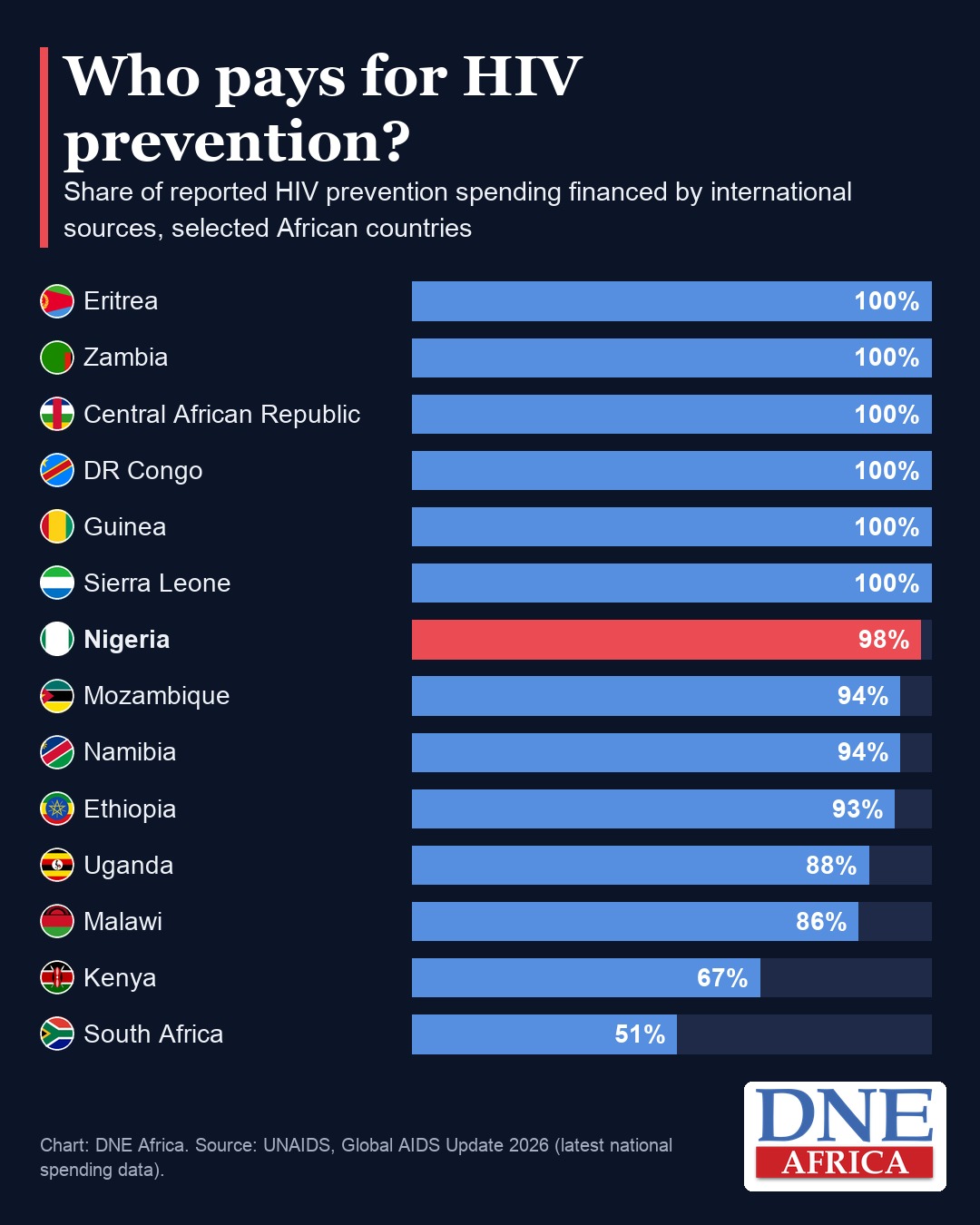
About 40.7% of the region’s HIV funding came from domestic sources in 2025, but only 20% if South Africa is excluded, UNAIDS said. Prevention is the most exposed to HIV funding cuts: international sources pay for all reported prevention spending in Eritrea and Zambia, 94% in Mozambique and Namibia, 93% in Ethiopia, 88% in Uganda and 86% in Malawi.
The report records the HIV funding cuts at street level. Between 2024 and 2025 HIV testing in the region fell by 13%, condom distribution by 17% and use of pre-exposure prophylaxis (PrEP), the preventive medicine, by 8%. Voluntary medical male circumcisions fell from 3.1mn to 1.5mn across 13 of 15 priority countries, with only Mozambique and South Africa holding up.
In Zambia, 32 wellness centres serving more than 20,000 people from key populations closed between January and May 2025, and the number of people receiving PrEP at least once fell by 64% in 2025, UNAIDS said. In Malawi, 18 drop-in centres reduced operations, affecting about 7,000 people on PrEP and 7,600 on HIV treatment. Ethiopia and Uganda expanded access with domestic and other funding, and Kenya and Rwanda used domestic money to protect priority programmes, it added.
How have HIV funding cuts affected western and central Africa?
In western and central Africa total HIV resources fell by 12% in 2025 to $1.98bn, including a 19.3% drop in international money, and domestic sources cover only 35% of the total, UNAIDS said. The number of people receiving PrEP in the region fell by 70%, the steepest fall of any region.
Nigeria is the large country most exposed to HIV funding cuts: external financing accounts for about 98% of its HIV resources, and programme data show PrEP initiations among key populations falling by more than 80% in the first half of 2025, according to the report. Treatment reaches 74% of people living with HIV in the region, against 85% in eastern and southern Africa, and only 41% of children with HIV were on treatment in 2025.
Several governments have raised HIV budgets since 2025 in response to the HIV funding cuts, UNAIDS said, naming Burkina Faso, Burundi, the Central African Republic, Cote d’Ivoire, Gambia, Mali, Nigeria and Togo, with rises of more than 10% in Cote d’Ivoire, Gambia, Mali and Togo.
Is progress against HIV in Africa still on track?
The longer-term figures remain strong. New infections in eastern and southern Africa fell by 62% between 2010 and 2025, to 420,000, and AIDS-related deaths by 62%, to 240,000, the report said. Seven countries in the region (Botswana, Eswatini, Lesotho, Namibia, Rwanda, Zambia and Zimbabwe) have reached all three 95-95-95 testing and treatment targets. Lesotho’s own figures were reported this week. In western and central Africa, new infections fell by 46% to 190,000.
Some smaller epidemics are growing, the report said, including in Comoros and Madagascar, where public finances are under IMF review, and in Cabo Verde, Congo and Niger. Adolescent girls and young women remain three times more likely to acquire HIV than young men in both African regions.
UNAIDS said the estimates do not yet capture the full effect of the 2025 HIV funding cuts, because people fall out of care or lose access to prevention only gradually. “The world is sleepwalking into a preventable crisis,” Winnie Byanyima, the agency’s executive director, said in the press release.
What happens next?
The report points to the twice-yearly injection lenacapavir as the main new prevention tool. By November 2026, 175,000 people had started it in nine countries, all of them in Africa: Eswatini, Kenya, Lesotho, Mozambique, Nigeria, South Africa, Uganda, Zambia and Zimbabwe. Generic versions are expected from 2027 at about $40 per person per year in eligible lower-income countries, UNAIDS said.
The agency also called for debt relief and more fiscal space. In Angola, Eritrea, Gambia, Ghana, Nigeria and Uganda, debt-service payments exceed government health spending more than threefold, it said. Global Fund allocations for HIV are 18% lower than in the previous cycle across 13 sub-Saharan African countries, so the HIV funding cuts are likely to weigh on national budgets for years. The earlier halt to US aid to South Africa showed how quickly donor support can change.
FAQ
How large were the HIV funding cuts in 2025?
UNAIDS said international HIV financing fell by 18% in 2025 and US bilateral contributions by 26%. Total resources fell by 10% in eastern and southern Africa and 12% in western and central Africa.
Which African countries rely most on donors for HIV prevention?
International sources fund all reported prevention spending in Eritrea, Zambia, the Central African Republic, DR Congo, Guinea and Sierra Leone, and 98% in Nigeria, according to UNAIDS.
Have HIV funding cuts raised infections yet?
UNAIDS said its estimates do not yet show the full effect, because of the lag between service cuts and new infections. It has recorded falls in testing, PrEP use and condom distribution.
What is lenacapavir?
Lenacapavir is an HIV prevention injection given twice a year. UNAIDS said 175,000 people in nine African countries had started it by November 2026, with generic versions expected from 2027.


