

Togo vaccination coverage for the core childhood vaccine rose from 9% of infants in 1981 to 90% in 2024, according to a 45-year study published on Tuesday in The Lancet Regional Health – Africa.
The study, by researchers at the World Health Organization and Togo’s health ministry, found that the gains in Togo vaccination coverage tracked a steady long-term improvement more closely than new vaccines or mass campaigns. It also linked urban growth to lower coverage.
What did the Togo vaccination coverage study find?
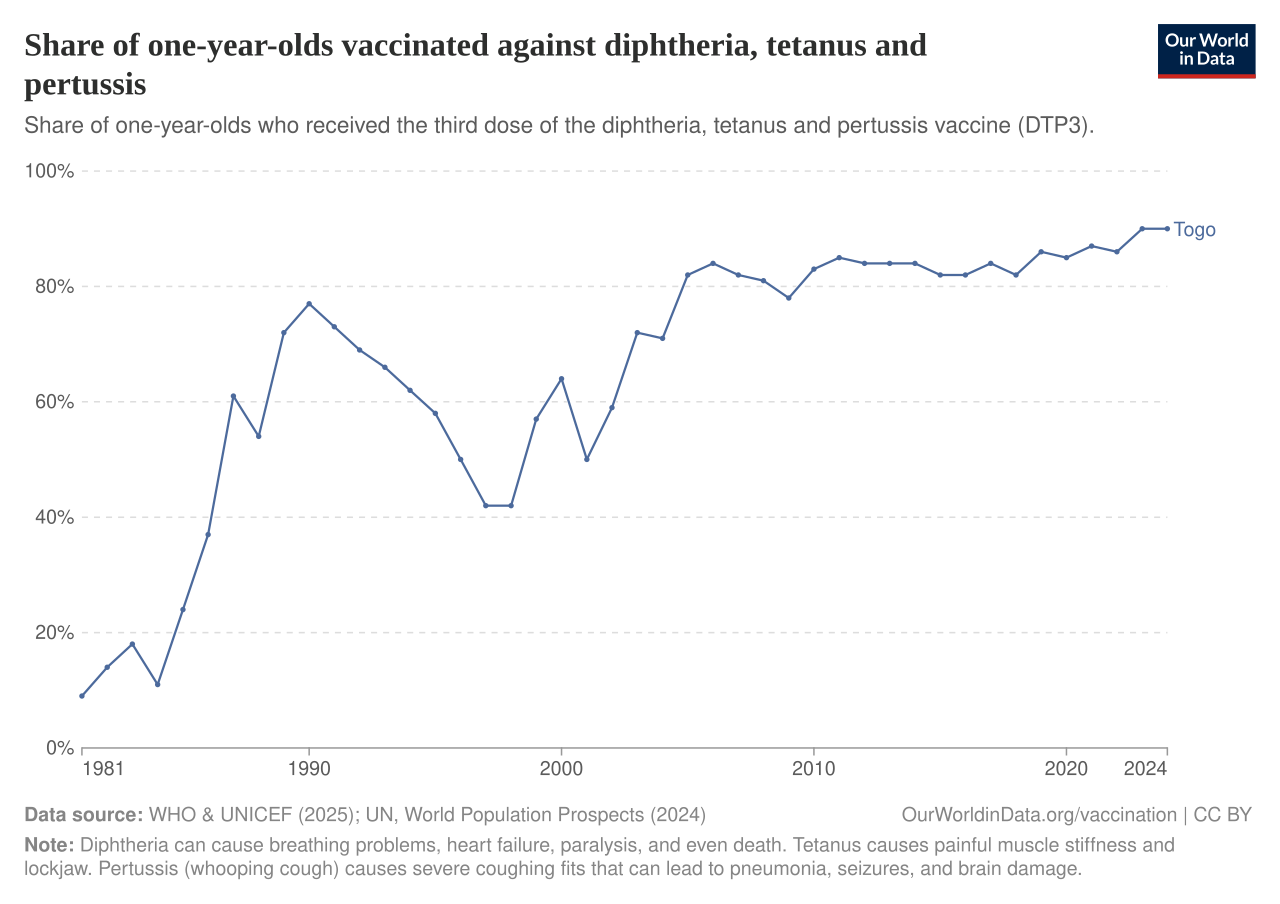
The authors analysed annual WHO and UNICEF national estimates for three vaccines given in a child’s first year. Coverage of the third dose of the diphtheria, tetanus and pertussis vaccine (DTP3, now given as the pentavalent jab) rose from 9% in 1981 to 90% in 2024. The first dose of measles vaccine went from 11% in 1984 to 81%, and BCG, given against tuberculosis at birth, from 44% to 96%.
Togo added 11 vaccines, covering 15 antigens, in nine phases over the period, with the pace quickening after 2014, the study in The Lancet Regional Health – Africa said. The country ran 33 vaccination campaigns between 1984 and 2024, close to one a year.
Tested one at a time, the introduction of the yellow fever vaccine in 2005 was linked to a jump in coverage of all three vaccines, followed by slower growth. When the authors put the yellow fever, pentavalent and measles-rubella introductions into a single model, those links weakened and were no longer statistically significant. The underlying trend over time remained significant for all three vaccines. Years with at least one campaign showed no significant link with routine coverage.
Why does urban growth matter for vaccination in Togo?
Higher gross domestic product per person was linked to higher coverage in every model. A larger urban share of the population was linked to lower coverage, which the authors said “challenges the assumption” that city dwellers have better access to care. They said rapid and unplanned urban growth may leave children in informal settlements and peri-urban areas behind, as seen in other low- and middle-income countries.
Togo vaccination coverage also fell sharply in the 1990s. The study links the decline from 1990 to 2001 to political and economic crisis, strikes and the partial suspension of international aid. WHO and UNICEF estimates compiled by Our World in Data show DTP3 coverage dropping from 77% in 1990 to 42% in 1997 and 1998.
Who did the research and what are its limits?
The lead author, Dadja Essoya Landoh, is based at the WHO Regional Office for Africa in Brazzaville and at the African Centre for Research in Epidemiology and Public Health (CARESP) in Lomé. Co-authors work for the immunisation division of Togo’s health ministry, the University of Lomé, WHO and UNICEF. The study received no specific funding, and the authors declared no competing interests.
It is an ecological study: it uses national yearly figures, not data on individual children, so it cannot show cause and effect. The authors said the long-term trend bundles together economic growth, political stability and health system changes, and overlapping reforms make it impossible to credit any single programme. National figures can hide regional gaps, and the WHO and UNICEF estimates carry their own data-quality limits. Because the campaign measure only recorded whether one took place in a given year, the authors cautioned against reading the result as proof that campaigns had no effect.
How does Togo compare with the rest of Africa?
The latest WHO and UNICEF estimates, for 2025, put Togo vaccination coverage at 90% for DTP3, 81% for the first measles dose and 96% for BCG, unchanged from 2024, according to the WHO Global Health Observatory. DTP3 coverage across the WHO African region averaged 76% in 2025.
Measles coverage remains below the 95% needed for elimination, the study noted. A 2017-18 national survey cited by the authors found 72% of children aged 12 to 23 months fully immunised, with wide social and regional differences.
Gaps in routine immunisation have had visible costs in the region this year, with diphtheria outbreaks in Senegal and Nigeria.
To sustain Togo vaccination coverage, the authors called for long-term investment in routine services rather than reliance on campaigns, with a focus on fast-growing urban and insecure areas. They said further research should look at regional differences and at “zero-dose” children who receive no vaccines.
FAQ
How much has Togo vaccination coverage risen?
Coverage of the third DTP dose rose from 9% in 1981 to 90% in 2024, and measles first-dose coverage from 11% in 1984 to 81%, according to the study, which used WHO and UNICEF estimates.
What drove the rise in Togo vaccination coverage?
The study found gains were more consistently linked to a long-term trend over time than to individual vaccine introductions or campaigns. The authors said this is consistent with gradual health system strengthening, but their design cannot prove cause.
Why is urban growth linked to lower Togo vaccination coverage?
The study found a negative association between the urban share of the population and coverage. The authors suggested rapid, unplanned urban growth may leave children in informal and peri-urban areas under-served.
Where was the study published?
It was published online on 24 November 2026 in The Lancet Regional Health – Africa as an open-access article. It received no specific funding.


