

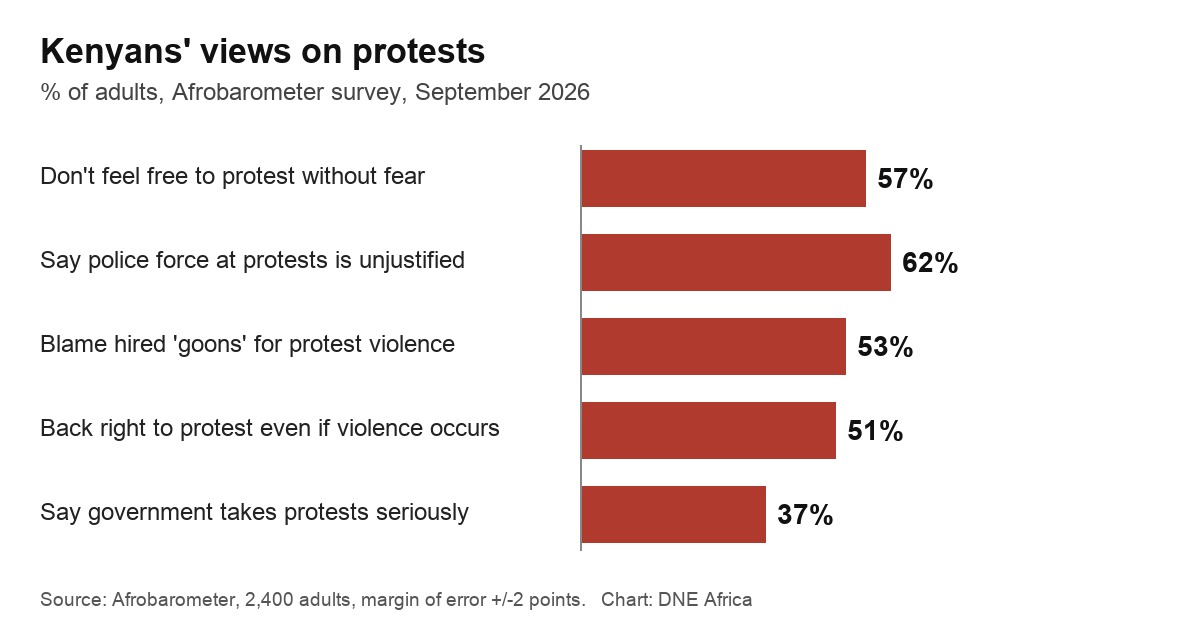
A majority of Kenyans, 57%, say they do not feel free to join public protests without fear of intimidation, arrest or violence, according to a Kenya protest survey by Afrobarometer released in Nairobi on 24 November.
The findings come less than a year before the August 2027 general election, after two years in which street protests over taxes and policing have repeatedly turned deadly. They suggest many citizens see protest as risky and doubt that it changes government decisions.
What did the Kenya protest survey find?
The Afrobarometer news release is based on face-to-face interviews with a nationally representative sample of 2,400 adults in September 2026, carried out by the Institute for Development Studies at the University of Nairobi. The margin of error is plus or minus 2 percentage points.
About four in 10 respondents, 41%, said people were completely or somewhat free to protest without such fears, according to the survey charts.
On the right itself, the Kenya protest survey shows a split. About 51% agreed that citizens should always be allowed to protest even if demonstrations sometimes turn violent, while 45% disagreed, the survey found.
Who do Kenyans blame for violence at protests?
When protests turn violent, 53% of respondents said the main fault lay with “goons”, people hired to cause trouble. Another 29% blamed the police and 16% the protesters themselves.
In the Kenya protest survey a majority, 62%, said police use of force to keep order during protests was unjustified. Only 37% of those polled believed the government takes concerns raised through protests seriously.
How does the Kenya protest survey compare with earlier rounds?
Afrobarometer has polled Kenya since 2003. In a policy paper published in February, it said the share of Kenyans who reported joining a protest in the previous year fell from 17% in 2003 to a low of 6% in 2021, before rising to 8% in its April-May 2024 survey. Across 38 African countries the average was about 7%.
The same paper found that Kenyans who posted about politics on social media were 1.9 times more likely to protest, and that young, urban and male respondents were more likely to take part. Its 2024 fieldwork ended weeks before protesters stormed Parliament on 25 June 2024 over the Finance Bill.
Protests have continued since. During the Saba Saba demonstrations on 7 July 2025, the Kenya National Commission on Human Rights said 31 people were killed; the National Police Service put the toll at 11 and said each incident would be investigated. Rights groups have pressed for accountability, as DNE Africa reported last year.
What do the authorities say?
The government and police had not responded publicly to the survey by the time of publication. The police have set out their position ahead of the campaign: in a statement on 16 August, National Police Service spokesperson Muchiri Nyaga said officers “must facilitate the right to peaceful assembly while ensuring public order and safety”, and warned politicians against incitement, Capital FM reported. Interior Principal Secretary Raymond Omollo said the government would protect citizens exercising their right to assemble.
Kenya’s 2010 constitution guarantees everyone the right to assemble and demonstrate “peaceably and unarmed” under Article 37. The general election is due in August 2027, and the Kenya protest survey suggests the campaign will unfold amid wide public wariness of street protest.
FAQ
What does the Kenya protest survey show?
Afrobarometer found that 57% of Kenyans do not feel free to join public protests without fear of intimidation, arrest or violence, and 62% consider police use of force at protests unjustified.
Who carried out the Kenya protest survey?
The Institute for Development Studies at the University of Nairobi, Afrobarometer’s Kenya partner, interviewed 2,400 adults in September 2026. The results were released on 24 November.
Who do Kenyans blame for protest violence?
About 53% blame people hired to cause trouble, known as “goons”, 29% blame the police and 16% blame protesters.
Do Kenyans think protests change government decisions?
Only 37% said the government takes concerns raised through protests seriously, according to the survey.


