
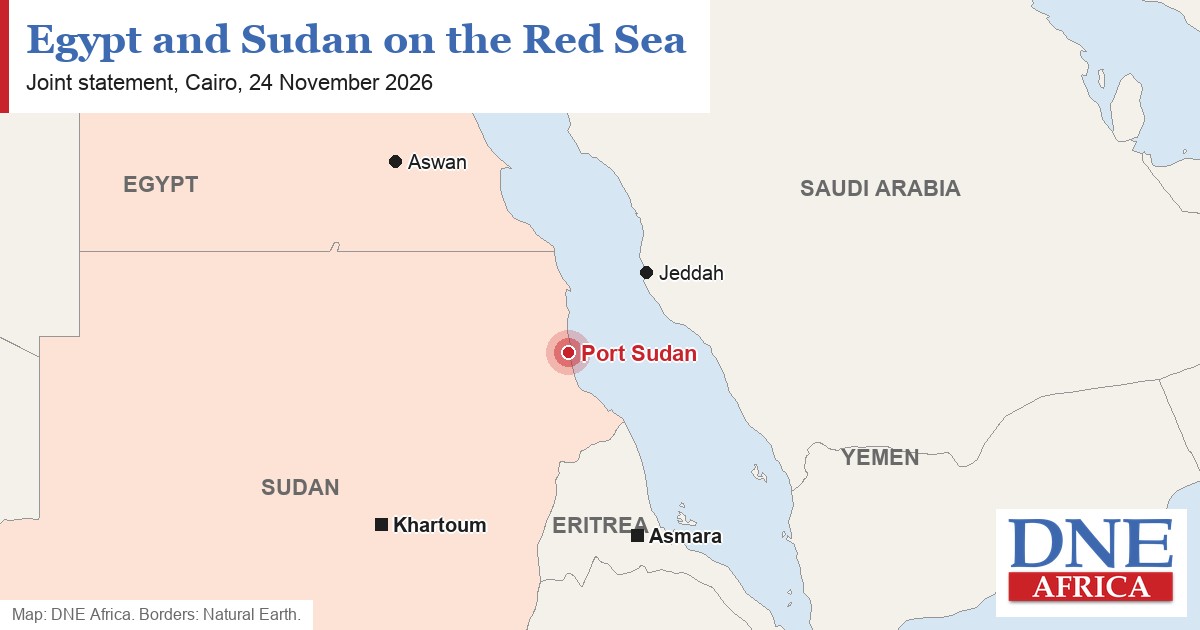

Egypt and Sudan rejected Red Sea militarisation and any naval access for states that do not border the sea, in a joint statement in Cairo on 24 November after Sudan’s Prime Minister Kamil Idris met President Abdel Fattah al-Sisi.
The statement, at the end of Mr Idris’s working visit, also tied the two countries’ Nile water security together and restated Egypt’s readiness to act under a joint defence agreement. It lands as Red Sea access, and fears of Red Sea militarisation, have become central questions for the Horn of Africa.
What did Egypt and Sudan agree in Cairo?
President Sisi received Mr Idris and his delegation with Badr Abdelatty, Egypt’s foreign minister, present, according to Ambassador Mohamed El-Shenawy, the presidency’s spokesman. Mr Idris delivered a letter from General Abdel Fattah al-Burhan, chairman of Sudan’s Transitional Sovereignty Council, which stressed the “historical” ties between the two countries and Sudan’s wish to deepen co-operation, the spokesman said. Mr Idris also held talks with Prime Minister Mostafa Madbouly.
Egypt reaffirmed its support for Sudan’s unity, sovereignty and national institutions, and its rejection of “parallel entities”, according to the statement. It said Egyptian and Sudanese national security were directly linked and that Egypt was ready to take the measures allowed by international law and the two countries’ joint defence agreement.
The two sides agreed to raise trade and investment, to work together on health, medicines, education and culture, and to co-ordinate the voluntary return of Sudanese citizens. Egypt said it would support Sudan’s reconstruction and welcomed Egyptian companies taking part. Mr Idris invited Mr Madbouly to visit Sudan.
What does the statement say on Red Sea militarisation?
The governance of the Red Sea is “the exclusive responsibility of its coastal states, in accordance with international law”, the statement said, according to the text carried in Arabic by Sudan Tribune and Sudan’s Tag Press. Both countries stressed freedom of navigation as their answer to Red Sea militarisation.
They rejected “any maritime access for any non-coastal state” at the expense of coastal states’ sovereignty, territory and ports, and any attempt to exploit regional conditions for Red Sea militarisation or for unilateral steps that affect the sovereignty of states in the region.
The statement did not name a country. Ethiopian officials have said in recent weeks that access to the sea is a “strategic and developmental necessity” for their landlocked country, and Prime Minister Abiy Ahmed has repeatedly said Ethiopia will secure an outlet. Egypt’s foreign minister set out the same position on Red Sea militarisation on 21 November. Ethiopia’s government had not commented on the statement by Tuesday evening.

What did they say about the Nile?
The two downstream countries said their water security was “an indivisible system” and that they would defend their water rights and uses under the 1959 Nile Waters Agreement. They rejected unilateral measures in the Eastern Nile basin, described the Grand Ethiopian Renaissance Dam as a continuing threat to downstream states, and called on Ethiopia to return to co-operation based on no significant harm, prior notification and consultation.
They agreed to keep co-ordinating through the Permanent Joint Technical Commission for Nile Waters and a “2+2” mechanism of foreign and irrigation ministers, and backed the Nile Basin Initiative in restoring consensus among all basin states. Ethiopia has long said the dam does not cause significant harm downstream.
What about the war in Sudan?
Both sides condemned drone attacks on civilians and infrastructure in Sudan, especially power stations and water facilities, which the statement said were “launched from a neighbouring country”. It did not name the country, and the claim could not be independently verified. They backed Sudan’s army in protecting national security, borders and water rights. The war between Sudan’s army and the RSF militia began in April 2023; our Sudan war explainer sets out the background.
FAQ
What did Egypt and Sudan say about Red Sea militarisation?
They rejected any attempt to militarise the Red Sea and said its governance is the exclusive responsibility of the states on its coast, under international law.
Who met in Cairo on 24 November 2026?
Sudan’s Prime Minister Kamil Idris met President Abdel Fattah al-Sisi and Prime Minister Mostafa Madbouly, and delivered a letter from General Abdel Fattah al-Burhan.
Does the statement mention Ethiopia?
Ethiopia is named on the Nile, where both countries called on it to change its approach to the dam. The Red Sea section rejects access for non-coastal states without naming any country.
Why does Red Sea militarisation matter to Egypt?
Egypt earns foreign currency from Suez Canal traffic that passes through the Red Sea, and has said that only the coastal states should manage the sea’s security.


