
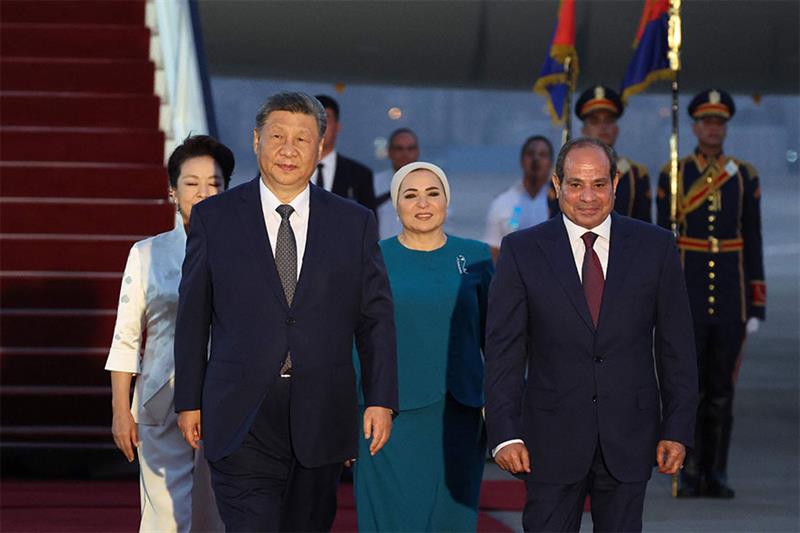

Chinese President Xi Jinping’s visit to Egypt this week highlights Cairo’s growing importance to Beijing’s strategy across the Middle East, Africa and the wider Global South.
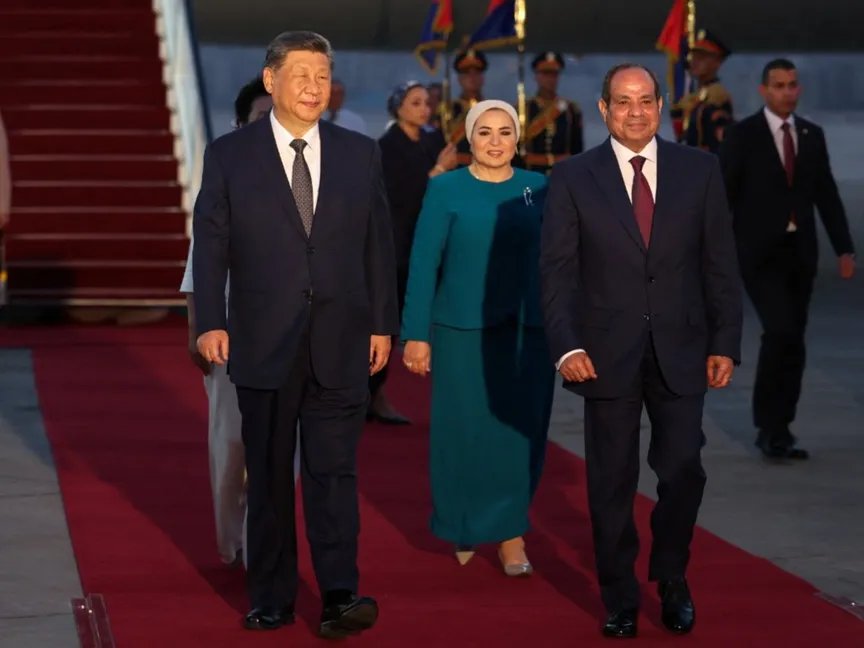
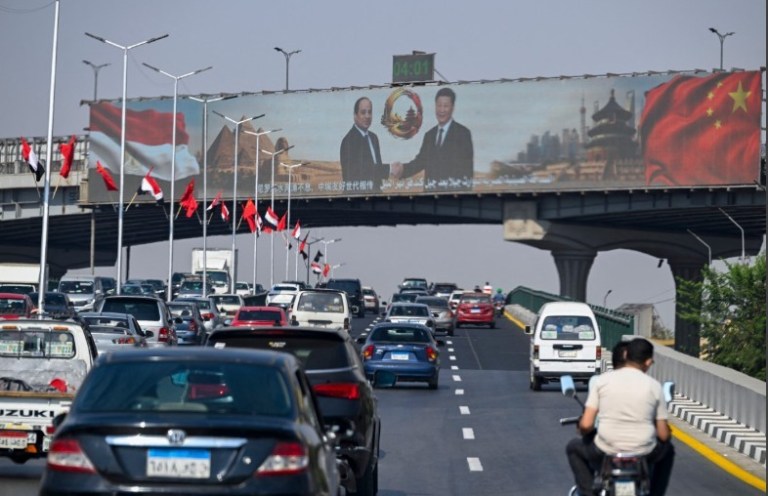
Xi arrived in Cairo on Tuesday for his first visit to Egypt in a decade, meeting his counterpart President Abdel Fattah El-Sisi as the two countries mark 70 years of diplomatic relations. The visit is expected to strengthen political and economic cooperation while advancing the comprehensive strategic partnership signed in 2014.
Egypt’s strategic location linking Africa, the Middle East and the Mediterranean, along with its control of the Suez Canal and political influence in the region and on the continent, makes it an important partner for China.
“Egypt was an obvious choice” for Xi because it touches on Israel and the Palestinian issue, Africa and the Persian Gulf, said Eric Olander, co-founder of the China Global South Project, according to Reuters.
China has consistently supported a ceasefire in Gaza and a two-state solution, while backing Egypt’s mediation and humanitarian efforts. With tensions across the Middle East continuing, Cairo’s diplomatic and geographic position gives it added significance for Beijing.
Trade, investment and technology
Economic cooperation remains at the heart of Egypt-China relations, with Chinese investment spanning manufacturing, infrastructure, renewable energy, ports and technology.
Nader Rong, a journalist specialising in Asian affairs, said the partnership could now move beyond traditional trade toward greater Chinese investment, technology transfer and local manufacturing.
He argued that stronger cooperation could help turn Egypt into a production and export base for Chinese products destined for African markets, combining Chinese investment and expertise with Egypt’s strategic location.
The technology dimension is already attracting attention. Huawei has reportedly submitted a proposal to build AI data centres for the Egyptian government and supply more than 2,000 AI chips. The proposal has not been confirmed as a final project, and it remains unclear whether Huawei will be selected.
If implemented, such infrastructure could strengthen Egypt’s domestic computing capacity and support applications in healthcare, agriculture and government services, while raising important issues around cybersecurity, privacy and data governance.
A broader partnership
The relationship is also expanding beyond economics. Chinese journalist Li Jing said Xi’s visit reflects the depth of ties between Cairo and Beijing, which increasingly encompass technology, culture and the arts.
Joint artistic projects and the participation of Egyptian artists in Chinese productions, she noted, have contributed to stronger people-to-people links between the two countries.
For Cairo, closer cooperation with Beijing could bring investment, technology and access to the Chinese market. For China, Egypt offers a strategically positioned partner and a potential gateway to markets across Africa.
The relationship is consequently entering a new phase — one that is increasingly defined not only by infrastructure and trade, but also by technology, manufacturing and deeper economic integration.
Xi’s visit therefore serves as more than a celebration of seven decades of diplomatic ties. It underscores the growing strategic value of Egypt to China’s engagement with Africa, the Middle East and the Global South.


