
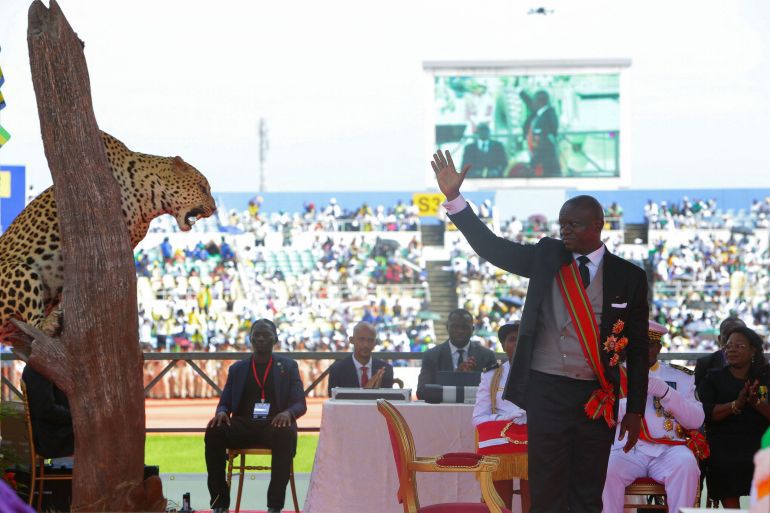

Gabonese President Brice Oligui Nguema has announced the launch of a new political party, signaling a strategic move to consolidate support ahead of the country’s upcoming parliamentary elections scheduled for September.
The founding congress of the new party, named “The Builders”, was held Saturday at the presidential palace in Libreville. The event marked the formal unveiling of the party’s structure and political roadmap in the presence of President Nguema and key political figures.
According to government sources, the party’s organizational structure will include a president, ten regional vice-presidents representing all internal provinces, as well as representatives of the Gabonese diaspora. An appointed secretary-general and a team of deputies will oversee administrative functions, personnel management, and the handling of public assets and resources.
President Nguema — who assumed office less than two years ago after leading a military coup that ousted former president Ali Bongo Ondimba — will have the authority to appoint all senior party leaders.
Supporters of the initiative describe the party as a unifying platform for the ruling coalition and a vehicle for ambitious national reform. They point to the party’s alignment with President Nguema’s political agenda, which emphasizes national reconstruction, institutional reform, and economic revitalization.
However, critics and political observers have expressed concern that the new entity could mirror the former Gabonese Democratic Party (PDG), which dominated the country’s political landscape for decades prior to the 2023 transition of power.
Legal Controversy Over Presidential Affiliation
The formation of the party has also stirred legal debate regarding President Nguema’s eligibility to join it. Article 82 of Gabon’s electoral law stipulates that elected officials who run as independents cannot join an existing political party during their term, under penalty of losing their mandate.
Nonetheless, the country’s Constitutional Court has ruled that the restriction does not apply to newly established parties. The court affirmed that “The Builders,” still in its formative stages, does not fall under the category of a pre-existing party as defined by law — thereby allowing the president to affiliate with it without violating electoral provisions.
New Political Party Law Raises Eyebrows
The launch comes shortly after the National Assembly passed a controversial new law in June regulating the formation and funding of political parties. The legislation introduces stricter requirements for party registration and operations, which opposition groups argue are designed to marginalize alternative voices and consolidate power under the current administration.
Some opposition leaders have labeled the law “provocative” and a step toward restoring a de facto one-party state.
As Gabon prepares for a critical electoral test in the fall, the emergence of “The Builders” party is poised to reshape the political landscape — with implications for governance, pluralism, and the country’s post-transition democratic trajectory.


